LEONID METEOR SHOWER: Earth is entering a stream of debris from Comet Tempel-Tuttle, source of the annual Leonid meteor shower. Watch this Leonid disintegrate over Michigan on Nov. 12th. Forecasters expect the shower to peak on the morning of Nov. 17th with 15 to 20 Leonids per hour: sky map.

BLUE STAR MEETS GREEN COMET: Over the weekend, Comet ATLAS (C/2020 M3) passed by the massive blue star Bellatrix, left shoulder of the constellation Orion. Amateur astronomer Bum-Suk Yeom photographed the close encounter from Namwon, South Korea:

"The juxtaposition of blue and green against the black velvet background of space was really quite striking," says Yeom.
Bellatrix is blue because it is hot. Almost 10 times as massive and 10,000 times more luminous than the sun, Bellatrix has a surface temperature of 22,000 K. The juggernaut produces most of its starlight in the form of blue and UV photons. Comet ATLAS is green because it is cold and carbonaceous. The icy comet, slightly warmed by the rays of the distant sun, spews diatomic carbon (C2) into space--a substance that glows green in the frigid vacuum of space.
It was a beautiful mixture of dissimilar things. More photos of the Bellatrix-ATLAS conjunction may be found here, here, and here.
Realtime Comet ATLAS Photo Gallery
Free: Spaceweather.com Newsletter
HISTORIC SPACEX LAUNCH: The United States spent nearly a decade without the ability to launch astronauts into space following the retirement of the shuttle program in 2011. Not anymore. In May 2020, two astronauts left Earth on a test flight onboard a SpaceX rocket. Last night they did it again. Martin Zloty photographed the launch from Land O' Lakes, Florida:

"Just minutes after SpaceX's historic launch of the 4-person crew (Nov. 15th at 7:27 p.m. EST), I captured the glowing exhaust some 130 miles away from my backyard using my cell phone!" says Zloty.
Unike the mission in May, this one was not a test. SpaceX's Crew Dragon capsule was certified for human spaceflight last week, paving the way for Nov. 15th's operational launch of 4 astronauts. The Dragon capsule — named Resilience by its crew in light of this year's many challenges — reached orbit nine minutes later. It will dock with the International Space Station late Monday and remain there until spring.
Realtime Spaceweather Photo Gallery
Free: Spaceweather.com Newsletter
ROSE QUARTZ ECLIPSE PENDANT: On Aug. 21, 2017, during the Great American Solar Eclipse, the students of Earth to Sky Calculus launched 11 space weather balloons from the path of totality. They aimed to photograph the Moon's shadow from the stratosphere--and they succeeded. As a fundraiser, some of the balloons carried jewelry. Here is a rose quartz crystal pendant entering the Moon's shadow more than 90,000 feet above the Malheur National Forest in eastern Oregon:
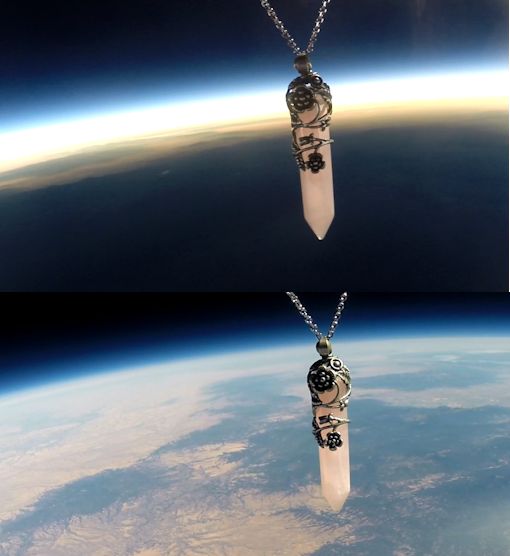
During the 2.5 hour flight, the pendants were wrapped in the Moon's shadow for more than two minutes, experiencing a spooky darkness colder than -50 C.
You can have one for $169.95. Each crystal pendant comes with a unique gift card showing the jewelry passing through the Moon's shadow and floating at the top of Earth's atmosphere. The interior of the card tells the story of the flight and confirms that this gift has been to the edge of space and back again.
Far Out Gifts: Earth to Sky Store
All sales support hands-on STEM education
Realtime Aurora Photo Gallery
Free: Spaceweather.com Newsletter