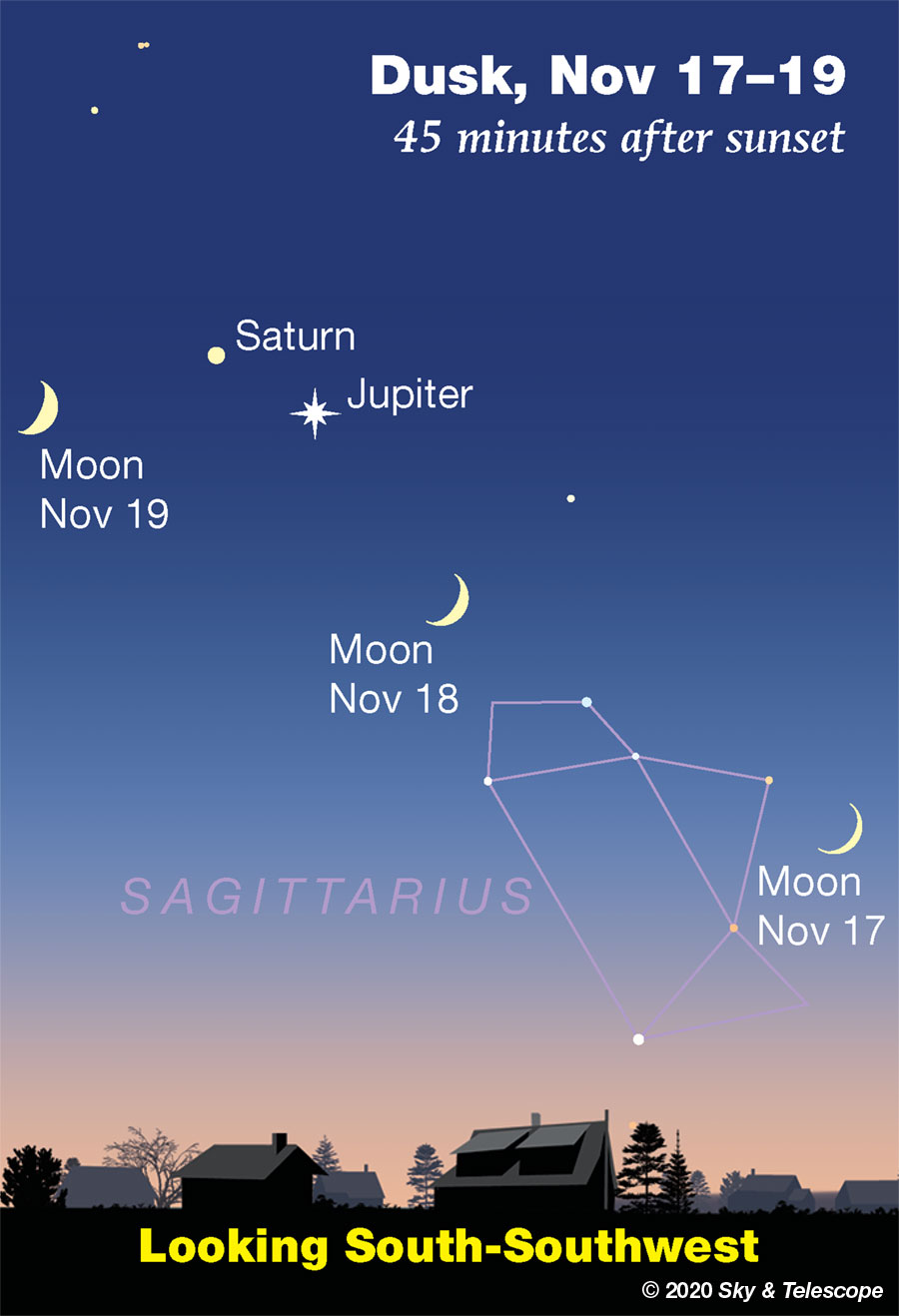
SUNSET PLANETS: When the sun goes down tonight, step outside and look south. Jupiter and Saturn pop out of the twilight even before the sky fades to black. On Tuesday and Wednesday, the crescent Moon will pass by the two planets, forming a shape-shifting triangle in the evening sky. Sky & Telescope: sky map.
THE SODIUM TAIL OF MERCURY: The biggest comet in the Solar System is actually a planet. It's Mercury. Researchers have known for years that Mercury has an enormous tail. Last week, Dr. Sebastian Voltmer photographed it from his backyard in Spicheren, France:

"This stacked image was exposed through a custom-made sodium filter," explains Voltmer. "The trees are from an initial exposure, which I blended into the final stack."
First predicted in the 1980s, Mercury's tail was discovered in 2001. Its source is Mercury's super-thin atmosphere. Mercury is so close to the sun, pressure from sunlight itself can push atoms out of the atmosphere and into space. The escaping gas forms a tail more than 24 million km long.
The tail is rich in sodium--a substance sputtered from Mercury's surface by solar wind and micrometeorite impacts. That's why Voltmer's yellow sodium filter did such a good job revealing the gaseous stream.
Realtime Spaceweather Photo Gallery
Free: Spaceweather.com Newsletter
3D ANIMATION OF MARS: Can you cross your eyes? Then get ready to see something amazing. A team of astronomers led by François Colas of the Paris Observatory has spent much of the past month photographing Mars, and they've assembled the images into an unparalleled 3D animation of the Red Planet. Hit play and follow the instructions in the video:
Tips: If you have trouble seeing the 3D animation, try hitting the full screen button in the lower right corner of the video. Also, make sure you're using full HD resolution.


"We think this is the best map of Mars ever taken from the ground," says renowned astrophotographer Thierry Legault, a member of the imaging team. "The animation shows a complete rotation of the planet."
What makes these images so amazing? Two things: (1) The team used the historic 1 meter telescope atop Pic du Midi in the French Pyrenees. Situated in a Dark Sky Reserve with excellent seeing at 9400 ft elevation, the telescope routinely takes some of the best pictures of Mars this side of the Hubble Space Telescope. (2) During their photo campaign (Oct. 8th - Nov. 1st), Mars made a decade-class close approach to Earth, swelling in size to almost twice its average apparent diameter. The Red Planet won't come so close again until Sept. 2035, making these perhaps the best ground-based images for some time to come.
Realtime Spaceweather Photo Gallery
Free: Spaceweather.com Newsletter
CAPT. KIRK BOBBLEHEAD (COLLECTOR'S ITEM): To support their crowdfunded research program, the students of Earth to Sky Calculus have launched James T. Kirk to the stratosphere onboard a cosmic ray balloon. Note the moon over Kirk's shoulder in this photo taken 36 km (118,100 ft) above Earth's surface:

You can have him for $170.10. The price is the serial number of the Enterprise, NCC1701, divided by 10. The students are selling Kirk to buy more helium! He comes with a greeting card showing the high-quality resin bobblehead in flight and telling the story of his journey to the stratosphere and back again.
Far Out Gifts: Earth to Sky Store
All sales support hands-on STEM education
Realtime Aurora Photo Gallery
Free: Spaceweather.com Newsletter