POSSIBLE FARSIDE SUNSPOT: NASA's STEREO-A spacecraft is monitoring a UV hotspot on the farside of the sun that might be a big sunspot. We will find out soon enough. The active region will rotate into view over the sun's eastern limb early next week. Sunspot alerts: SMS Text

SUNSET PLANETS: When the sun goes down tonight, step outside and look south. The crescent Moon is near Jupiter and Saturn. Jean-Baptiste Feldman sends this picture from Ladoix-Serrigny, France:
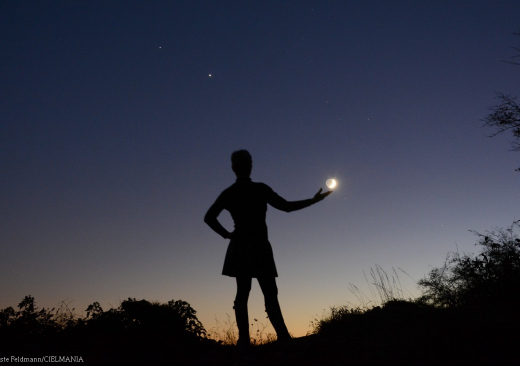
"The Moon was approaching the two planets on Nov. 18th," says Feldman. "They will be even closer tonight."
This is a good opportunity to locate Jupiter and Saturn; you'll want to keep an eye on them in the weeks ahead. The two giant planets are in the early stages of a Great Conjunction. For the next month, they'll converge until, on Dec. 21st, they lie only 0.1 degrees apart--an incredible pairing. This will be the first Jupiter-Saturn conjunction since the year 2000, and the closest Jupiter-Saturn conjunction since the year 1623!
Realtime Spaceweather Photo Gallery
Free: Spaceweather.com Newsletter
LEONID FIREBALL AND SMOKE TRAIL: Last night, a piece of Comet Tempel-Tuttle exploded over Missouri. Dan Bush photographed the fireball, which was so bright it cast shadows and momentarily blinded the camera:
"When I made the video, I had to leave out the brightest frame because it overwhelmed the stack of images, turning it all white," says Bush.
The aftermath was just as interesting as the fireball itself. "Note the smokey trail of debris," points out Bush. "It hung in the sky, twisting in the winds of the upper atmosphere for more than 5 minutes after the flash."
Comet Tempel-Tuttle is the source of the annual Leonid meteor shower, which peaked on Nov. 17-18 with peak rates near 15 meteors per hour. Sometimes, though, just one Leonid is enough.
Realtime Spaceweather Photo Gallery
Free: Spaceweather.com Newsletter
CAPT. KIRK BOBBLEHEAD (COLLECTOR'S ITEM): To support their crowdfunded research program, the students of Earth to Sky Calculus have launched James T. Kirk to the stratosphere onboard a cosmic ray balloon. Note the moon over Kirk's shoulder in this photo taken 36 km (118,100 ft) above Earth's surface:

You can have him for $170.10. The price is the serial number of the Enterprise, NCC1701, divided by 10. The students are selling Kirk to buy more helium! He comes with a greeting card showing the high-quality resin bobblehead in flight and telling the story of his journey to the stratosphere and back again.
Far Out Gifts: Earth to Sky Store
All sales support hands-on STEM education
Realtime Aurora Photo Gallery
Free: Spaceweather.com Newsletter