DIY DEEP SPACE NETWORK: Amateur radio operator Scott Tilley (VE7TIL) has built a miniature Deep Space Network in his own back yard. Using a modest dish antenna and custom receivers, he routinely detects spacecraft as far away as Mars. Would you like to know how he does it? Tilley shares his secrets in this month's AMSAT Journal. Look for the article entitled "In Search of the Ultimate DX."
SOMETHING FLARE-Y THIS WAY COMES: Earlier today, Earth-orbiting satellites detected two long-duration B-flares. UV images from NASA's Solar Dynamics Observatory pinpoint the explosions near the sun's southeastern limb:

These flares are bigger than they look. The blast sites are located behind the edge of the sun, so much of the action was hidden from view. What's causing these flares? Probably a pair of sunspots. They will rotate into view no later than Monday. Stay tuned!
AN ELVE ABOVE TROPICAL STORM IOTA: Last Saturday, Nov. 14th, tropical storm Iota passed by Puerto Rico. Soon to become a Category 5 hurricane, the intensifying storm was crackling with powerful bolts of lightning. Hoping to catch a bit of the light show, Frankie Lucena pointed his video camera at the storm, and here is what he saw:

"A huge red donut of light flashed above the storm's outer bands," he says. "It came and went in a fraction of a second."
This is an example of an ELVE (Emissions of Light and Very Low Frequency Perturbations due to Electromagnetic Pulse Sources). First seen by cameras on the space shuttle in 1990, ELVEs appear when a pulse of electromagnetic radiation from cloud-to-ground lightning propagates up toward space and hits the base of Earth's ionosphere. A faint ring of deep-red light marks the spot where the EMP hits.
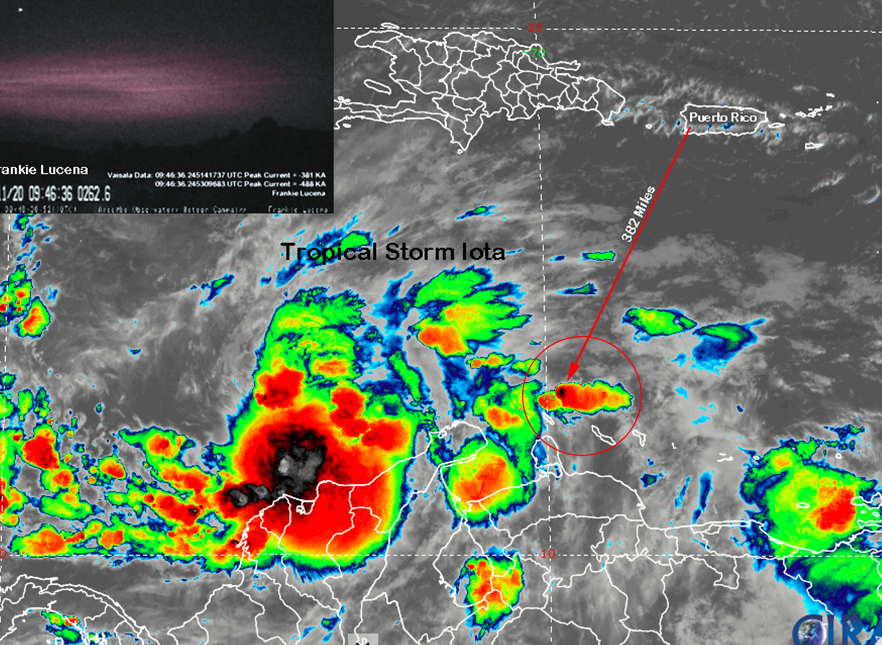
ABOVE: The red arrow points from Lucena's camera to the source of the ELVE in Iota's outer bands.
The lightning bolt that created this ELVE was very powerful indeed. "According to Steven Cummer of Duke University, who checked the Vaisala Global Lightning Detection Network, the peak current was 381 kilo-Ampères (kA)," says Lucena. For comparison, normal cloud-to-ground flashes only reach 10-30 kA.
ELVEs are elusive--and that's an understatement. Blinking in and out of existence in mere milliseconds, they are completely invisible to the human eye. Brevity may explain why ELVEs are a more recent discovery than other lightning-related phenomena. Learn more here and here.
Realtime Spaceweather Photo Gallery
Free: Spaceweather.com Newsletter
CAPT. KIRK BOBBLEHEAD (COLLECTOR'S ITEM): To support their crowdfunded research program, the students of Earth to Sky Calculus have launched James T. Kirk to the stratosphere onboard a cosmic ray balloon. Note the moon over Kirk's shoulder in this photo taken 36 km (118,100 ft) above Earth's surface:

You can have him for $170.10. The price is the serial number of the Enterprise, NCC1701, divided by 10. The students are selling Kirk to buy more helium! He comes with a greeting card showing the high-quality resin bobblehead in flight and telling the story of his journey to the stratosphere and back again.
Far Out Gifts: Earth to Sky Store
All sales support hands-on STEM education
Realtime Aurora Photo Gallery
Free: Spaceweather.com Newsletter