THE SOLAR WIND IS QUICKENING: Earth is entering a stream of solar wind blowing faster than 450 km/s. The source: a northern hole in the sun's atmosphere. Arctic sky watchers should be alert for auroras tonight, Nov. 21-22, as the solar wind speed ticks upward. Aurora alerts: SMS Text

BRIGHTENING COMET ERASMUS: Every 2000 years, Comet Erasmus (C/2020 S3) visits the inner Solar System. News Flash: It's back. Discovered on Sept. 17, 2020, by South African astronomer Nicolas Erasmus, the dirty snowball is plunging toward the sun for a close encounter inside the orbit of Mercury on Dec. 12th. This is what it looks like:
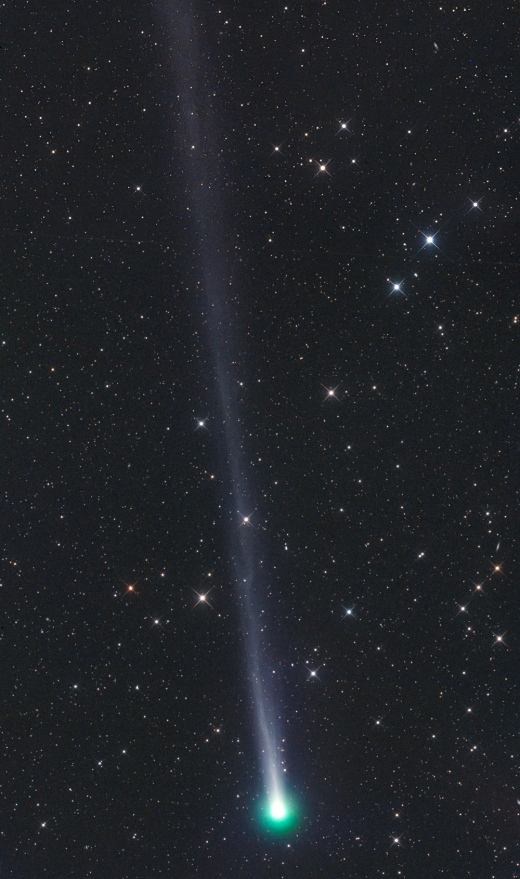
Gerald Rhemann took the picture Friday morning, Nov. 20th, using a 12-inch telescope in Farm Tivoli, Namibia. "The tail is magnificent," he says. "In fact, I couldn't fit it in a single field of view. This two-panel composite shows the first 3 degrees--and it keeps going well past the edge of the photo."

Comet Erasmus is brightening as it approaches the sun. Right now it is 7th magnitude--an easy target for backyard telescopes. Forecasters believe it will more than triple in brightness to 5th magnitude by the time it dips inside the orbit of Mercury next month. Only the glare of the nearby sun will prevent it from being visible to the naked eye.

Where should you look? If you can find Venus, you can find the comet. Look low and southeast before sunrise. Comet Erasmus is in the constellation Hydra just to the right of Venus in neighboring Virgo. The bright star Spica is nearby, too, providing another useful reference point. Sky maps: Nov. 22, 23, 24, 25, 26.


Realtime Comet Photo Gallery
Free: Spaceweather.com Newsletter
GIRLS CAN'T WHAT?! On Oct. 30th, an all-woman team of Earth to Sky students launched a cosmic ray balloon to the stratosphere. This Christmas ornament hitched a ride, flying 98,424 feet high:
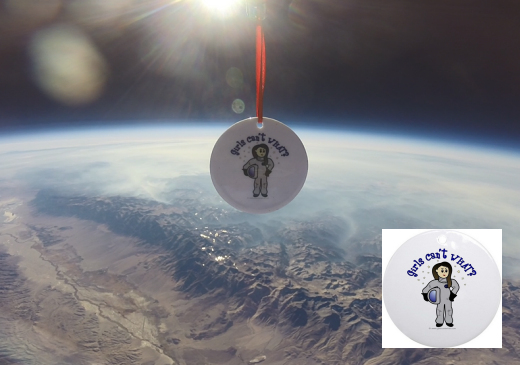
You can have it for $97.95. Inscribed with the words "Girls Can't What?", the ceramic disk makes a great gift for young women scientists.
The students of Earth to Sky Calculus are selling edge-of-space Christmas ornaments to support their cosmic ray ballooning program. Each one comes with a greeting card showing the disk in flight and telling the story of its journey to the edge of space and back again.
Far Out Gifts: Earth to Sky Store
All sales support hands-on STEM education
Realtime Aurora Photo Gallery
Free: Spaceweather.com Newsletter
Realtime Spaceweather Photo Gallery
Free: Spaceweather.com Newsletter