SUNDIVING COMET ERASMUS: Comet Erasmus (C/2020 S3) will soon be inside the orbit of Mercury. Now passing Venus in the early morning sky, the brightening comet is an easy target for backyard telescopes. It may be visible for only a few more days before the sun's glare swallows it, so set your alarm for dawn and enjoy the show. Sky maps: Nov. 23, 24, 25, 26. Browse: photo gallery, full story.


BIG NEW SUNSPOT: A new sunspot is rotating over the sun's eastern limb--and it is big. Philippe Tosi of Nîmes, France, photographed the emerging dark core this morning. It is several times wider than Earth:

The arrival of this sunspot, provisionally numbered AR2786, has been anticipated for days. NASA's STEREO-A spacecraft saw it while it was still on the farside of the sun. Although it is quiet now, the calm may be temporary. AR2786 was flaring late last week, and it could do so again.
The face of the sun is now peppered with sunspots--a sign that Solar Cycle 25 is gaining steam. In fact, two more sunspots may be on the way:

This farside image of the sun from STEREO-A shows a pair of UV hotspots just over the horizon. They will rotate into view 2 to 3 days from now, potentially bringing the sunspot count to its highest level in years. Stay tuned! Solar flare alerts: SMS Text
Realtime Spaceweather Photo Gallery
Free: Spaceweather.com Newsletter
DUST STORM ON MARS: A global dust storm is brewing on Mars. Since mid-November, amateur astronomers have been seeing tendrils of yellow-orange dust creep around the Red Planet. Austrian astrophotographer Michael Karrer took this pucture on Nov. 18th:

"What a surprise to see such interesting structures!" says Karrer.
Dust storms on Mars are not unusual. Small ones happen every few months. Every few years, more or less, a regional storm gets out of control and swallows the entire planet. Such a storm in 2018 killed NASA's Opportunity rover.
The trajectory of this storm is still unknown. Will it quickly subside, or swallow Mars whole? New images taken by Maximilian Teodorescu of Magurele, Romania, suggest that the storm might be 'going global.' "All areas of Mars are beginning to lose contrast," says Teodorescu. Stay tuned.
Realtime Mars Photo Gallery
Free: Spaceweather.com Newsletter
THE PINK AURORA PEARL: Inspired by the color of rare pink auroras, this freshwater pearl flew to the stratosphere on Sept. 25th during a G1-class geomagnetic storm. It hitched a ride onboard an Earth to Sky Calculus cosmic ray balloon, floating 112,205 feet above the Sierra Nevada mountains of central California:
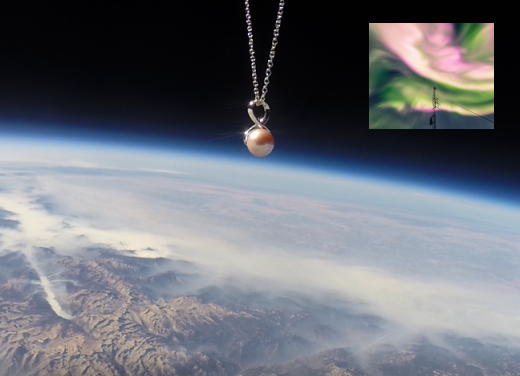
You can have it for $249.95. The students are selling space pearls to support their cosmic ray monitoring program.
Measuring 9 mm in diameter, the Aurora Pearl is mounted on a 925 sterling silver infinity twist and suspended on a matching 17 inch long sterling silver chain. Each pearl comes with a greeting card showing the pendant in flight and telling the story of its journey to the edge of space.
Far Out Gifts: Earth to Sky Store
All sales support hands-on STEM education
Realtime Aurora Photo Gallery
Free: Spaceweather.com Newsletter