MAGNIFICENT SUNSPOT: New sunspot AR2786 is so big it could swallow Earth with barely a ripple. The dimensions of the spot make it an easy target for safely-filtered backyard telescopes. Look here, here, here and here. The sunspot is turning toward Earth and could soon become a source of geoeffective flares. Solar flare alerts: SMS Text
SOLAR FLARE HURLS PLASMA BOMB: Sunspot AR2785 erupted during the late hours of Nov. 23rd (2335 UT), producing a C4-class solar flare. The explosion hurled a plume of plasma more than 350,000 km across the sun. NASA's Solar Dynamics Observatory recorded the splashdown:

A pulse of ultraviolet radiation from the flare hit Earth, briefly ionizing the top of our atmosphere. This, in turn, caused a shortwave radio blackout over the South Pacific, including eastern Australia and all of New Zealand: blackout map. Frequencies affected were mainly below 10 MHz.

More solar flares are in the offing. Three of the biggest sunspots of young Solar Cycle 25 (AR2783, AR2785, AR2786) are either facing Earth or turning in our direction. They all pose a threat for C-class flares (like the one shown above) with a slight chance of even stronger M-flares. Solar flare alerts: SMS Text
Realtime Spaceweather Photo Gallery
Free: Spaceweather.com Newsletter
DUST STORM ON MARS: A global dust storm is brewing on Mars. Since mid-November, amateur astronomers have been seeing tendrils of yellow-orange dust creep around the Red Planet. Austrian astrophotographer Michael Karrer took this pucture on Nov. 18th:

"What a surprise to see such interesting structures!" says Karrer.
Dust storms on Mars are not unusual. Small ones happen every few months. Every few years, more or less, a regional storm gets out of control and swallows the entire planet. Such a storm in 2018 killed NASA's Opportunity rover.
The trajectory of this storm is still unknown. Will it quickly subside, or swallow Mars whole? New images taken by Maximilian Teodorescu of Magurele, Romania, suggest that the storm might be 'going global.' "All areas of Mars are beginning to lose contrast," says Teodorescu. Stay tuned.
Realtime Mars Photo Gallery
Free: Spaceweather.com Newsletter
THE PINK AURORA PEARL: Inspired by the color of rare pink auroras, this freshwater pearl flew to the stratosphere on Sept. 25th during a G1-class geomagnetic storm. It hitched a ride onboard an Earth to Sky Calculus cosmic ray balloon, floating 112,205 feet above the Sierra Nevada mountains of central California:
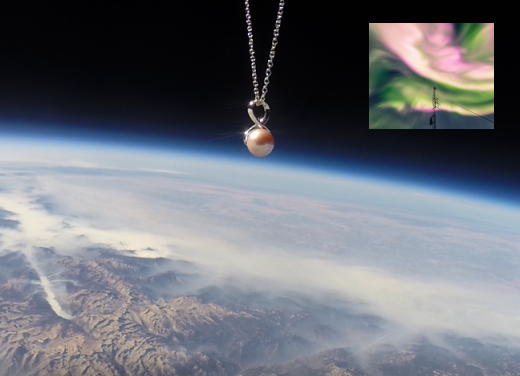
You can have it for $249.95. The students are selling space pearls to support their cosmic ray monitoring program.
Measuring 9 mm in diameter, the Aurora Pearl is mounted on a 925 sterling silver infinity twist and suspended on a matching 17 inch long sterling silver chain. Each pearl comes with a greeting card showing the pendant in flight and telling the story of its journey to the edge of space.
Far Out Gifts: Earth to Sky Store
All sales support hands-on STEM education
Realtime Aurora Photo Gallery
Free: Spaceweather.com Newsletter