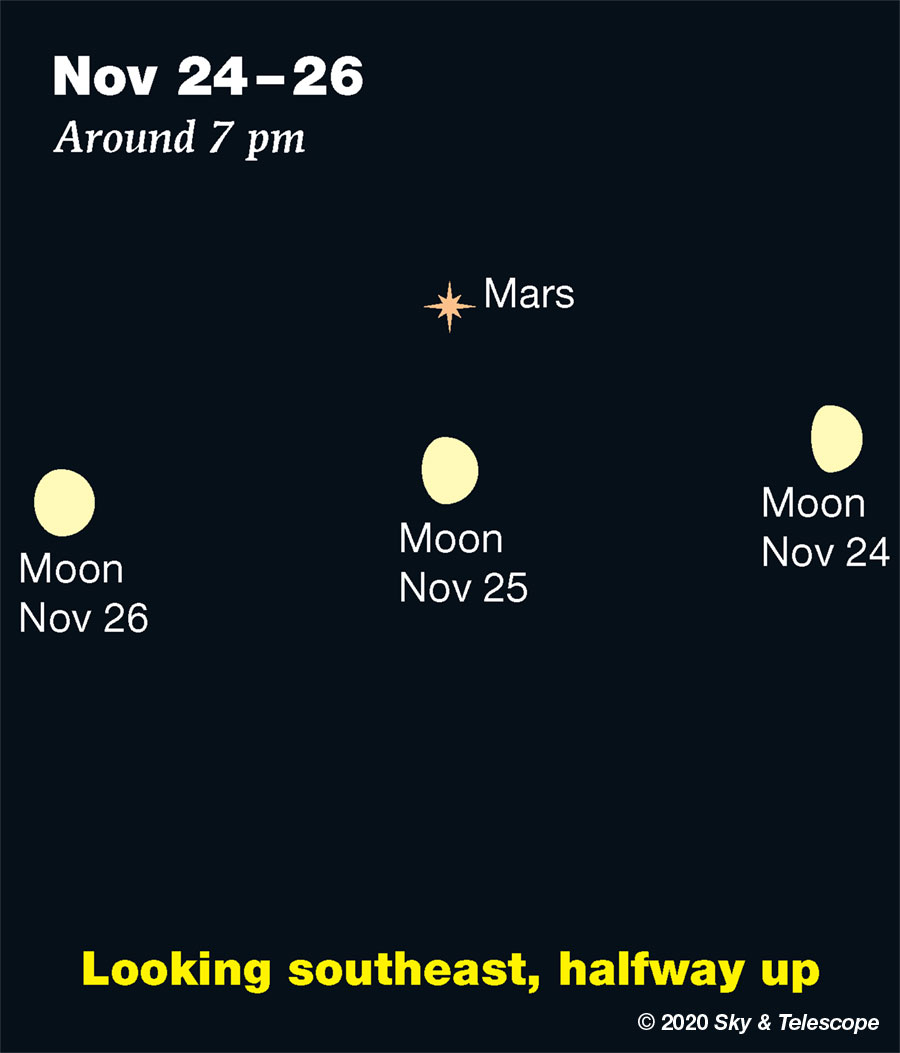
EVENING PLANET SHOW: When the sun goes down tonight, step outside and look southeast. The gibbous Moon is passing Mars in the constellation Pisces. Although Mars has dimmed a little since its close approach to Earth last month, it is still as bright as Sirius, the brightest star in the sky, so it will have no trouble shining through the lunar glare. Sky&Telescope: sky map.
LITTLE GREEN CANNONBALLS OF LIGHT: Just when you thought STEVE couldn't get any weirder. A new paper published in the journal AGU Advances reveals that the luminous purple ribbon we call "STEVE" is often accompanied by green cannonballs of light that streak through the atmosphere at 1000 mph.
"Citizen scientists have been photographing these green streaks for years," says Joshua Semeter of Boston University, lead author of the study. "Now we're beginning to understand what they are."

Above: The mysterious green streaks of light below STEVE. [Full Caption]
STEVE is a recent discovery. It looks like an aurora, but it is not. The purple glow is caused by hot (3000 °C) rivers of gas flowing through Earth's magnetosphere faster than 13,000 mph. This distinguishes it from auroras, which are ignited by energetic particles raining down from space. Canadian aurora watchers first called attention to the phenomenon about 10 years ago, whimsically naming it STEVE; researchers have been studying it ever since.
There's a dawning realization that STEVE is more than just a purple ribbon. Photographers often catch it flowing over a sequence of vertical pillars known as the "picket fence." They're not auroras either. And, now, Semeter's team has identified yet another curiosity in their paper, entitled "The Mysterious Green Streaks Below STEVE."
"Beneath the picket fence, photographers often catch little horizontal streaks of green light," explains Semeter. "This is what we studied in our paper."

Above: Using amateur images, Semeter's team triangulated the height of "STEVE's cannonballs." [Full Caption]
Semeter's team gathered pictures of the streaks taken by citizen scientists in Canada, the United States and New Zealand. In some cases, the same streaks were photographed by widely-separated photographers, allowing a triangulation of their position. Analyzing dozens of high-quality images, the researchers came to these conclusions:
1. The streaks are not streaks. They are actually point-like balls of gas moving horizontally through the sky. In photos, the 'green cannonballs' are smeared into streaks by the exposure time of the cameras.
2. The cannonballs are typically 350 meters wide, and located about 105 km above Earth's surface.
3. The color of the cannonballs is pure green--much more so than ordinary green auroras, reinforcing the conclusion that they are different phenomena.

Above: The pure green of STEVE's cannonballs (upper left) is compared to the blue-green and other mixed colors of auroras. Credit: Joshua Semeter, Boston Univ.
So, what are the cannonballs? Semeter believes they are a sign of turbulence. "During strong geomagnetic storms, the plasma river that gives rise to STEVE flows at extreme supersonic velocities. Turbulent eddies and whirls dump some of their energy into the green cannonballs."
This idea may explain their pure color. Auroras tend to be a mixture of hues caused by energetic particles raining down through the upper atmosphere. The 'rain' strikes atoms, ions, and molecules of oxygen and nitrogen over a wide range of altitudes. A hodge-podge of color naturally results from this chaotic process. STEVE's cannonballs, on the other hand, are monochromatic. Local turbulence excites only oxygen atoms in a relatively small volume of space, producing a pure green at 557.7 nm; there is no mixture.
"It all seems to fit together, but we still have a lot to learn," says Semeter. "Advancing this physics will benefit greatly from the continued involvement of citizen scientists."
If you're an aurora photographer looking to contribute, be sure to read Semeter et al's original research at https://agupubs.onlinelibrary.wiley.com
Realtime Spaceweather Photo Gallery
Free: Spaceweather.com Newsletter
APOLLO 11 PROOF SILVER DOLLAR (COLLECTOR'S ITEM): Are you looking for a far-out gift? Consider this: On July 20, 2019 (the 50th anniversary of the Apollo 11 Moon landing), the students of Earth to Sky Calculus flew this rare proof silver dollar to the stratosphere:
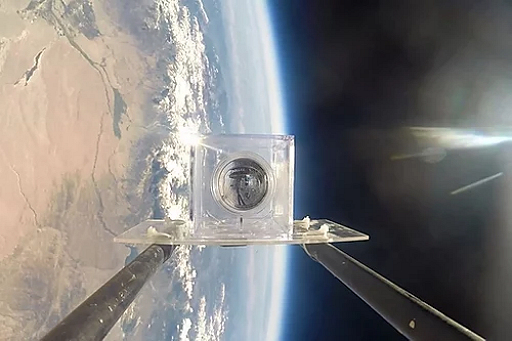
The US Mint created the coins to celebrate the first Moon landing--but you can no longer buy them from the Mint. You can, however, get one from Earth to Sky Calculus. The students are selling the collector's item for $249.95 to support their cosmic ray ballooning program.
The silver dollar is curved and reproduces the helmet of astronaut Buzz Aldrin. Reflected in Buzz's visor are Neil Armstrong, the United States flag, and the lunar lander. The opposite side of the coin shows Neil's iconic footprint on the Moon. Included is a greeting card showing the coin in flight and a certificate of authenticity.


Far Out Gifts: Earth to Sky Store
All sales support hands-on STEM education
Realtime Aurora Photo Gallery
Free: Spaceweather.com Newsletter