POSSIBLE CME IMPACT: A CME launched by yesterday's M4.4-class solar flare might sideswipe Earth's magnetic field on Dec. 1-2, according to NOAA analysts. The glancing blow, if it occurs, is expected to cause no more than minor G1-class geomagnetic storms with auroras over high-northern latitudes. Scroll down for the full story. Instant geomagnetic storm alerts: SMS Text.

MAJOR SOLAR FLARE AND CME (UPDATED): Yesterday (Nov. 29th at 1311UT), Earth-orbiting satellites detected the biggest solar flare in more than 3 years. NASA's Solar Dynamics Observatory recorded this extreme-ultraviolet movie of the M4.4 category blast:

X-rays and UV radiation from the flare ionized the top of Earth's atmosphere, producing a shortwave radio blackout over the South Atlantic: map. Ham radio operators and mariners may have noticed strange propagation effects at frequencies below 20 MHz, with some transmissions below 10 MHz completely extinquished.

Remarkably, this flare was even bigger than it seems. The blast site is located just behind the sun's southeastern limb. As a result, the explosion was partially eclipsed by the body of the sun. It might have been an X-class event.
The flare also hurled a significant coronal mass ejection (CME) into space, shown here in a coronagraph movie from the Solar and Heliospheric Observatory (SOHO):
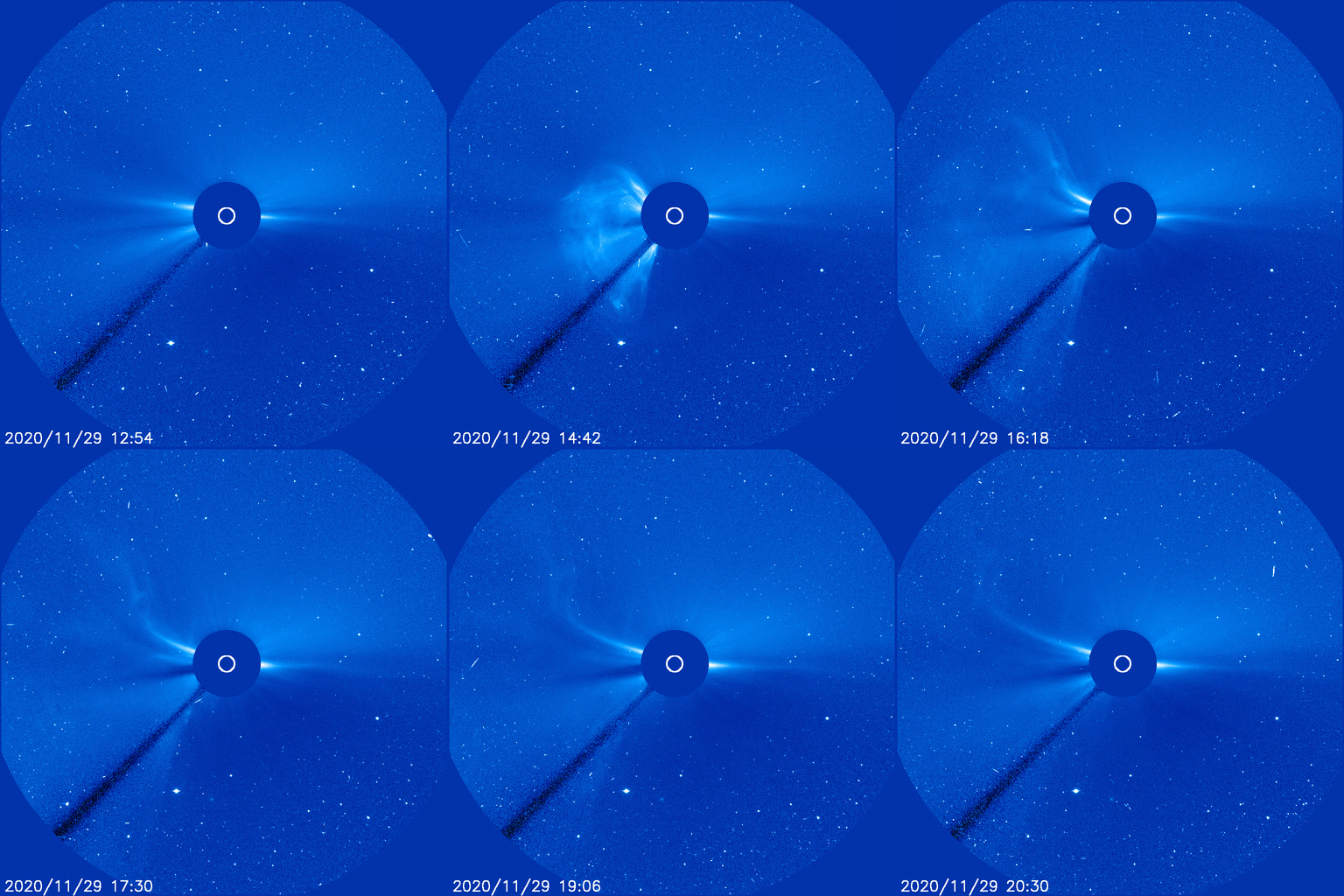
Update: At first it appeared that the CME would completely miss Earth. However, NOAA analysts believe that the outskirts of the cloud might deliver a glancing blow to Earth's magnetic field on Dec. 1-2. If so, the impact could spark a minor G1-class geomagnetic storm with auroras over northern countries such as Canada, Iceland, Norway and Sweden.
It would be a different story if the main body of the CME hit. Then we would be anticipating a strong geomagnetic storm. Maybe next time!
"Next time" could be just days away. The hidden sunspot that produced this major event will rotate onto the Earthside of the sun during the next 24 hours or so. Then its ability to spark geomagnetic storms will be greatly increased. Instant solar flare alerts: SMS Text.
Realtime Spaceweather Photo Gallery
Free: Spaceweather.com Newsletter
A SHADOW FALLS ACROSS THE MOON: Earlier today, a shadow fell across the northern highlands of the Moon. Fred Espenak photographed the penumbral lunar eclipse from the Dark View Observatory in Portal, Arizona:

"The image on the left was taken just before the eclipse began," says Espenak. "The image on the right was taken a 2:43 AM MST, the time of greatest eclipse. The shading was definitely noticeable to the naked eye."
A penumbral eclipse happens when the Moon dips into the pale outskirts (penumbra) of Earth's shadow. It's much less dramatic than a total eclipse of the Moon, which involves the dark-red center of Earth's shadow. In fact, most people wouldn't even notice a penumbral eclipse; it's that subtle.
Subtle or not, "this eclipse will have to be my consolation prize because the continuing COVID-19 pandemic prevents me from traveling to Chile in two weeks for the total solar eclipse on Dec. 14," laments Espenak. "This will be the first total solar eclipse I have missed in 28 years."
GIFTS FROM THE EDGE OF SPACE: Christmas is less than one month away. Are you looking for a far-out gift? Check out the Earth to Sky Store. It's filled with unique items that have flown to the edge of space onboard cosmic ray research balloons. And, today only, they're 15% off:

Carried aloft by giant helium balloons, these unique gifts have flown above 99.7% of Earth's atmosphere, experiencing space-like blasts of cosmic rays, extreme cold, and a wild ride parachuting back to Earth after the balloon explodes. Even Amazon doesn't carry items this far out.
Don't forget to enter coupon code "BLACKPEARL" at checkout for a 15% Black Friday discount.
Far Out Gifts: Earth to Sky Store
All sales support hands-on STEM education
Realtime Aurora Photo Gallery
Free: Spaceweather.com Newsletter