ALL QUIET: Solar activity is very low, and likely to remain so for the next 72 hours. The only sunspot on the solar disk (AR2793) is in decay, posing no threat for strong flares, and no solar wind streams are expected to reach Earth before Dec. 21st. Instant solar flare alerts: SMS Text.
SOME COMETS LIKE IT HOT: Comet Erasmus (C/2020 S3) is dipping inside the orbit of Mercury. The furiously vaporizing comet is not easy to see from Earth because of solar glare. SOHO, however, has a great view:

The Solar and Heliospheric Observatory (SOHO) specializes in finding comets close to the sun. Onboard coronagraphs use an opaque disk to block solar glare, revealing stars, planets and comets painfully close to the sun. Erasmus's transit across SOHO's field of view is just getting started. Join SOHO for a ringside seat.
THE GREAT CONJUNCTION OF JUPITER AND SATURN: It doesn't get much better than this. On Dec. 16th and 17th, a whisper-thin crescent Moon passed by Jupiter and Saturn, just as the two planets were converging for their finest conjunction since the Middle Ages. Photographer Marek Nikodem and a friend enjoyed the view from a hillside near Szubin, Poland:

"The cosmic trio was stunning. What a glorious sight!" says Nikodem.
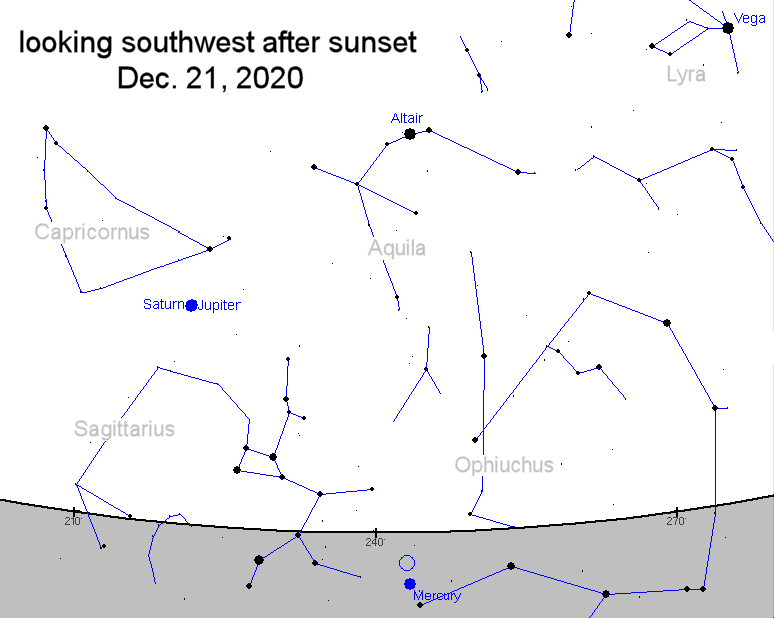
And now it is about to get better. On Dec. 21st, Jupiter and Saturn will be just 0.1 degrees apart, their tightest naked-eye conjunction since March 1226. This is so close that some people may perceive them as a single "Christmas star." Saturn will be as close to Jupiter as some of Jupiter's moons, and the view through a telescope will be fantastic.

To see the Great Conjunction, all you have to do is step outside after sunset and look southwest. Jupiter pops out of the twilight long before the sky fades to black, and Saturn is not far behind. Can you say, "photo-op"? Submit your pictures here.
Realtime Spaceweather Photo Gallery
Free: Spaceweather.com Newsletter
GIFTS FROM THE EDGE OF SPACE: Christmas is less than two weeks away. Are you looking for a far-out gift? Check out the Earth to Sky Store. It's filled with unique items that have flown to the edge of space onboard cosmic ray research balloons. From now until Christmas, all gifts are 10% off:

Carried aloft by giant helium balloons, these unique gifts have flown above 99.7% of Earth's atmosphere, experiencing space-like blasts of cosmic rays, extreme cold, and a wild ride parachuting back to Earth after the balloon explodes. Even Amazon doesn't carry items this far out.
All items come with a greeting card showing the gifts in flight, and telling the story of their journey to the edge of space and back again. Don't forget to enter coupon code "SPACESANTA" at checkout for a 10% holiday discount!
Far Out Gifts: Earth to Sky Store
All sales support hands-on STEM education
Realtime Aurora Photo Gallery
Free: Spaceweather.com Newsletter