GEOMAGNETIC STORM WATCH: A minor (G1-class) geomagnetic storm is possible on Dec. 23rd when a fast-moving stream of solar wind hits Earth's magnetic field. The gaseous material is flowing from a northern hole in the sun's atmosphere. High-latitude sky watchers should be alert for auroras when the solar wind arrives. Aurora alerts: SMS Text.


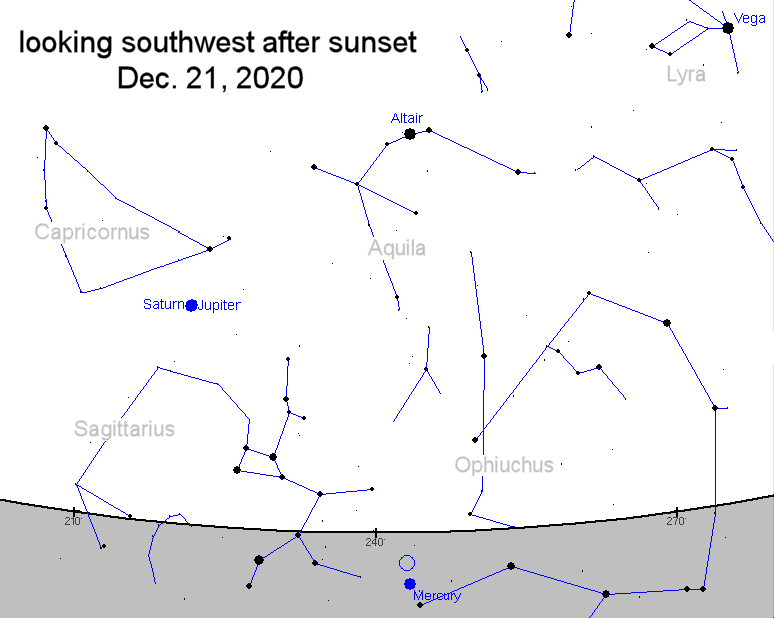
THE GREAT CONJUNCTION OF JUPITER AND SATURN: Want to see something that astronomers have been waiting 800 years to witness? Just step outside at sunset and look southwest. Jupiter and Saturn are having their finest conjunction since the Middle Ages. Last night in Gleichen, Alberta, Alan Dyer marked the occasion with a Great Conjunction selfie:

"Two nights before closest approach, the planets were less than 1/4 degree apart," says Dyer. "Inset is a picture I took through the telescope; you can see the rings of Saturn and Jupiter's moons in the same field of view!"
At closest approach on Dec. 21st, the two planets will lie just 0.1 degrees apart. That’s so close, some people will perceive them as a single brilliant star. Viewed through binoculars or a small telescope, Saturn will appear as close to Jupiter as some of Jupiter’s moons.

This is a once in a lifetime photo-op, so don't miss it. Click here and here for photo tips and browse the photo gallery to see history being made. Sky map.
Realtime Spaceweather Photo Gallery
Free: Spaceweather.com Newsletter
GEMINID RADIO ECHOES: The 2020 Geminid meteor shower was surprisingly 'radio-active.' "I detected hundreds of radar echoes from Geminids flying over Europe during the peak of this year's shower," reports Stuart Green, who gathered these data at his amateur radio observatory in Preston UK:

"I monitored the Geminids throughout the month of December," he says. "The shower peaked on Dec. 13th and 14th when Earth passed through a thick stream of debris from rock comet 3200 Phaethon. After that, activity fell off sharply."
How did he do it? Green monitors signals from France's GRAVE space surveillance radar, used by the French government to track Earth-orbiting satellites. The Geminids added an extra set of echoes not normally present. Using a Yagi antenna in his attic and a radio receiver tuned to 143 MHz (the operating frequency of the radar), Green listened to the activity.

"The show is over until next year," says Green. Or is it? The annual Ursid meteor shower is expected to have a stronger-than-usual peak on Dec. 21/22. Stay tuned for echoes.
Realtime Meteor Photo Gallery
Free: Spaceweather.com Newsletter
GIFTS FROM THE EDGE OF SPACE: Christmas is less than two weeks away. Are you looking for a far-out gift? Check out the Earth to Sky Store. It's filled with unique items that have flown to the edge of space onboard cosmic ray research balloons. From now until Christmas, all gifts are 10% off:

Carried aloft by giant helium balloons, these unique gifts have flown above 99.7% of Earth's atmosphere, experiencing space-like blasts of cosmic rays, extreme cold, and a wild ride parachuting back to Earth after the balloon explodes. Even Amazon doesn't carry items this far out.
All items come with a greeting card showing the gifts in flight, and telling the story of their journey to the edge of space and back again. Don't forget to enter coupon code "SPACESANTA" at checkout for a 10% holiday discount!
Far Out Gifts: Earth to Sky Store
All sales support hands-on STEM education
Realtime Aurora Photo Gallery
Free: Spaceweather.com Newsletter