SOLAR WIND, INCOMING: A stream of solar wind is heading for Earth. Estimated time of arrival: Dec. 29th. The minor jet of gas flowing from a small hole in the sun's atmosphere might be enough to spark the last auroras of 2020 around the Arctic Circle. Aurora alerts: SMS Text.

AURORA SURPRISE: There were no geomagnetic storms on Dec. 26th. So where did these auroras come from? "Last night, the Northern Lights made a remarkable appearance over Utsjoki in the far north of Finland," reports Rayann Elzein, who photographed the display in temperatures that plunged to -36 C:

"It was so cold ... but worth the chill to witness this beautiful show," says Elzein. "For about 30-40 minutes, the auroras danced overhead with super fast movements. The highlight was a bright purple nitrogen fringe!"
Elzein lives in the right place to see auroras without geomagnetic storms. The Finnish Lapland is located beneath Earth's persistent auroral oval. A gentle rain of solar wind electrons, guided to Earth by our planet's curved magnetic field, creates a polar ring of Northern Lights that intersects the latitude of Utsjoki. Often dim but sometimes surprisingly bright, auroras appear there on most dark nights--no storm required.
Realtime Aurora Photo Gallery
Free: Spaceweather.com Newsletter
SUNSPOTS AT SUNRISE: As 2020 comes to an end, photographers are starting to notice something they haven't seen in a while: little black spots. "I saw them at sunrise this morning in the Alps," says Michel Willemin who sends this picture from Plateau de Diesse, Switzerland:

"Two sunspot groups were clearly visible," he says.
For much of the past 4 years, Solar Minimum has supressed the production of sunspots, keeping the solar disk blank and featureless. "The re-appearance sunspots in 2020 is a clear sign of rising solar activity," notes Willemin. Indeed, Solar Cycle 25 is rapidly gaining steam; 2021 promises many more "little black spots" and, with them, solar flares, CMEs, and geomagnetic storms. Sunrise is just the beginning.
Realtime Spaceweather Photo Gallery
Free: Spaceweather.com Newsletter
THE SHOOTING STAR PENDANT: It's simple. It's elegant. And it's been to the edge of space. On Sept. 27th, the students of Earth to Sky Calculus launched a cosmic ray balloon to the stratosphere. This stainless steel "shooting star" pendant hitched a ride, all the way to 108,245 feet:
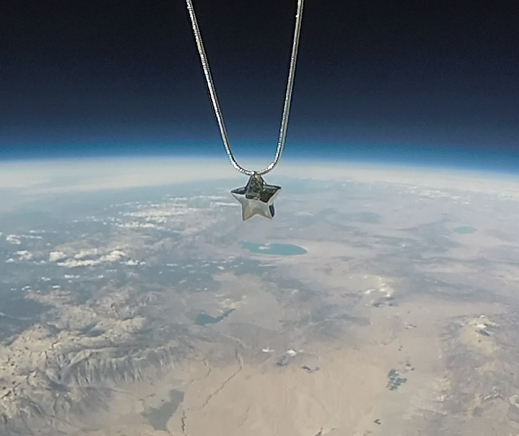
You can have it for $119.95. The students are selling shooting star pendants to support their cosmic ray ballooning program. Each one comes with greeting card showing the item in flight and telling the story of its journey to the edge of space and back again. These make great birthday and Christmas gifts.
Bonus: The star contains a hidden chamber, which you may fill with the ashes of a loved one or anything else you wish to keep close to your heart.

Far Out Gifts: Earth to Sky Store
All sales support hands-on STEM education
Realtime Aurora Photo Gallery
Free: Spaceweather.com Newsletter