LONG NIGHTS MOON: There's a full Moon this week, and it has a special name: The Long Nights Moon, according to the ancient folklore of some Native American tribes. They named it after the long nights of December. Look for the Long Nights Moon soaring high in the midnight sky on Tuesday, Dec. 29th; it is often surrounded by icy moon halos that make great photo-ops.
NOCTILUCENT CLOUDS ARE MISSING: Something strange is happening 50 miles above Antarctica. Or rather, not happening. Noctilucent clouds (NLCs), which normally blanket the frozen continent in December, are almost completely missing. These images from NASA's AIM spacecraft compare Christmas Eve 2019 with Christmas Eve 2020:
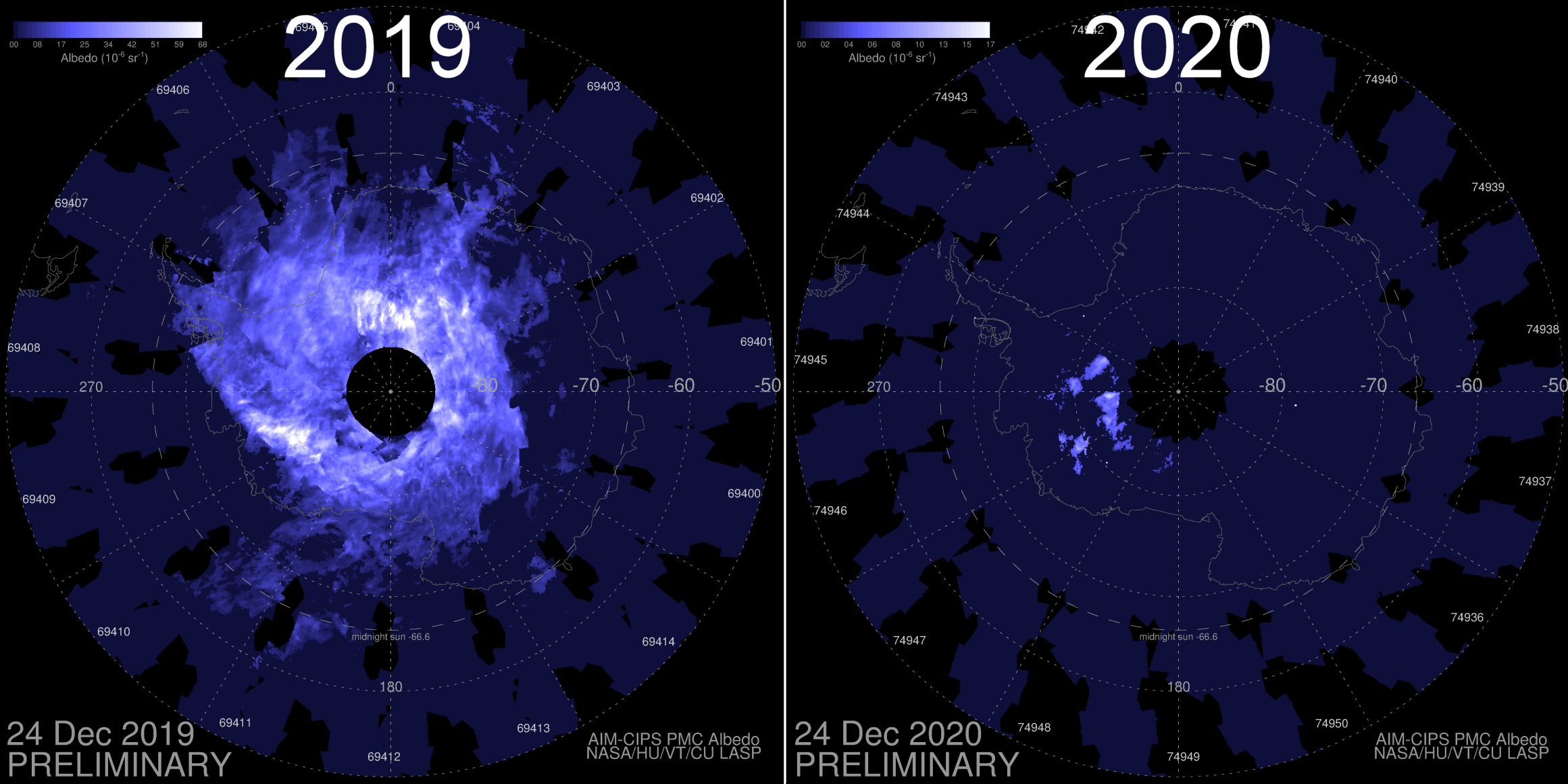
"The comparison really is astounding," says Cora Randall of the University of Colorado's Laboratory for Atmospheric and Space Physics. "Noctilucent cloud frequencies are close to zero this year."
NLCs are Earth's highest clouds. They form when summertime wisps of water vapor rise up from the poles to the edge of space. Water crystallizing around specks of meteor dust 83 km (~50 miles) above Earth's surface creates beautiful electric-blue structures, typically visible from November to February in the south, and May to August in the north.
A crucial point: Noctilucent clouds form during summer. And that's the problem. Although summer officially started in Antarctica one week ago, the southern stratosphere still seems to think it's winter. In particular, the stratospheric polar vortex, which should be breaking up around now, is stubbornly hanging on. The polar vortex chokes off gravity waves, which would normally carry water vapor into the upper atmosphere. Without water vapor, NLCs cannot form.
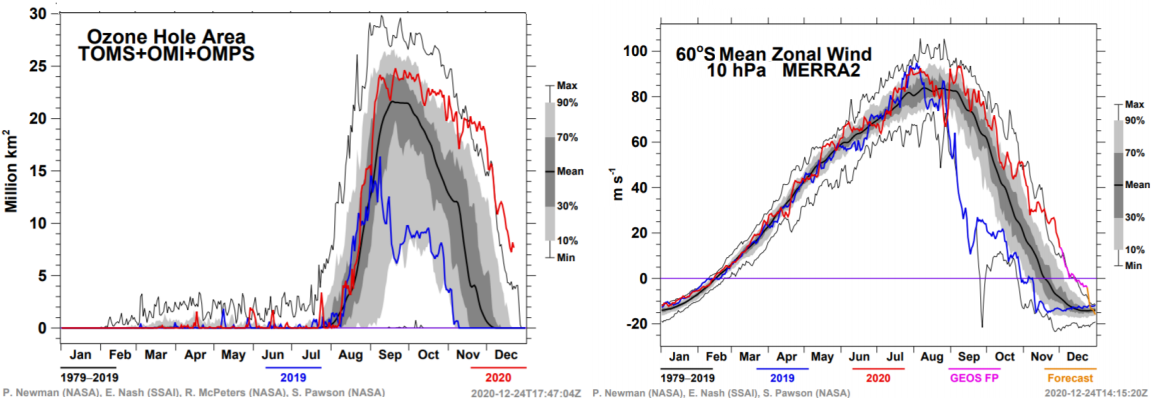
Above: These plots of ozone hole size and zonal wind speed highlight unusual conditions in the southern stratosphere in Dec. 2020.
"The southern hemisphere stratosphere is very unusual this year," says Randall. "The ozone hole is exceptionally large, until recently zonal winds have been blowing in the wrong direction, and overall the stratosphere is much more 'winter-like' than it should be in December."
Eventually, the stratosphere will shift into its summer-like state, and NLCs can begin to blossom. But when? Researchers don't know. If the clouds remain suppressed only one more week, it will break previous records of low NLC activity in the southern hemisphere. Stay tuned for updates right here on Spaceweather.com.

UPDATE: How do you make noctilucent clouds appear? Publish a story called "Noctilucent Clouds are Missing." Hours after publication of this news item, NASA's AIM satellite reported an uptick of NLC activity over Antarctica. "It's still nowhere as many clouds as last year, but it makes sense given the recent steep drop in zonal wind speed and ozone hole area," notes Randall. "The atmosphere definitely has a mind of its own this season!"

Realtime Noctilucent Cloud Photo Gallery
Free: Spaceweather.com Newsletter
A BLACK PEARL AT THE EDGE OF SPACE: It came from Tahiti--and now it's been to the edge of space. On Feb. 27, 2020, this genuine Black Tahitian South Sea Cultured Pearl flew to the stratosphere onboard an Earth to Sky Calculus cosmic ray balloon, soaring more than 100,000 feet above the Sierra Nevada mountains of central California:
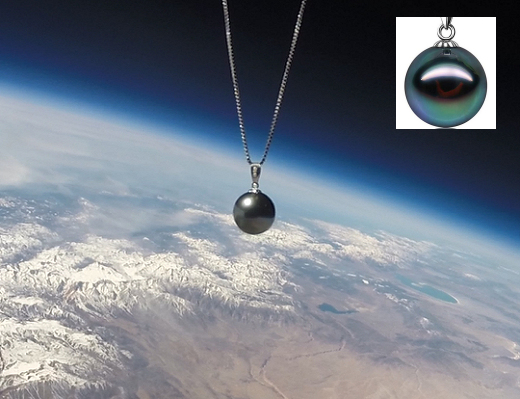
You can have it for $229.95. The students are selling these exotic space pearls to fund their cosmic ray monitoring program. Measuring 10 mm in diameter, the pearl has an 18K white gold clasp and is suspended from a matching 925 Sterling Silver chain. Each pearl comes with a greeting card showing the pendant in flight and telling the story of its journey to the stratosphere and back again.
Far Out Gifts: Earth to Sky Store
All sales support hands-on STEM education
Realtime Aurora Photo Gallery
Free: Spaceweather.com Newsletter
Realtime Spaceweather Photo Gallery
Free: Spaceweather.com Newsletter