NEW YEAR, NEW SOLAR CYCLE: 2021 has begun, and the forecast calls for stormy space weather. After 3 years of deep solar minimum, new Solar Cycle 25 is gaining strength. Sunspots counts have suddenly increased, heralding solar flares, geomagnetic storms and auroras in the months ahead. Happy New Year! Instant solar flare alerts: SMS Text.
NEW YEAR'S SUN PILLAR: It's New Year's Day, and the sunrise in Iceland was something special. "A pink shaft of light sprung up from the eastern horizon," says Wioleta Gorecka, who sends this picture from the port of Hafnarfjordur:
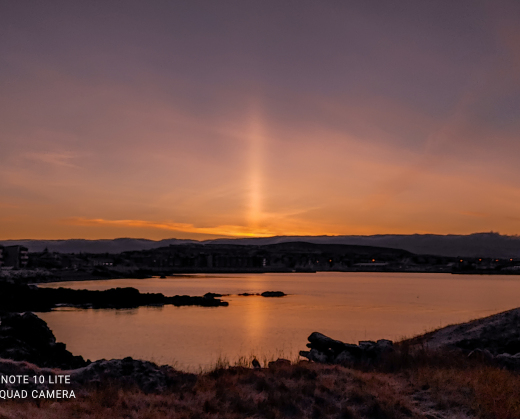
"What a beautiful way to greet 2021," she says.
This is a sun pillar,caused by plate-shaped ice crystals fluttering like leaves in distant cirrus clouds. The crystals intercept sunbeams, bending and reflecting them into a tall column of light. Look for pillars around sunrise and sunset; they are especially easy to find in cold places like Iceland where icy clouds bookend the short days of winter.
Realtime Spaceweather Photo Gallery
Free: Spaceweather.com Newsletter
LUNAR PARHELIC CIRCLE: A parhelic circle is an unforgettable sight. Thin and pale, it circles the zenith in a majestic arc, always keeping the same distance above the horizon. On Dec. 27th, Göran Strand of Handöl, Sweden, saw a parhelic circle but, strangely, the sun was nowhere around. This parhelic circle was passing through the Moon:
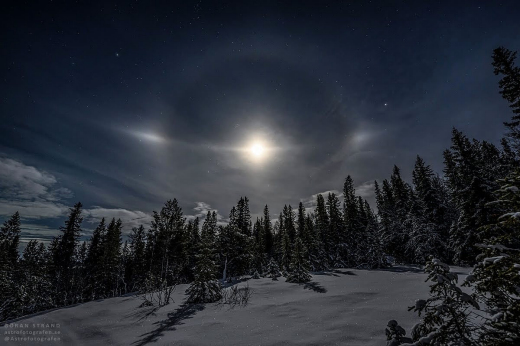
"It has been a long time since I saw a lunar halo, and I can't remember the last time I saw one with such a prominent parhelic circle," says Strand. "It was an amazing sight."
The parhelic circle is not the ring around the Moon; that's a 22-degree halo. Instead it is the almost-horizontal arc cutting through the Moon. The rest of the parhelic circle was too big to fit in the field of view of Strand's camera.
Parhelic circles are formed by sunlight reflecting from the vertical faces of ice crystals--millions of them floating in thin cirrus clouds spread almost evenly across the sky. In this case, bright moonlight + cirrus clouds performed the same trick.
Note: Because this circle is caused by moonlight rather than sunlight, it is most correctly called a "parselenic circle."
Realtime Spaceweather Photo Gallery
Free: Spaceweather.com Newsletter
THE PINK AURORA PEARL: Inspired by the color of rare pink auroras, Spaceweather.com and the students of Earth to Sky Calculus launched a pink pearl to the stratosphere. It hitched a ride onboard the students' cosmic ray balloon, and reached an altitude 112,205 feet above the Sierra Nevada mountains of central California:
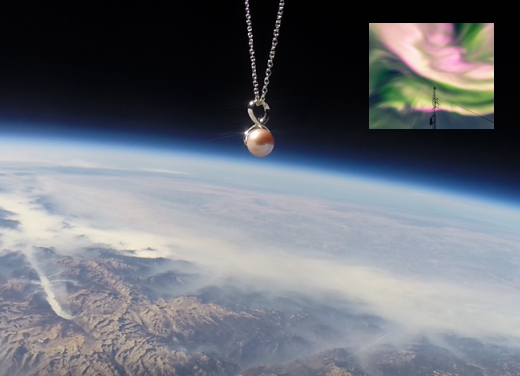
You can have it for $249.95. The students are selling space pearls to support their cosmic ray monitoring program. Measuring approximately 9 mm in diameter, the Aurora Pearl is mounted on a 925 sterling silver infinity twist, with a matching 17-inch long sterling silver chain. Each pearl comes with a greeting card showing the pendant in flight and telling the story of its journey to the edge of space.
Far Out Gifts: Earth to Sky Store
All sales support hands-on STEM education
Realtime Aurora Photo Gallery
Free: Spaceweather.com Newsletter