ERUPTIONS ON THE SUN: Yesterday, Jan. 2nd, two filaments of magnetism in the sun's southern hemisphere became unstable and erupted. A faint CME hurled into space by the double-blast will probably sail to the south of Earth, missing our planet. NOAA forecasters are modeling the CMEs now to confirm. Stay tuned. Aurora alerts: SMS Text.
QUADRANTID FIREBALLS: Last night, NASA's network of all-sky meteor cameras recorded 16 Quadrantid fireballs over the USA. A moth in New Mexico resting on one of the station's camera domes witnessed this one:
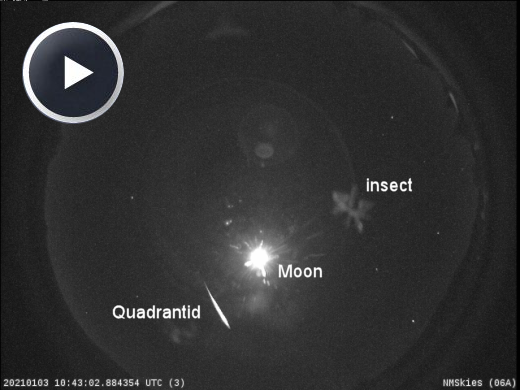
The fireball was easily visible despite glare from the nearby gibbous Moon. Indeed, all of the Quadrantids picked up by NASA were remarkably bright, a sign that the underlying debris stream was rich in fireball-producing gravel.
Quadrantids are debris from shattered comet 2003 EH1. Every year in early January they appear, oh-so-briefly, streaming out of the obsolete constellation Quadrans Muralis not far from the North Star. This year's encounter appears to have happened during the early hours of Jan. 3rd, with as many as 100 Quadrantids per hour observed in some places.
Realtime Spaceweather Photo Gallery
Free: Spaceweather.com Newsletter
LUNAR LIBRATION: Did you see last week's full Moon? It was unique. Why? Because no two full Moons are exactly alike. To prove it, Paolo Bardelli of Sumirago, Italy, photographed the last 12 full Moons and stacked the pictures to highlight their differences:
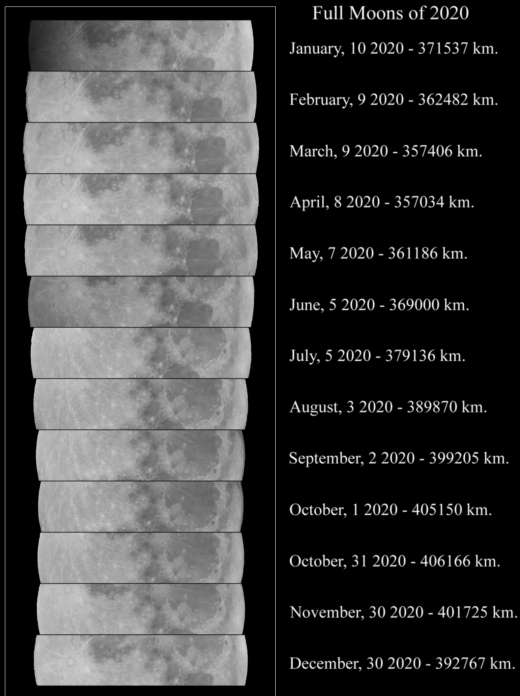
"From each full Moon photo, I cut out a slice, then placed the slices side by side," explains Bardelli. "The Moons of Jan. 10th and June 5th are dark because they are taken from shots of the penumbral eclipses that occurred in those days."
None of the slices are the same. Some are wide, others narrow. Each one faces in a slightly different direction. These differences are a result of the Moon's motion around its tilted, elliptical orbit. Each full Moon occurs at a different point in that orbit, and so we see it from a slightly different distance and angle.
Scroll up and down past the slices; they seem to rock back and forth. The rocking motions are called libration; because of them we can see 59% of the Moon's surface rather than the 50% you might have learned in school. So pay attention to the next full Moon (Jan 28th). It's as unique as you are.
Realtime Spaceweather Photo Gallery
Free: Spaceweather.com Newsletter
THE PINK AURORA PEARL: Inspired by the color of rare pink auroras, Spaceweather.com and the students of Earth to Sky Calculus launched a pink pearl to the stratosphere. It hitched a ride onboard the students' cosmic ray balloon, and reached an altitude 112,205 feet above the Sierra Nevada mountains of central California:
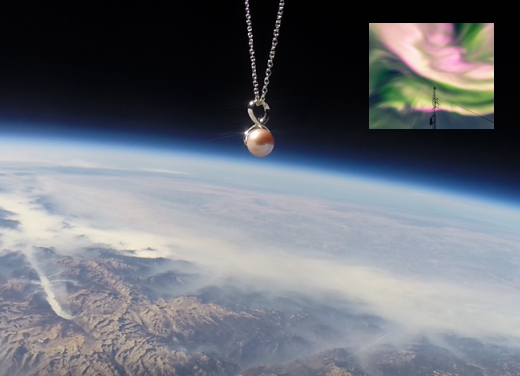
You can have it for $249.95. The students are selling space pearls to support their cosmic ray monitoring program. Measuring approximately 9 mm in diameter, the Aurora Pearl is mounted on a 925 sterling silver infinity twist, with a matching 17-inch long sterling silver chain. Each pearl comes with a greeting card showing the pendant in flight and telling the story of its journey to the edge of space.
Far Out Gifts: Earth to Sky Store
All sales support hands-on STEM education
Realtime Aurora Photo Gallery
Free: Spaceweather.com Newsletter