SOLAR SECTOR BOUNDARY CROSSING: Earth is about to cross a fold in the heliospheric current sheet--a vast wavy structure in interplanetary space separating regions of opposite magnetic polarity. The crossing, called a "solar sector boundary crossing," is expected on Jan. 10th and (in combination with an incoming solar wind stream) could cause geomagnetic activity around Earth's poles this weekend. Aurora alerts: SMS Text.
NOCTILUCENT CLOUDS OVER ARGENTINA: They're back. Noctilucent clouds (NLCs), recently missing, are once again circling the South Pole. And, in an unexpected twist, they've just appeared over Argentina as well.
"This is a very rare event," reports Gerd Baumgarten of Germany's Leibniz-Institute of Atmospheric Physics, whose automated cameras caught the meteoritic clouds rippling over Rio Grande, Argentina (53.8S) on Jan. 3rd:
A second camera recorded the clouds at even higher latitude: Rio Gallegos (51.6S). At this time of year, noctilucent clouds are supposed to be confined to the Antarctic--not Argentina. In the whole history of atmospheric research, NLCs have been sighted at mid-southern latitudes only a handful of times.
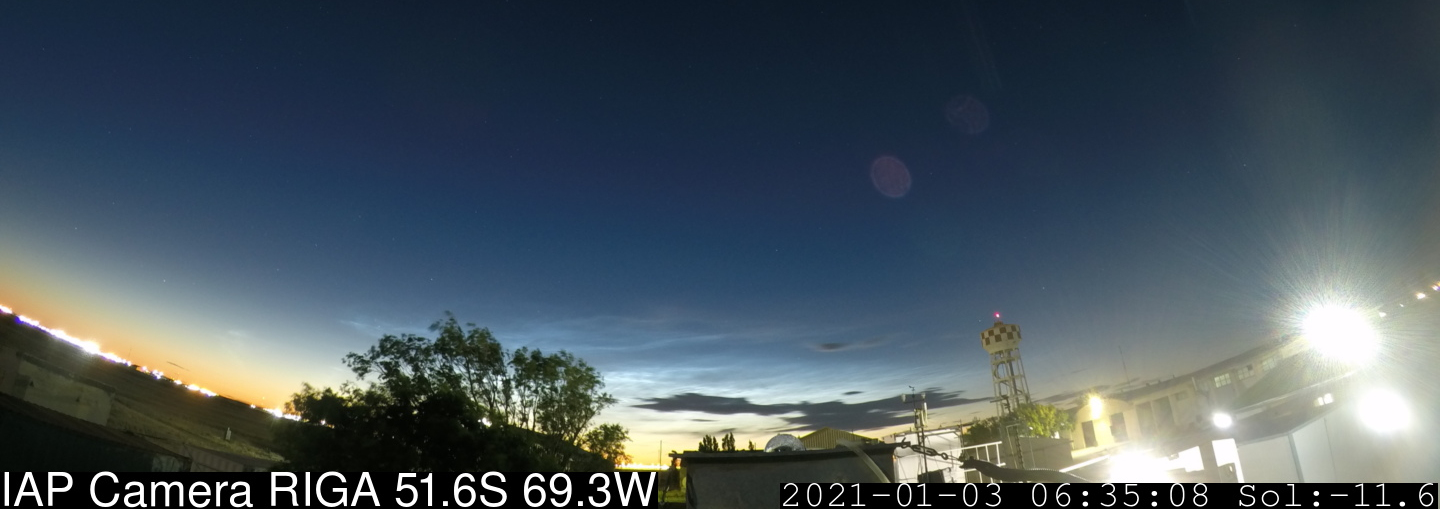
"Personally, I am thrilled to see NLCs in Argentina, as I had not expected them to occur so far north," says Natalie Kaifler of the German Aerospace Center (DLR), who operates a lidar (laser radar) alongside one of Baumgarten's cameras.
Kaifler's lidar "pinged" the clouds during the display and confirmed that they are genuine NLCs. Echoes pinpointed their altitude more than 80 km above Earth's surface:
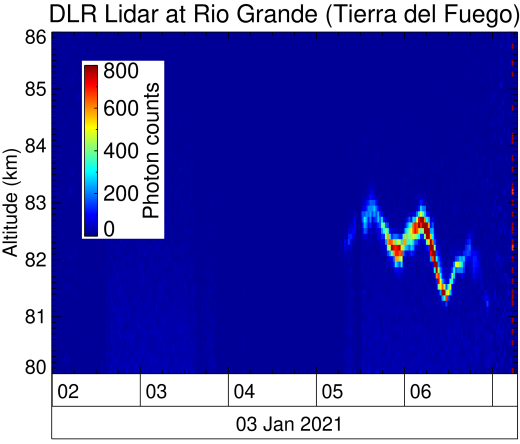
Above: The ~hour-long oscillations in these lidar echoes may be caused by gravity waves propagating upward from the Andes 82 km below.
NLCs are Earth's highest clouds. They form when summertime wisps of water vapor rise up from the poles to the edge of space. Water crystallizing around specks of meteor dust ~83 km above Earth's surface create beautiful electric-blue structures, typically visible from November to February in the south, and May to August in the north.
This season has been unusual, though. The normal onset of NLCs over the South Pole has been delayed for more than a month as strange weather patterns played out above Antarctica. Now, suddenly, they're back, and showing up in unexpected places.
Baumgarten has set up two cameras in southern Argentina to catch unexpected NLCs. "If it happens again," he says, "we'll let you know." Stay tuned!
Realtime NLC Photo Gallery
Free: Spaceweather.com Newsletter
A BLACK PEARL IN THE STRATOSPHERE: It came from Tahiti--and now it's been to the edge of space. On Oct. 30, 2020, this genuine Black Tahitian South Sea Cultured Pearl flew to the stratosphere onboard an Earth to Sky Calculus cosmic ray balloon, soaring 98,424 feet above the Sierra Nevada mountains of central California:
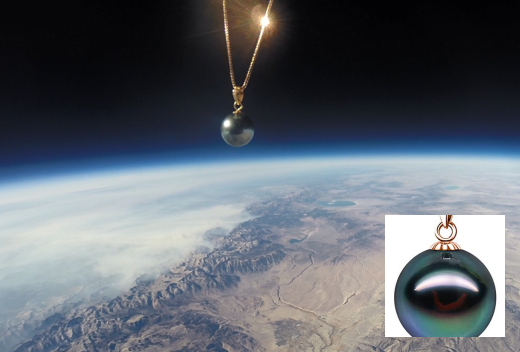
You can have it for $229.95. The students are selling these exotic space pearls to fund their cosmic ray monitoring program. Measuring 10 mm in diameter, the pearl has an 18K rose gold clasp and is suspended from a matching 925 Sterling Silver chain. Each pearl comes with a greeting card showing the pendant in flight and telling the story of its journey to the edge of space.
Far Out Gifts: Earth to Sky Store
All sales support hands-on STEM education
Realtime Spaceweather Photo Gallery
Free: Spaceweather.com Newsletter
Realtime Aurora Photo Gallery
Free: Spaceweather.com Newsletter