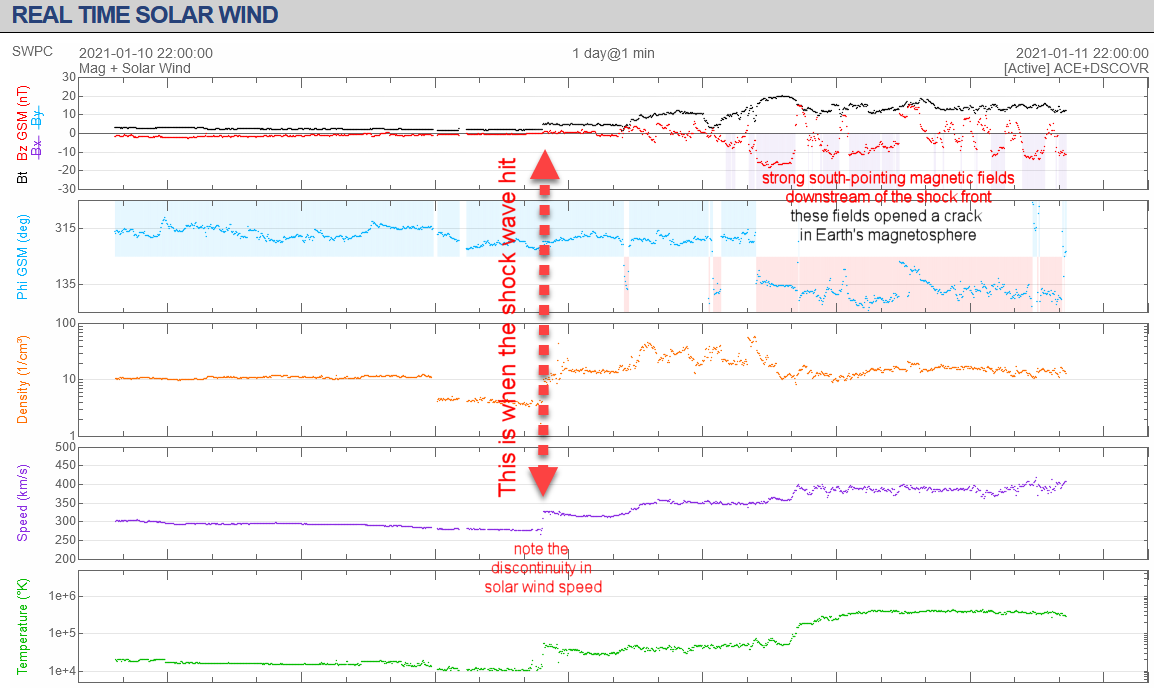
INTERPLANETARY SHOCK WAVE SPARKS AURORAS: Surprising some forecasters, an interplanetary shock wave hit Earth's magnetic field on Jan. 11th (see the data). The impact just after 08:30 UT did not trigger a geomagnetic storm. However, strong magnetic fields downstream of the shockfront opened a crack in Earth's magnetosphere.
Suddenly, "we were seeing bright blue and purple auroras over Abisko, Sweden," reports Chad Blakley of Lights over Lapland, whose automated webcam captured the display:
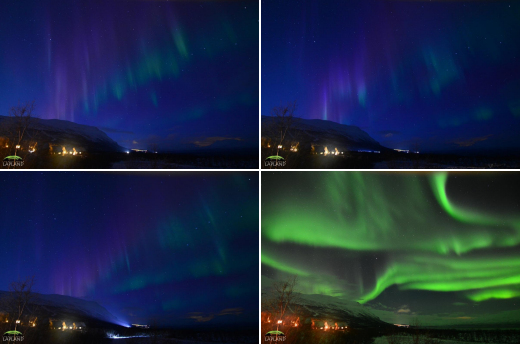
"They were visible in twilight," he says. "My cell phone was buzzing with reports from guides and friends who could see the rare blue Northern Lights dancing overhead. I've been chasing auroras in Arctic Sweden for more than 10 years, and I've only seen the blue lights two or three times - very special!"
"Later, the auroras turned green," he says, "and the display is still underway."
The shock wave was not expected. In retrospect, perhaps it should have been. On Jan. 8th, a huge filament of magnetism launched itself off the surface of the sun. NOAA's GOES-16 satellite recorded the eruption:
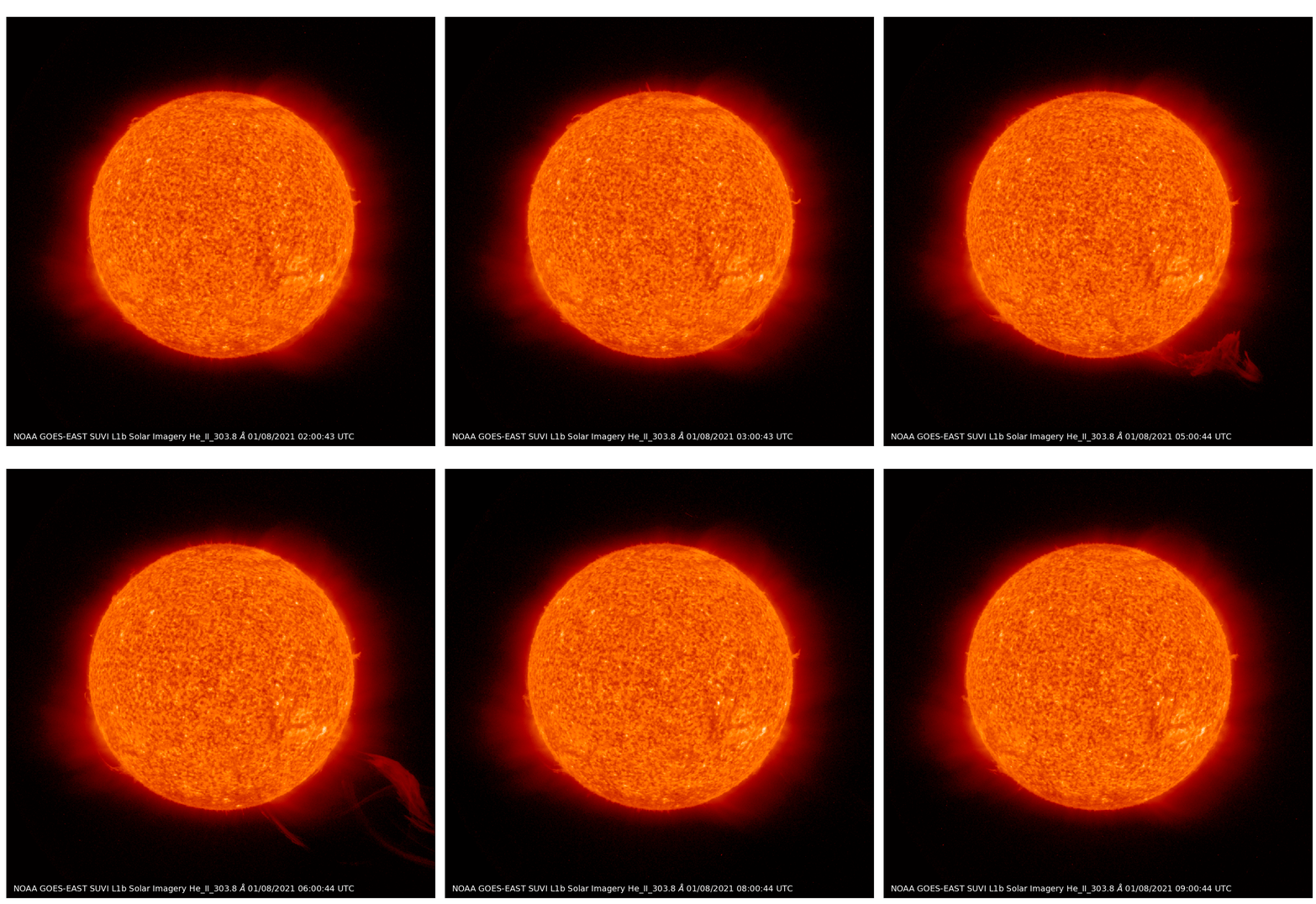
The arcing plumes of hot plasma were so large--looping more than a million km from surface to apex--they didn't fit in the field of view of most solar observatories. GOES-16, however, was able to capture much of their structure. It was a magnificent eruption.
At first the blast did not seem to be Earth-directed. However, today's event may have been a glancing blow from the debris. Aurora alerts: SMS Text.
Realtime Aurora Photo Gallery
Free: Spaceweather.com Newsletter
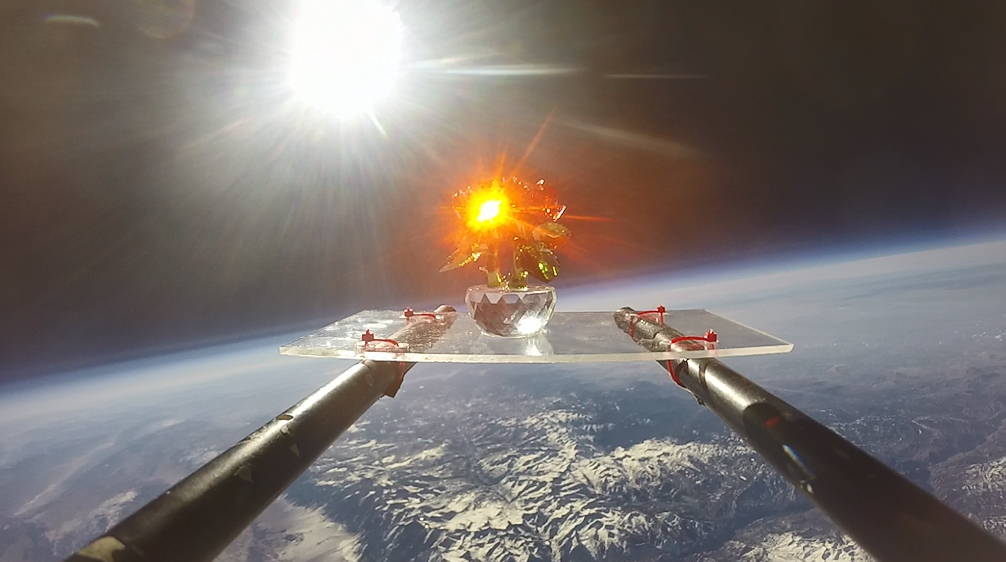
A FAR-OUT VALENTINE'S GIFT: Valentine's Day is coming. To get ready for the most romantic day of the year, the students of Earth to Sky Calculus launched a crystal bouquet of roses to the stratosphere on Jan. 1, 2021. Here it is floating on a cosmic ray balloon 102,690 feet above the Sierra Nevada mountains of central California:
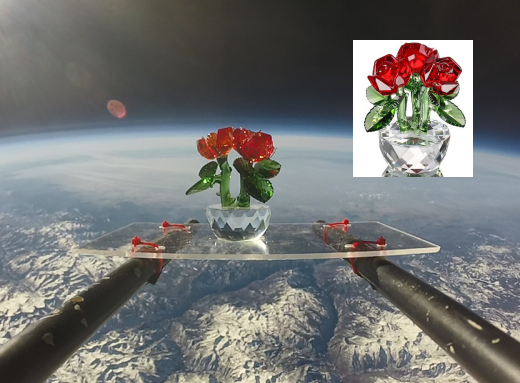
You can have them for $129.95. The students are selling space roses to fund their cosmic ray ballooning program. The flowers are made of high-quality Borosilicate Crown Crystal often used in lenses and prisms. That's why they glitter so colorfully in high-altitude sunlight. Each bouquet comes with a greeting card showing the flowers in flight and telling the story of their journey to the stratosphere and back again.
Far Out Gifts: Earth to Sky Store
All sales support hands-on STEM education
A DREAM CATCHER IN THE SKY: The first big snow of the year blanketed the high country of North Carolina last week. Todd Bush of Banner Elk knew just what to do. "I launched a drone to look around," he says. "And this is what it saw."
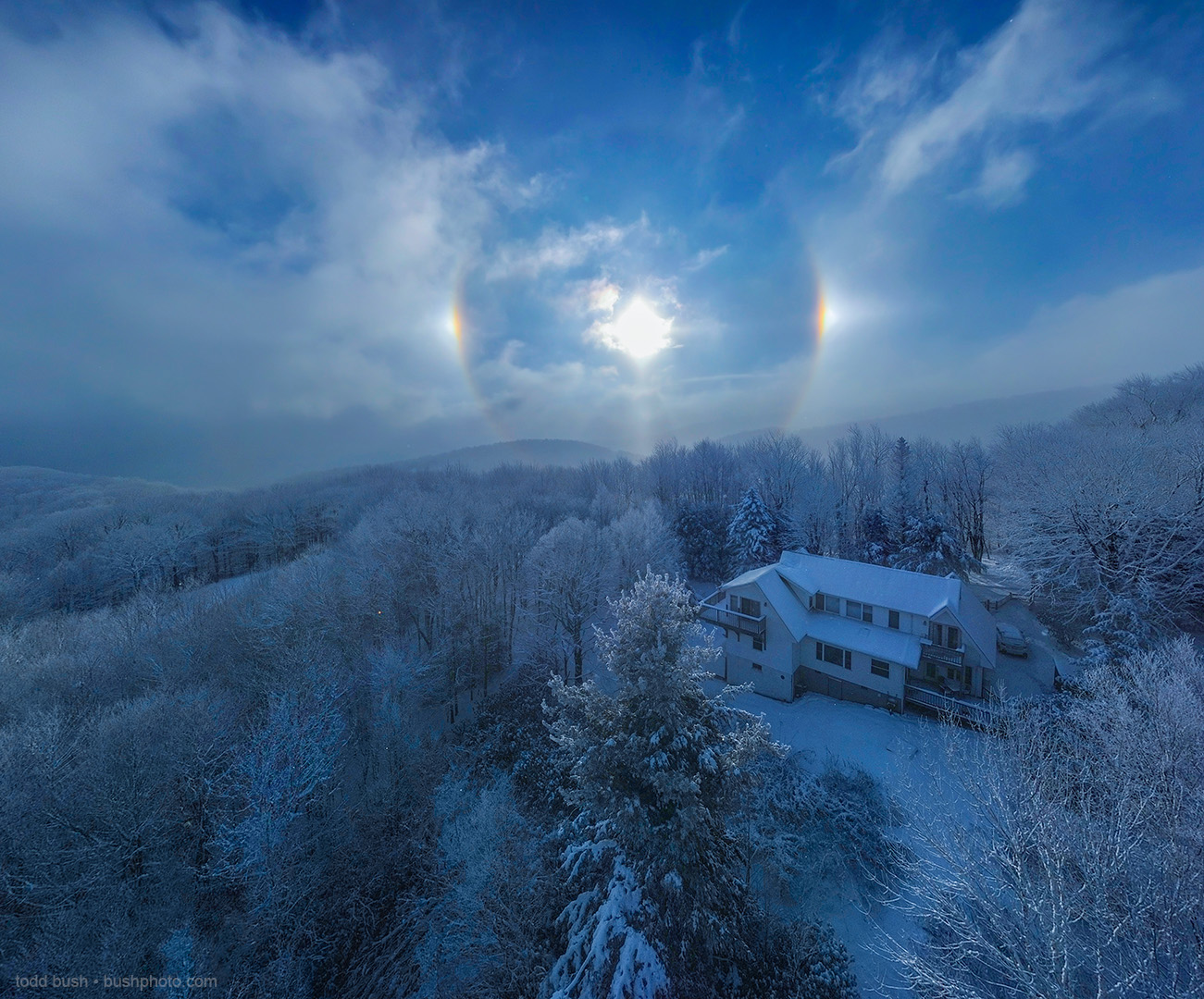
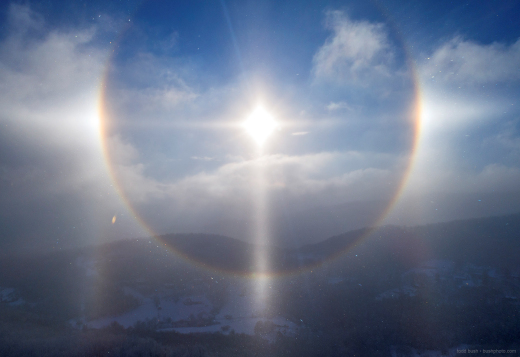
"BIG surprise," he says. "It looked like a dream catcher!"
Close. It was a sun halo made of diamond dust. The cold morning air was filled with jewel-like ice crystals of exceptional purity called "diamond dust." A close look at the picture shows specks of light in the air. Those are individual crystals.

Diamond dust halos are famously sharp and bright. The drone captured four types of halo: A pair of sundogs, a pair of sub-sundogs (subparhelia), a 22-degree ring, a fraction of a parhelic circle, and a lower sun pillar. Apparently, that's what it takes to make a dream catcher in the sky.
Realtime Spaceweather Photo Gallery
Free: Spaceweather.com Newsletter
Realtime Aurora Photo Gallery
Free: Spaceweather.com Newsletter