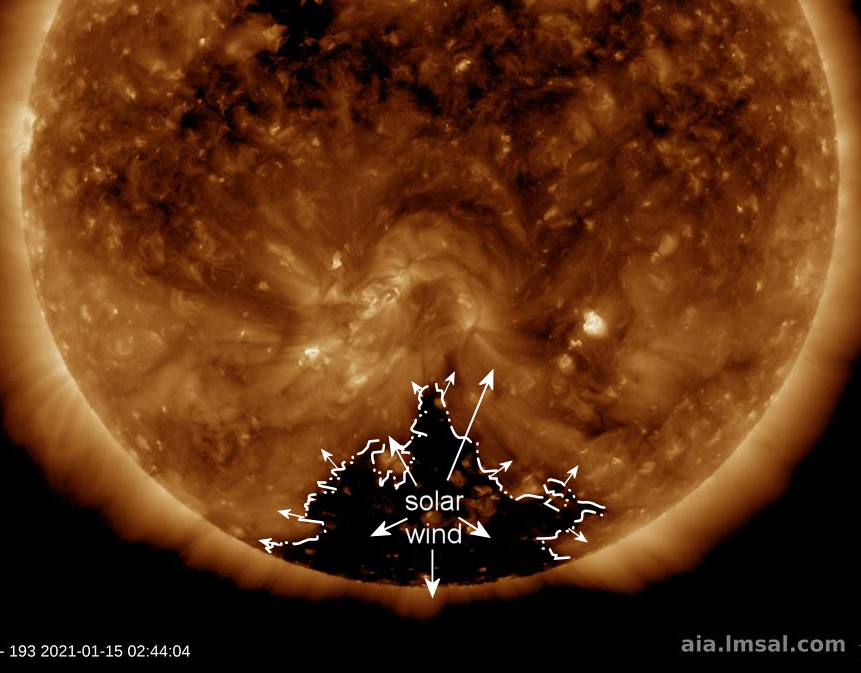
SOLAR WIND, INCOMING: A stream of solar wind is approaching Earth. Estimated time of arrival: Jan. 18th. Its source is a southern hole in the sun's atmosphere. NOAA forecasters expect the solar wind speed to top 500 km/s when the stream arrives, probably sparking Arctic auroras. Aurora alerts: SMS Text.
THE SUN SPUTTERS BACK TO LIFE: Solar Cycle 25 really is underway. Breaking a string of 12 spotless days, a new sunspot (AR2796) is emerging in the sun's southern hemisphere, inset in this magnetic map from NASA's Solar Dynamics Observatory (SDO):
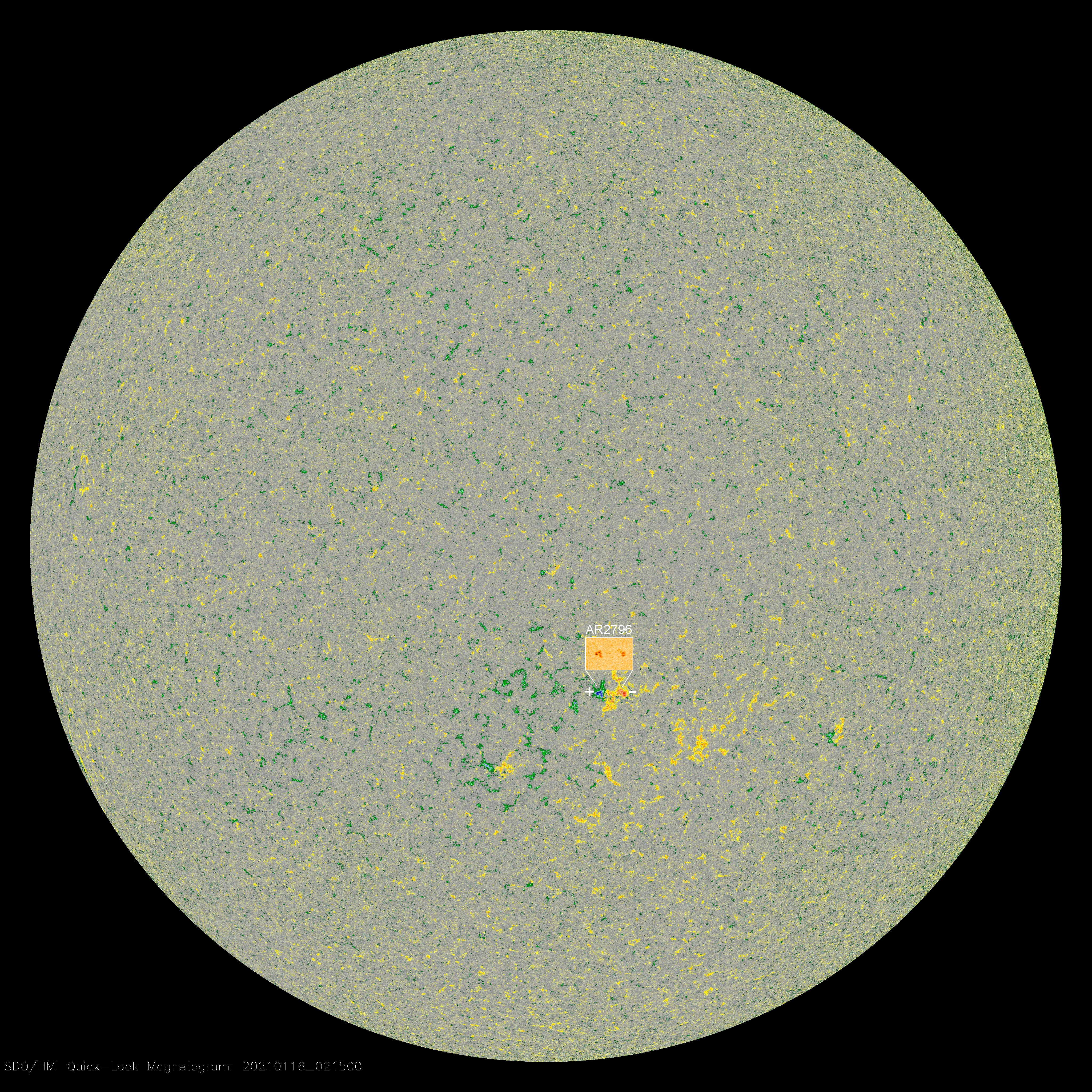
Above: False colors in this SDO magnetogram indicate magnetic polarity: Green +, yellow -
The +/- polarity of this sunspot marks it as a member of new Solar Cycle 25. Old Solar Cycle 24 sunspots would be the opposite, -/+, according to Hale's Law.
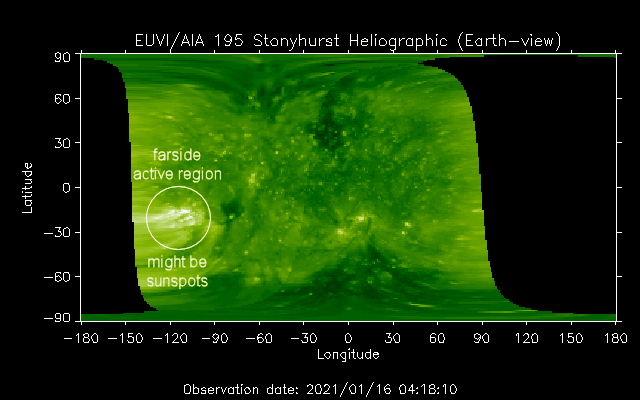
AR2796 is small and so far poses no threat for strong flares. It may not be the only sunspot, however. NASA's STEREO-A spacecraft is monitoring an active region just behind the sun's eastern limb. It could be a larger sunspot group soon to appear.
Realtime Spaceweather Photo Gallery
Free: Spaceweather.com Newsletter
'MIND-BLOWING' IMAGE OF THE ISS: Imagine trying to take a crystal clear picture of something that zooms by in a split second traveling 17,000 mph. On Jan. 8th, astronomer Michael Tzukran did exactly that. Rapidly swiveling his telescope on a rooftop in Tel Aviv University, Israel, he captured this image of the International Space Station (ISS) as it arced overhead:
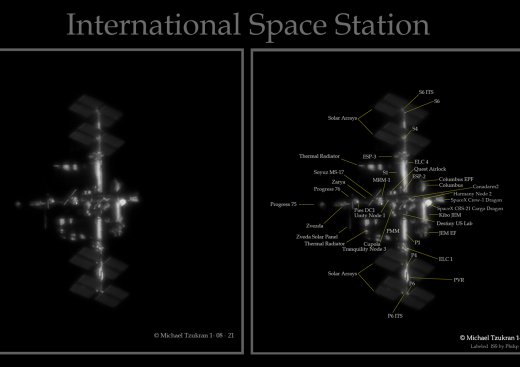
Even other astrophotographers are impressed. "This is a mind-blowing image," says Philip Smith, himself a longtime photographer of the ISS. Smith labeled Tzukran's photo, identifying more than 30 space station subsystems, modules, and other docked spacecraft.
"To me this image marks a great historical moment in time," says Smith. "This is the first time there are SpaceX Dragons docked to the ISS on Harmony Node 2 at the same time."
Realtime Spaceweather Photo Gallery
Free: Spaceweather.com Newsletter
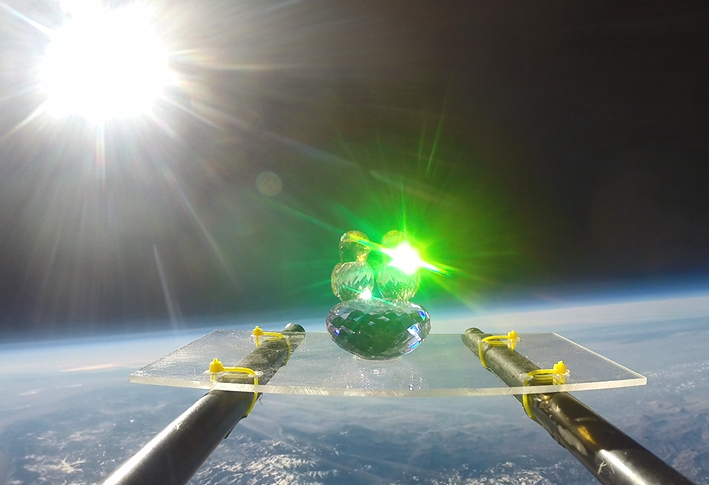
LOVE BIRDS IN THE STRATOSPHERE: Valentine's Day is coming. To get ready for the most romantic day of the year, the students of Earth to Sky Calculus launched a pair of crystal love birds to the stratosphere on Jan. 1, 2021. Here they are floating on a cosmic ray balloon 102,690 feet above the Sierra Nevada mountains of central California:
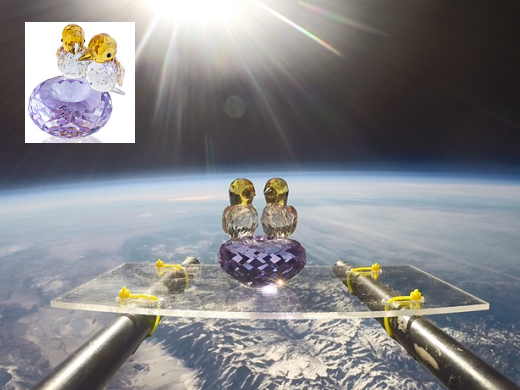
You can have them for $129.95. The students are selling love birds to fund their cosmic ray ballooning program. Made of high-quality Borosilicate Crown Crystal often used in lenses and prisms, the birds glitter colorfully in sunlight, even at the edge of space. Each purchase comes with a greeting card showing the birds in flight and telling the story of their journey to the stratosphere and back again.

Far Out Gifts: Earth to Sky Store
All sales support hands-on STEM education
Realtime Aurora Photo Gallery
Free: Spaceweather.com Newsletter