GEOMAGNETIC UNREST EXPECTED: For the next three days, Earth's polar magnetic field may be unsettled. The reason: A solar wind stream is approaching Earth, due to arrive on Jan. 18th. Solar wind speeds could top 500 km/s--not fast enough to cause a full-fledged geomagnetic storm, but possibly enough for some beautiful Arctic auroras. Aurora alerts: SMS Text.
COMETS DIVE-BOMB THE SUN: Since it was launched in 1995, SOHO has watched more than 4000 comets fall into the sun. Today alone it happened twice. Coronagraphs onboard the spacecraft caught two sungrazers in mid-disintegration, one bright and one really bright:
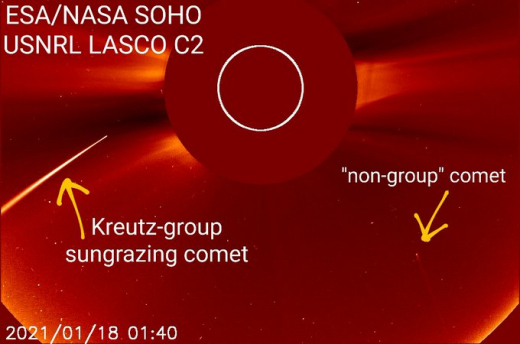
Hours after this snapshot was taken, the comets were gone, apparently vaporized by intense solar heat.
The one on the left is a member of the Kreutz family--a swarm of fragments from a giant comet that broke apart many centuries ago. "More than 85% of SOHO comets belong to this group, but this is a VERY bright example," says sungrazing comet expert Karl Battams of the Naval Research Lab in Washington DC. "We see maybe one like this every year or two. It was probably ~50-meters in diameter but will have been totally destroyed by the sun."
"The comet on the right is a little different," cointinues Battams. "It's a 'non-group' comet--that is, a random, sporadic comet not part of any known family." The fact that it met its doom in the fires of the sun on the same day as the Kreutz sungrazer is a complete coincidence. When you discover as many comets as SOHO has, these things are bound to happen.
Realtime Spaceweather Photo Gallery
Free: Spaceweather.com Newsletter
SUPERCOOLED "WINTER RAINBOW": On Jan. 17th, a very cold winter day in Kuusalu, Estonia, photographer Jüri Voit saw a rainbow almost as white as snow. "It appeared over the Gulf of Finland--a triple rainbow in clear air 12 degrees below freezing," says Voit.
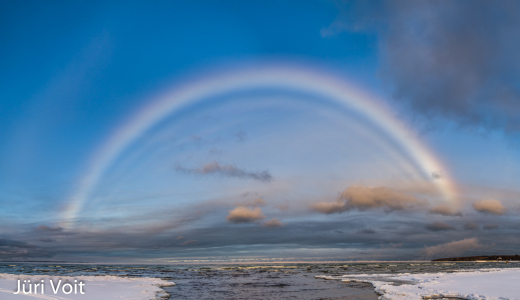
A rainbow in freezing air? According to atmospheric optics expert Les Cowley, "this is actually not atriple rainbow. It's a fogbow with inner supernumeraries."
Fogbows are close cousins of rainbows. They are formed in essentially the same way. Light bouncing in and out of water droplets creates a luminous arc. In this case, the droplets were fogdrops rising from the sea surface, supercooled to remain liquid in the freezing air.
Fog droplets are very small, much smaller than raindrops, which explains why fogbows are so pale. Tiny droplets cause a diffraction effect not seen in ordinary rainbows. As a result, the colors are smeared together resulting in a wintry-white hue.
Realtime Spaceweather Photo Gallery
Free: Spaceweather.com Newsletter
LOVE BIRDS IN THE STRATOSPHERE: Valentine's Day is coming. To get ready for the most romantic day of the year, the students of Earth to Sky Calculus launched a pair of crystal love birds to the stratosphere on Jan. 1, 2021. Here they are floating on a cosmic ray balloon 102,690 feet above the Sierra Nevada mountains of central California:
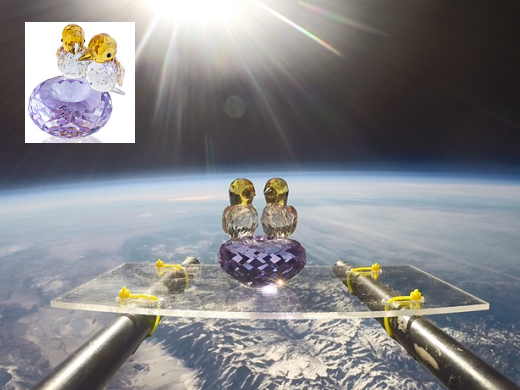
You can have them for $129.95. The students are selling love birds to fund their cosmic ray ballooning program. Made of high-quality Borosilicate Crown Crystal often used in lenses and prisms, the birds glitter colorfully in sunlight, even at the edge of space. Each purchase comes with a greeting card showing the birds in flight and telling the story of their journey to the stratosphere and back again.

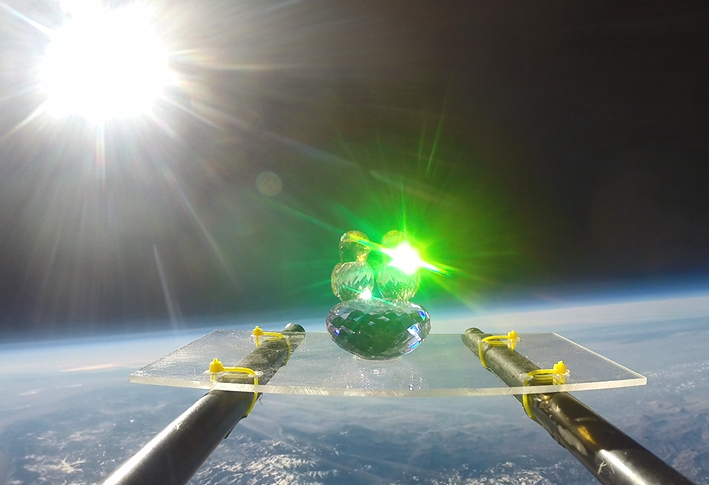
Far Out Gifts: Earth to Sky Store
All sales support hands-on STEM education
Realtime Aurora Photo Gallery
Free: Spaceweather.com Newsletter