SOLAR WIND STREAM: Earth is entering a stream of solar wind flowing from a northern hole in the sun's atmosphere. Forecasters expect wind speeds to top 600 km/s on Jan. 20-21, possibly fast enough to spark a minor G1-class geomgnetic storm. Arctic auroras are likely. Aurora alerts: SMS Text.


A MUSICAL NOTE FROM THE MAGNETOSPHERE: High above the Arctic Circle in Lofoten, Norway, citizen scientist Rob Stammes operates a space weather monitoring station. His sensors detect ground currents, auroras, radio bursts, and disturbances in Earth's magnetic field. Yesterday, he says, "I received a musical note from the magnetosphere."
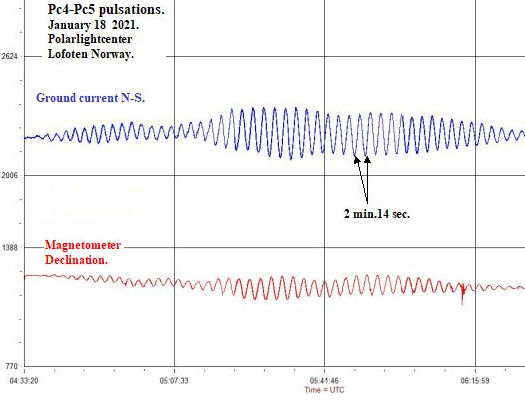
"Around 05.30 UTC on Jan. 18th, our local magnetic field began to swing back and forth in a rhythmic pattern," he says. "Electrical currents in the ground did the same thing. It was a nearly pure sine wave--like a low frequency musical note. The episode lastesd for more than 2 hours."
Stammes has received such notes before, but they are rare. "I see a pattern like this only about once a year," he says.
Space physicists call this phenomenon a "pulsation continuous" or "Pc" for short. Imagine blowing across a piece of paper, making it flutter with your breath. Solar wind does the same thing to magnetic fields. Pc waves are essentially flutters propagating down the flanks of Earth's magnetosphere excited by the breath of the sun.

Above: a magnetometer in Abisko, Sweden, recorded the same waves.
Yesterday's set of waves washed over Norway and Sweden, but almost nowhere else, according to the global INTERMAGNET network of magnetometers. It was a strictly regional phenomenon.
What happens in the sky when such a pure tone emerges from the natural background cacophony of magnetic activity? "I wish I knew," says Stammes. "I was asleep at the time." In fact, it's possible that no one knows. Tones like these are rare, and they all too often occur while skies are cloudy or daylit, blocking any peculiar auroras from view. Stammes says he plans to build an alert system to help him find out. No pun intended: Stay tuned.
Realtime Spaceweather Photo Gallery
Free: Spaceweather.com Newsletter
THE *BIG* SPACE BOUQUET: Just in time for Valentine's Day--the biggest batch of crystal roses ever flown to space! On Jan. 13, 2021, the students of Earth to Sky Calculus launched this 4-flower bouquet to the stratosphere. Floating on a cosmic ray balloon, it rose (no pun intended) to an altitude 109,252 feet above the Sierra Nevada of central California:
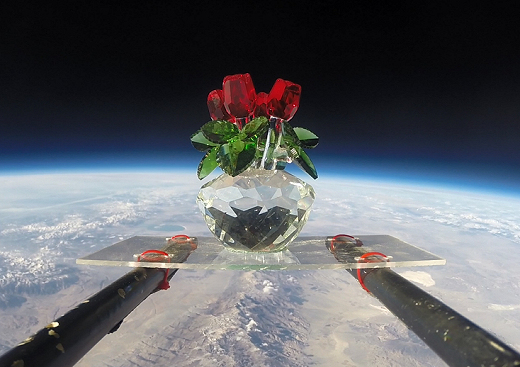
You can have them for $169.95. The students are selling space roses to fund their cosmic ray ballooning program. The flowers, stems and base are all made of Borosilicate Crown Crystal, the kind used in high-quality lenses and prisms. That's why the flowers glitter so colorfully in sunlight at the edge of space.

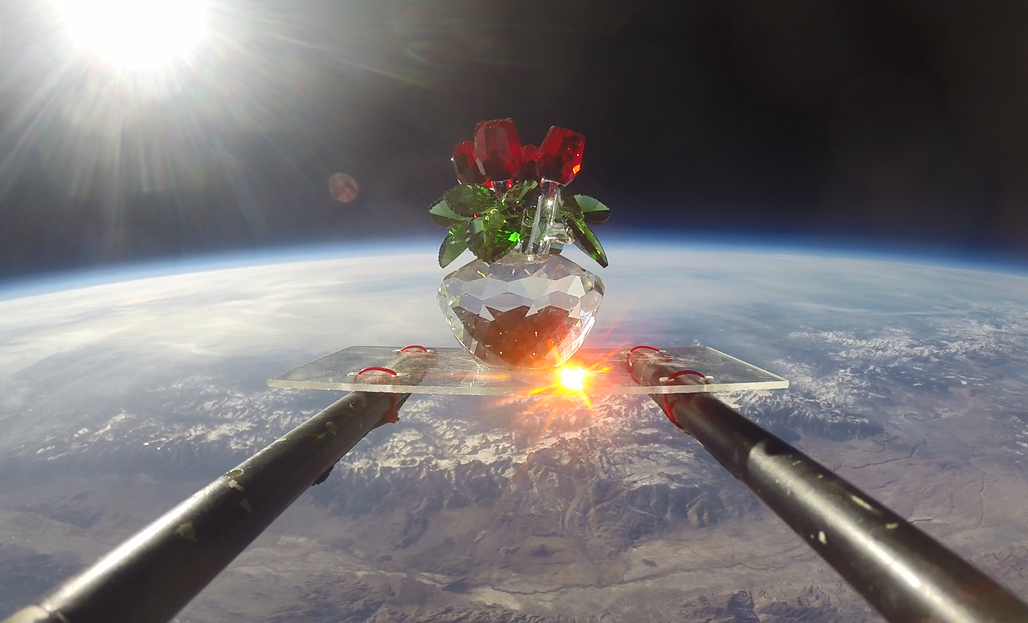
Each purchase comes with a greeting card showing the bouquet in flight and telling the story of its journey to the stratosphere and back again.
Far Out Gifts: Earth to Sky Store
All sales support hands-on STEM education
Realtime Aurora Photo Gallery
Free: Spaceweather.com Newsletter