SOLAR WIND STREAM MISSES EARTH: The storm is cancelled. A solar wind stream expected to hit Earth on Jan. 21st, bringing a chance of G1-class geomagnetic storms, apparently missed. It's not surprising; the stream emerged from a northern hole in the sun's atmosphere. It was not squarely Earth-directed, and probably sailed high above our planet's North Pole. Maybe next time.

WHAT'S OVER THE HORIZON? It's a new sunspot, probably. NASA's Solar Dynamics Observatory is monitoring a spray of hot plasma jutting over the sun's northeastern limb:
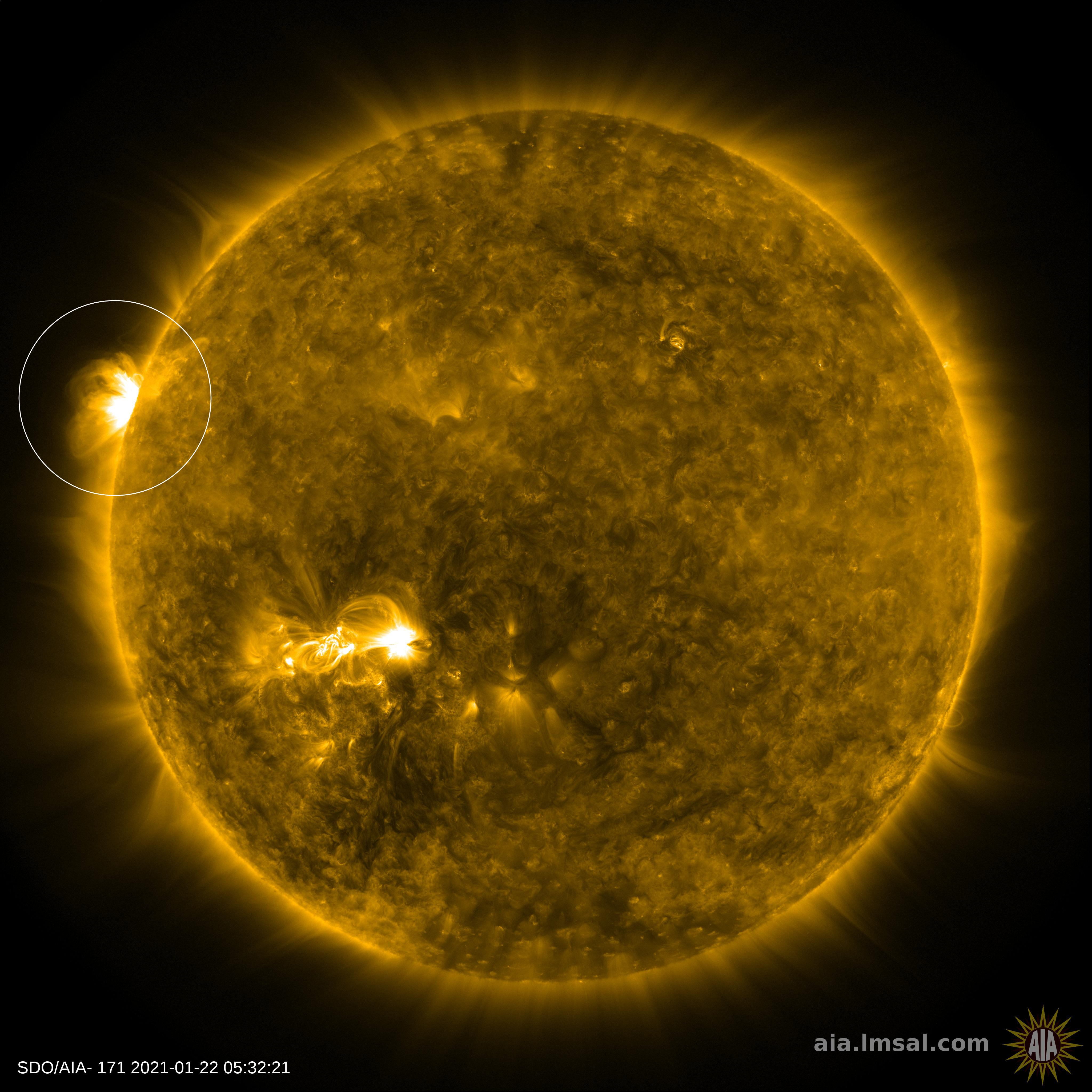
This looks like the magnetic canopy of a sunspot group, temporarily hidden behind the edge of the sun. The dark cores, if they exist, will rotate into view during the next 24 hours. Stay tuned.
Realtime Spaceweather Photo Gallery
Free: Spaceweather.com Newsletter
SIRIUS AND THE PUP: Sirius, a.k.a. the "Dog Star", is the brightest star in the sky. It's almost twice as massive as the sun and 26 times more luminous. We've all seen it. But have you ever seen the Dog Star's pup? It is circled red in this close-up picture taken by Michael Teoh on Jan. 20th:
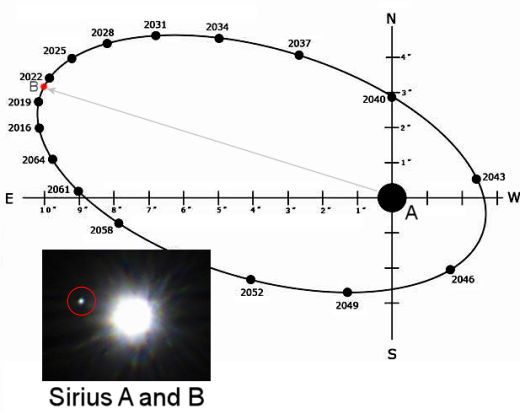
The pup is Sirius's white dwarf companion. Discovered in 1862, the extremely dense star packs the mass of our sun into a sphere about the size of Earth. It is 10,000 times fainter than Sirius and orbits the "big dog" at about the same distance as Uranus orbits the sun. No wonder it is so hard to find.
To split the two stars, Teoh used a APM-LZOS 9-inch refracting telescope at the Heng Ee Observatory in Penang, Malaysia. "I imaged the pup (Sirius B) on my first try," he says. "It was 11.2 arcseconds from Sirius."
Now is a good time to see the pup as it travels around its elliptical orbit near maximum separation from Sirius for the next few years. With steady seeing and a clear atmosphere, it is possible to split the pair using telescopes as small as 6 inches.
Realtime Spaceweather Photo Gallery
Free: Spaceweather.com Newsletter
THE *BIG* SPACE BOUQUET: Just in time for Valentine's Day--the biggest batch of crystal roses ever flown to space! On Jan. 13, 2021, the students of Earth to Sky Calculus launched this 4-flower bouquet to the stratosphere. Floating on a cosmic ray balloon, it rose (no pun intended) to an altitude 109,252 feet above the Sierra Nevada of central California:
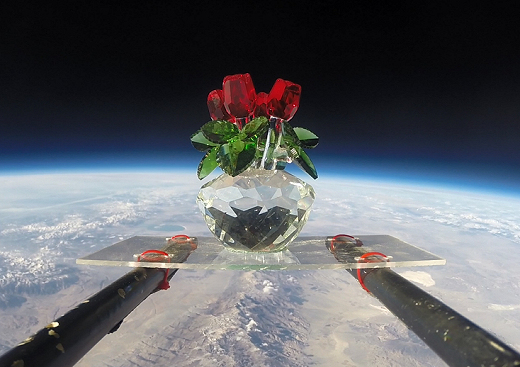
You can have them for $169.95. The students are selling space roses to fund their cosmic ray ballooning program. The flowers, stems and base are all made of Borosilicate Crown Crystal, the kind used in high-quality lenses and prisms. That's why the flowers glitter so colorfully in sunlight at the edge of space.

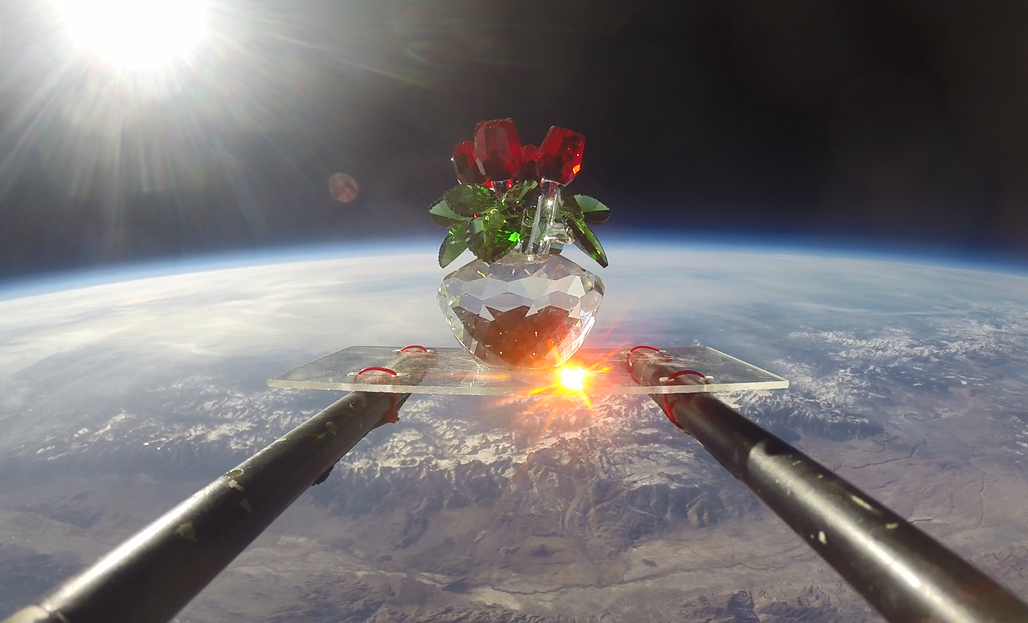
Each purchase comes with a greeting card showing the bouquet in flight and telling the story of its journey to the stratosphere and back again.
Far Out Gifts: Earth to Sky Store
All sales support hands-on STEM education
Realtime Aurora Photo Gallery
Free: Spaceweather.com Newsletter