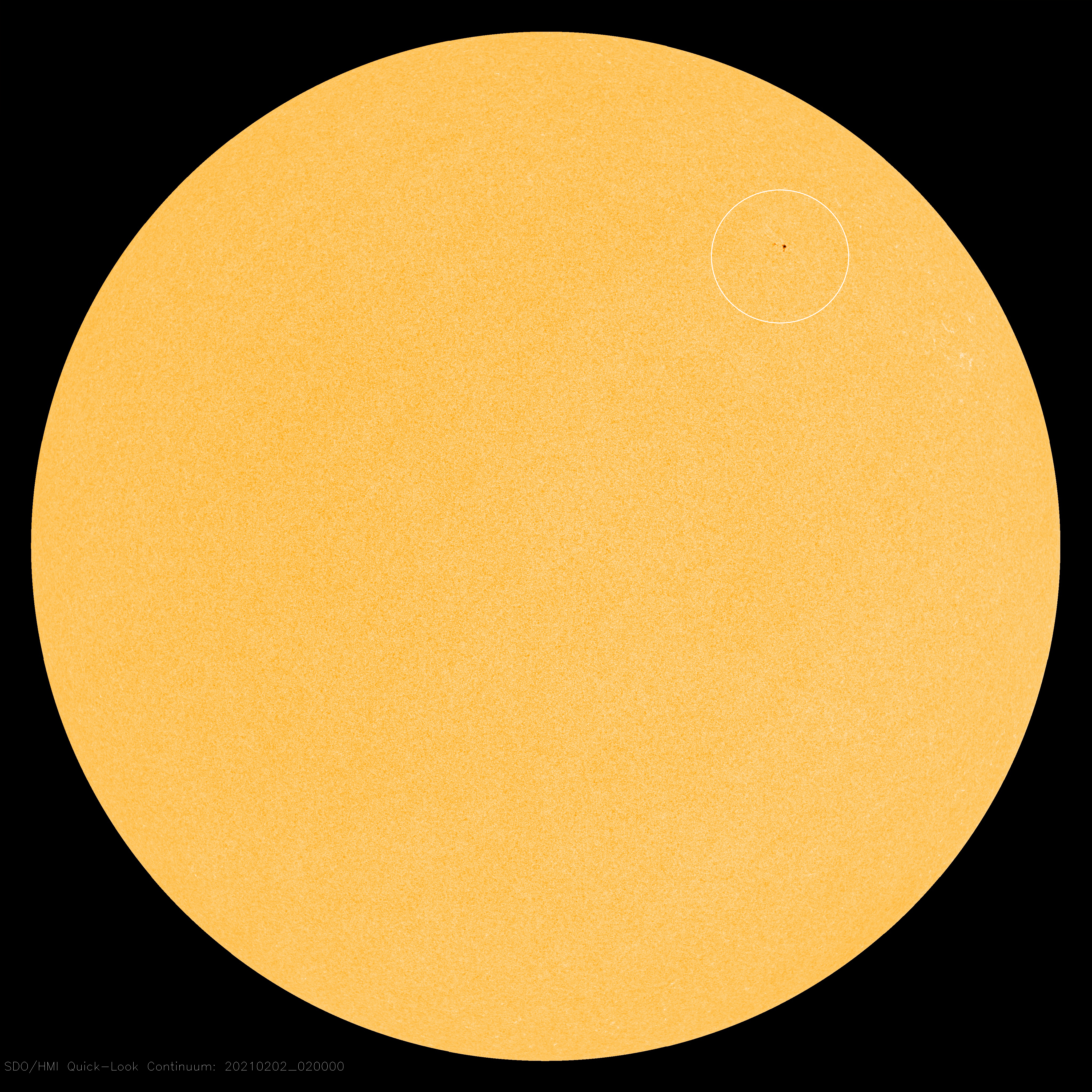
NEW SUNSPOT ALERT: Breaking a string of 5 spotless days, a new sunspot is emerging in the sun's northern hemisphere, right here. So far, Solar Cycle 25 has produced sunspots mainly in the sun's southern hemisphere. This new spot restores some balance to the lopsided solar cycle. Aurora alerts: SMS Text.
SOLAR WIND SPARKS AURORAS, RATTLES MAGNETIC FIELD: A stream of solar wind is blowing around Earth faster than 500 km/s. First contact with the gaseous material late on Feb. 1st sparked bright auroras over Alaska. Todd Salat photographed the display from Portage Depot (40 miles SE of Anchorage):
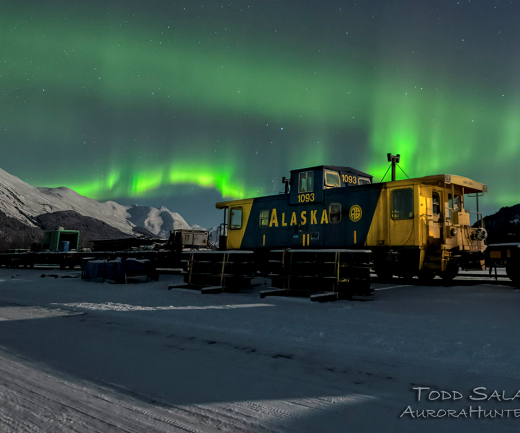
"Alaska Railroad Caboose #1093 rests for the night under a beautiful moonlit aurora display," says Salat. "If this caboose could talk, I bet it would have a lot of aurora stories to tell. What a great night for a light show!"
In addition to making auroras, the solar wind stream is also rattling Earth's magnetic field. Magnetogram data collected by Stuart Green in Preston UK shows the ongoing activity:
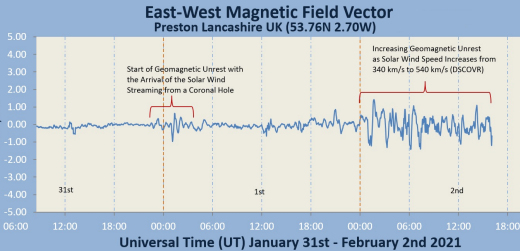
"The expected solar wind has arrived, twitching magnetometer needles around the globe, including my own here in the UK," says Green. "It never ceases to be a thrill when the effects of space weather are detected in my own back yard."
Deconstructing Green's plot: A tremor early on Feb. 1st heralded the solar wind's arrival. It was caused by dense interplanetary plasma scooped up and pushed toward Earth by the solar wind stream--much like a snowplow pushing snow down a winter street. The stream itself punched through late Feb 1st/early Feb. 2nd. Solar wind velocities shot up from 300 km/s to 500 km/s, and Earth's magnetic field has been disturbed ever since.
Arctic sky watchers should remain alert for auroras as the solar wind continues to blow on Feb. 2nd and 3rd. Aurora alerts: SMS Text.
Realtime Aurora Photo Gallery
Free: Spaceweather.com Newsletter
THE *BIG* SPACE BOUQUET: Just in time for Valentine's Day--the biggest batch of crystal roses ever flown to space! On Jan. 13, 2021, the students of Earth to Sky Calculus launched this 4-flower bouquet to the stratosphere. Floating on a cosmic ray balloon, it rose (no pun intended) to an altitude 109,252 feet above the Sierra Nevada of central California:
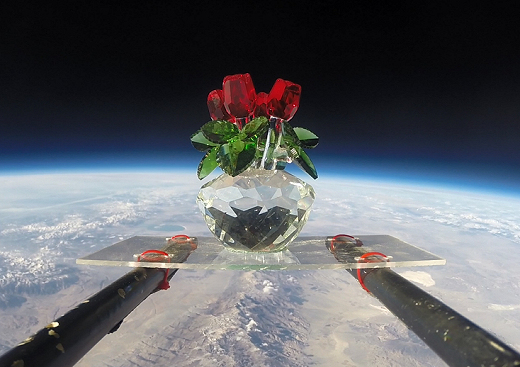
You can have them for $179.95. The students are selling space roses to fund their cosmic ray ballooning program. The flowers, stems and base are all made of Borosilicate Crown Crystal, the kind used in high-quality lenses and prisms. That's why the flowers glitter so colorfully in sunlight at the edge of space.

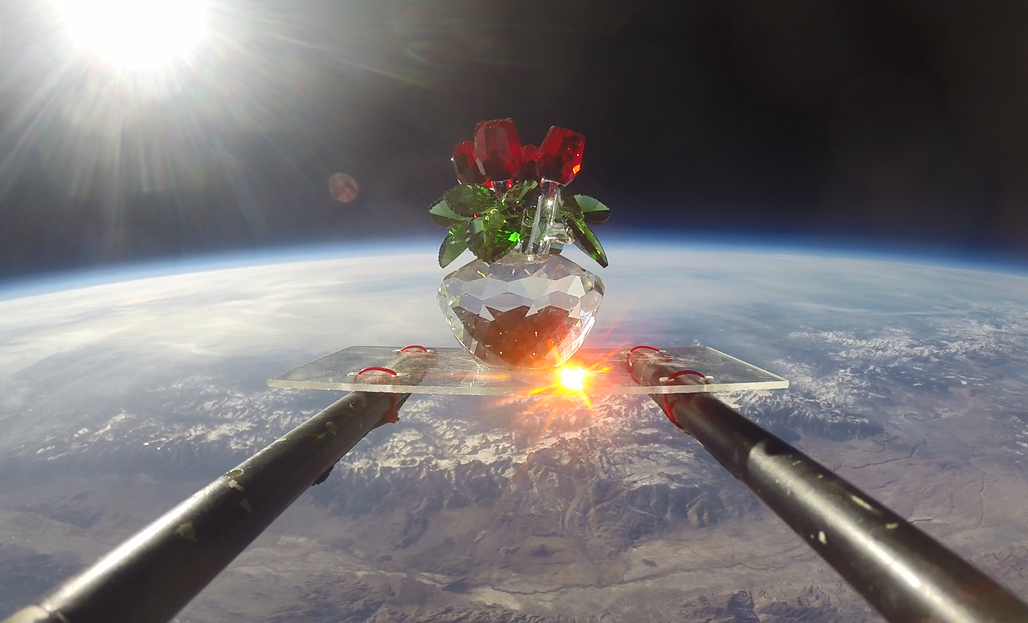
Each purchase comes with a greeting card showing the bouquet in flight and telling the story of its journey to the stratosphere and back again.
Far Out Gifts: Earth to Sky Store
All sales support hands-on STEM education
Realtime Spaceweather Photo Gallery
Free: Spaceweather.com Newsletter