CO-ROTATING INTERACTION REGION: What made the auroras of Feb. 2nd so good? It was a co-rotating interaction region (CIR). CIRs are transition zones between slow- and fast-moving streams of solar wind. Solar wind plasma piles up in these regions, creating density gradients and shock waves that can rock Earth's magnetic field much like a CME. A CIR hit Earth on Feb. 2nd and ... see below. Aurora alerts: SMS Text.
MIND-BENDING AURORAS: Usually, when aurora tour guide Marianne Bergli sees mind-bending auroras over Tromsø, Norway, she is surrounded by clients. Last night, she was all alone. "The lights were incredible--just fantastic," she says. "And I enjoyed the display all by myself."
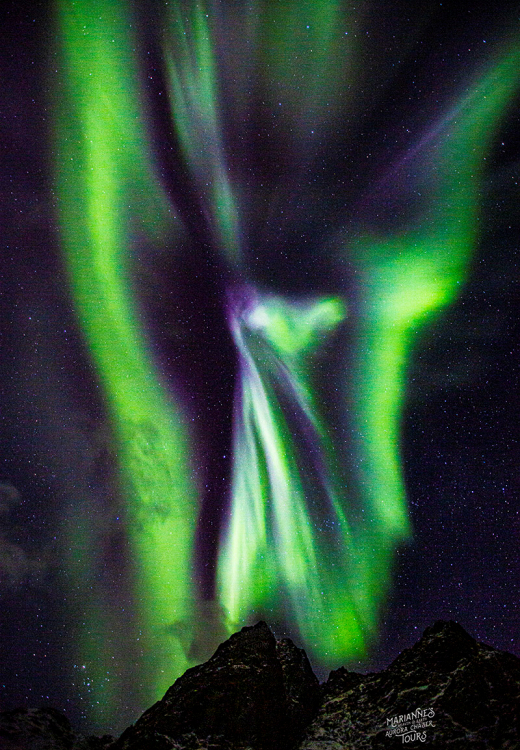
"Every color in the heavens cycled through the sky," she says. "It. Was. Amazing."
This is what happens when a co-rotating interaction region (CIR) hits Earth during a global pandemic: Lots of auroras, few tourists. Despite the lack of witnesses, though, the outburst really happened.
In the wake of the CIR, solar wind is now blowing around Earth at speeds near 500 km/s. If these conditions persist, more Arctic mind-benders are possible on Feb. 3rd. Says Bergli, "you are welcome to join us." Aurora alerts: SMS Text.
Realtime Aurora Photo Gallery
Free: Spaceweather.com Newsletter
VALENTINE'S GIFTS FROM THE EDGE OF SPACE: Does someone in your life love space? Shop the Earth to Sky Store for their perfect Valentine's gift. All items in the store have flown to the stratosphere on board cosmic ray research balloons--and from now until Feb. 14th, everything is 10% off:
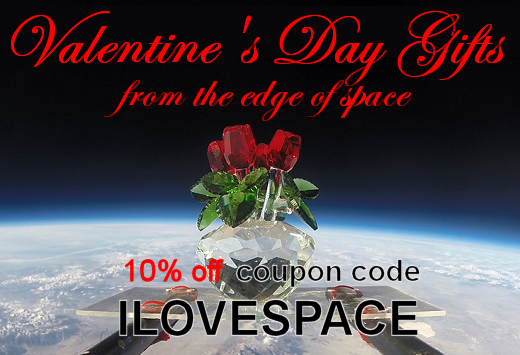
Each purchase comes with a greeting card showing the item in flight and telling the story of its journey to the stratosphere and back again. Don't forget to enter the coupon code "ILOVESPACE" for your Valentine's discount!
Far Out Gifts: Earth to Sky Store
All sales support hands-on STEM education
Realtime Spaceweather Photo Gallery
Free: Spaceweather.com Newsletter