THE SOLAR WIND IS SUBSIDING: Solar wind speeds have dipped below 500 km/s, bringing an end to the aurora episode caused by a CIR impact earlier this week. The next few days should be quiet as we await the arrival of another solar wind stream on Feb. 7th. Aurora alerts: SMS Text.
A BUCKETFUL OF STARS: One morning last week, Dr. Fred Stevenson of Coundon UK stepped into his back garden and looked down on a bucket of water he'd left outside overnight. "It was full of stars," he says. "The frozen surface looked like a little galaxy."
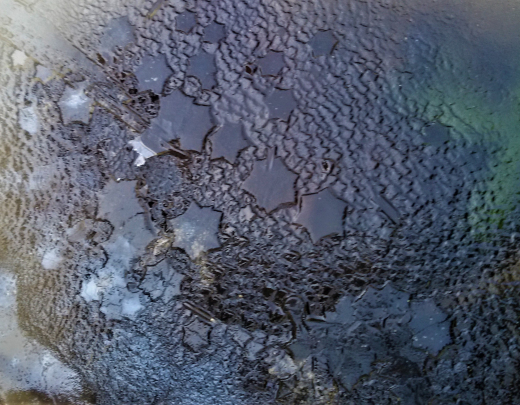
"The largest of the 'stars' was approximately 8 mm across, while the smallest was only 2 mm," he describes. "They stuck upwards from the surface - it looked as though you could almost peel them off."
What caused this strange display? The size and shape of the stars are important clues. They roughly match the dimensions of a special type of snowflake: the fernlike stellar dendrite. Six-pointed and starlike, fernlike stellar dendrites are the largest snow crystals, often falling to Earth with diameters of 5 mm or more.
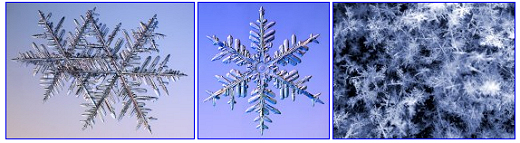
Above: Examples of fernlike stellar dendrites from "A Guide to Snowflakes"
Imagine a handful of these snowflakes landing gently on the surface of almost-freezing water.The snowflakes melt just as the water solidifies and voilà--a "bucket full of stars."
"It may well have snowed onto the ice surface at some point during the night," says Stevenson, but he's not sure because he was asleep when the stars formed. So, for now, it's just an idea. If anyone has a better one, let us know.
Realtime Spaceweather Photo Gallery
Free: Spaceweather.com Newsletter
NOCTILUCENT ROCKET CLOUDS: This morning before sunrise in Richmond, Virginia, pilot Curt Morse was at the airport preparing his plane for takeoff. "I looked up and was astonished to see very bright noctilucent clouds," he says.
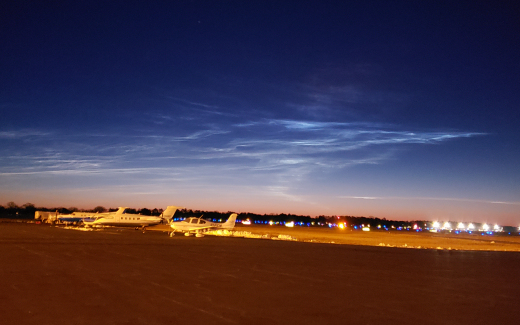
Noctilucent clouds don't naturally appear in the northern hemisphere at this time of year. But these weren't natural. They are rocket clouds. During the early hours of Feb. 4th, SpaceX launched 60 more Starlink satellites from Cape Canaveral, Florida. Ice crystals in the rocket's exhaust lingered in the upper atmosphere, producing luminous forms in the pre-dawn sky.
The clouds were probably visible up and down the east coast of the USA just before sunrise. Did you see them? Submit your images here.
Realtime Noctilucent Cloud Photo Gallery
Free: Spaceweather.com Newsletter
VALENTINE'S GIFTS FROM THE EDGE OF SPACE: Does someone in your life love space? Shop the Earth to Sky Store for their perfect Valentine's gift. All items in the store have flown to the stratosphere on board cosmic ray research balloons--and from now until Feb. 14th, everything is 10% off:

Each purchase comes with a greeting card showing the item in flight and telling the story of its journey to the stratosphere and back again. Don't forget to enter the coupon code "ILOVESPACE" for your Valentine's discount!
Far Out Gifts: Earth to Sky Store
All sales support hands-on STEM education
Realtime Aurora Photo Gallery
Free: Spaceweather.com Newsletter