HAM RADIO SPACE WEATHER NETWORK: A new article just published in EOS describes how ham radio is the new frontier in space weather research. Interested? All you need is a Personal Space Weather Station to join a global network of scientists studying how solar activity affects our planet. Learn more during the 2021 HamSCI Workshop, held virtually using Zoom on March 19th and 20th.
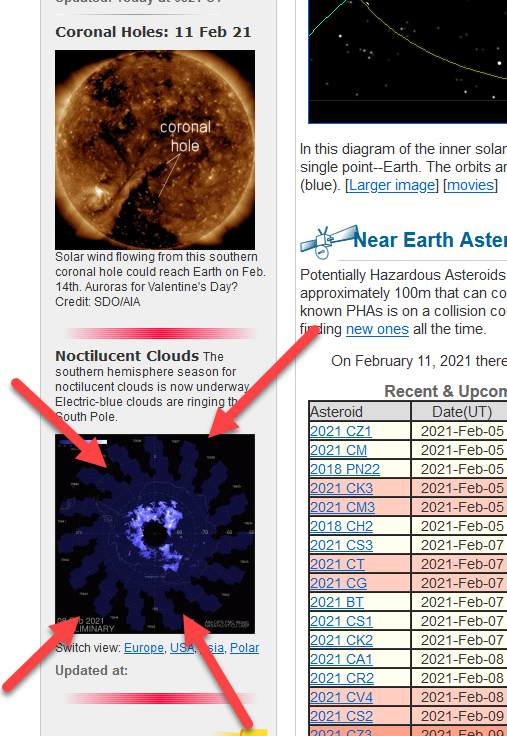
NOCTILUCENT CLOUDS ARE VANISHING: For the first time this year, noctilucent clouds (NLCs) are doing something normal. They're vanishing. This 30-day animation from NASA's AIM spacecraft shows a rapidly shrinking ring of NLCs over Antarctica:

NLCs are Earth's highest clouds. They form when summertime wisps of water vapor rise up to the edge of space and crystalize around specks of meteor smoke. In the southern hemisphere, NLC season normally runs from December through February, and the clouds are confined inside the Antarctic Circle.
However, this season has *not* been normal. The clouds were completely missing for most of December (no one knows why). When NLCs finally did appear, weeks late, they busted out of the Antarctic for rare sightings in Argentina.
The current fade may be the first normal thing they've done. South polar NLCs typically vanish in mid-to-late February. So far, so good. In a matter of days, perhaps, they will be gone. Then Earth will be without NLCs until late May when they normally re-appear over the North Pole. You can monitor the situation right here on Spaceweather.com.
Realtime Noctilucent Cloud Photo Gallery
Free: Spaceweather.com Newsletter
A BAD HAIR DAY ON THE SUN: Even the sun can have a bad hair day. Witness this strange coiffure photographed by Harlan Thomas of Calgary, Alberta, on Feb. 8th:
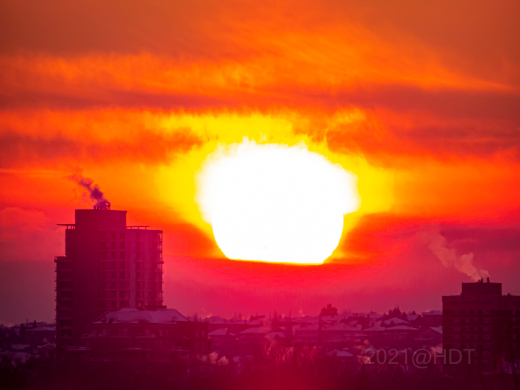
"I have been shooting sunsetsfor almost 10 years and this is the first time I have caught this type of light, it really was a magical moment," says Thomas. "For a moment I forgot that it was -30 C outside!"
Remarkably, this display was not caused by exotic atmospheric optics. Les Cowley explains: "There is no sign of significant miraging or disk distortion. I think that the sun happens to be shining through a ragged thin cloud that is scattering the light. Lone water droplets scatter light with little deflection - i.e. in the forward direction so that the area around the sun looks brighter."
In other words, it could happen anytime. Keep an eye on the sunset!
Realtime Spaceweather Photo Gallery
Free: Spaceweather.com Newsletter
VALENTINE'S GIFTS FROM THE EDGE OF SPACE: Does someone in your life love space? Shop the Earth to Sky Store for their perfect Valentine's gift. All items in the store have flown to the stratosphere on board cosmic ray research balloons--and from now until Feb. 14th, everything is 10% off:

Each purchase comes with a greeting card showing the item in flight and telling the story of its journey to the stratosphere and back again. Don't forget to enter the coupon code "ILOVESPACE" for your Valentine's discount!
Far Out Gifts: Earth to Sky Store
All sales support hands-on STEM education
Realtime Aurora Photo Gallery
Free: Spaceweather.com Newsletter