A NEW FORM OF SPACE WEATHER--EARTH WIND: The sun is windy. Every day, 24/7, a breeze of electrified gas blows away from the sun faster than a million mph. Solar wind sparks beautiful auroras around the poles of Earth, sculpts the tails of comets, and scours the surface of the Moon.
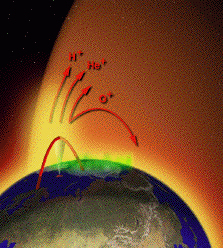 Would you believe, Earth is windy, too? Our own planet produces a breeze of electrified gas. It's like the solar wind, only different, and it may have important implications for space weather on the Moon.
"Earth wind" comes from the axes of our planet. Every day, 24/7, fountains of gas shoot into space from the poles. The leakage is tiny compared to Earth's total atmosphere, but it is enough to fill the magnetosphere with a riot of rapidly blowing charged particles. Ingredients include ionized hydrogen, helium, oxygen and nitrogen.
Once a month, the Moon gets hit by a blast of Earth wind. It happens around the time of the full Moon when Earth's magnetic tail points like a shotgun toward the lunar disk. For 3 to 5 days, lunar terrain is bombarded by H+, He+, O+, N2+ and other particles.
One effect of Earth wind, just discovered, is to create water. According to a new study published in the January 2021 edition of the Astrophysical Journal Letters, Earth wind can actually make H2O on the lunar surface.
"Hydrogen ions in Earth wind combine with oxygen in Moon rocks and soil to make hydroxyl (OH-) and water (H2O)," explains one of the lead authors, Quanqi Shi of Shandong University and the Chinese Academy of Sciences. "This came as a surprise."
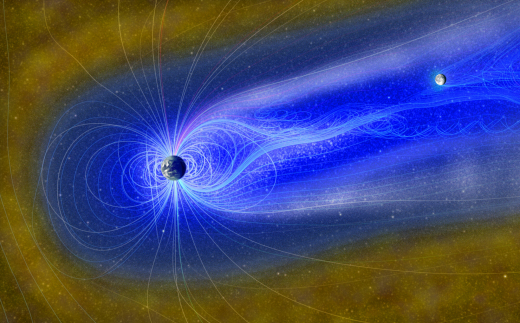
Above: Earth wind (blue) engulfs the full Moon, an artist's concept. Credit: E. Masongsong
Researchers have long known that hydrogen from space raining down on the Moon can create a temporary form of surface water. Solar wind does it all the time. However, this kind of water was expected to dry up once a month when the Moon enters Earth's magnetic tail. Terrestrial magnetism deflects solar wind, turning the faucet to the OFF position.
But that's not what happened.
The researchers looked at data from NASA's Moon Mineralogy Mapper (M3) onboard India's Chandrayaan-1 spacecraft, which was orbiting the Moon in 2009 when the Moon made multiple passes through Earth's magnetic tail. "We found that lunar surface water does not disappear as expected during the magnetosphere shielding period," says Shi. "Earth wind must be bridging the gap."
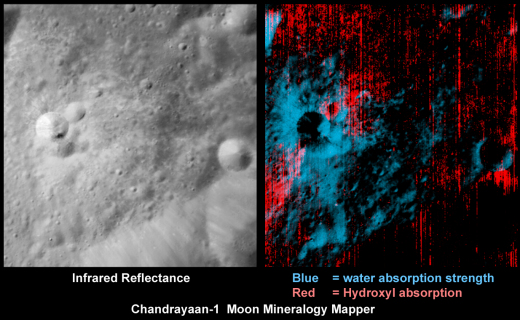
Above: Water- and hydroxyl-rich materials on the lunar surface. [more]
In fact, when it comes to producing water, Earth wind has some big advantages over solar wind. When the full Moon is inside Earth's magnetic tail, it is surrounded by Earth wind and feels its impact from every direction. The lunar nearside, lunar farside, and lunar poles are all peppered with Earth wind particles. In this sense, Earth wind can potentially make water anywhere--unlike the solar wind which rains down only on the lunar dayside.
Another potential advantage of Earth wind: It is oxygen rich, much more so than solar wind. "Oxygen is another key element of water," points out Shi. "Whether these oxygen ions can contribute to the formation of lunar water is a very intriguing question for future study."
A sharable version of this story is available here.
Realtime Spaceweather Photo Gallery
Free: Spaceweather.com Newsletter
VALENTINE'S GIFTS FROM THE EDGE OF SPACE: Does someone in your life love space? Shop the Earth to Sky Store for their perfect Valentine's gift. All items in the store have flown to the stratosphere on board cosmic ray research balloons--and from now until Feb. 14th, everything is 10% off:
Each purchase comes with a greeting card showing the item in flight and telling the story of its journey to the stratosphere and back again. Don't forget to enter the coupon code "ILOVESPACE" for your Valentine's discount!
Far Out Gifts: Earth to Sky Store
All sales support hands-on STEM education
Realtime Aurora Photo Gallery
Free: Spaceweather.com Newsletter