EXITING THE SOLAR WIND: A stream of solar wind hit Earth's magnetic field on Feb. 13th, sparking bright auroras over Alaska, Sweden, and Norway. The show is over now. Earth is exiting the stream, and aurora probabilities are low as the solar wind speed drops toward 300 km/s. Aurora alerts: SMS Text
IN SEARCH OF ... POLAR SUNSPOTS: This weekend something interesting *almost* happened on the sun. A sunspot tried to form near the sun's north pole. This snapshot from NASA's Solar Dynamics Observatory shows an active region approximately 60 degrees north of the sun's equator:

A dark core never formed at the base of this hot spot, but it may have been close. White light images of the sun's surface revealed a bright magnetic froth called plage, which often heralds a young sunspot bubbling up from below. With just a little more magnetic buoyancy, this sunspot might have made it.
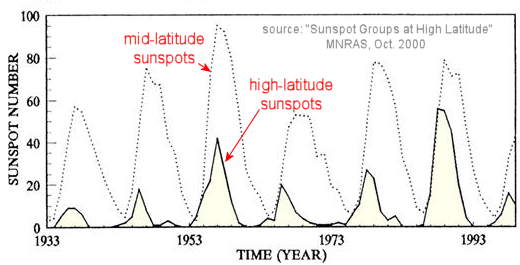
High-latitude sunspots are very rare. 95% of all sunspots appear within 30 degrees of the sun's equator, and in the past 50 years only a handful of outliers have appeared at latitudes greater than 40 degrees. Nevertheless, we've been on the lookout for such regions. Why? Because now is the time. Consider this plot of sunspot numbers going back to 1933:
Credit: Monthly Notices of the Royal Astronomical Society: ref
Solid curves trace high-latitude sunspots; dashed curves are for mid-latitudes. Sunspots far from the equator are much more common at the beginnings of solar cycles--a phenomenon also known as Spörer's law. This pattern has been observed and documented since the 19th century.
Solar Cycle 25 is just getting started. So, if you want to find a rare polar sunspot, now is the time to look. Or, maybe, next time.
Realtime Aurora Photo Gallery
Free: Spaceweather.com Newsletter
THIS IS *REAL* MONEY FROM SPACE: The US Mint has just released a reverse-proof dollar coin honoring the Hubble Space Telescope. The students of Earth to Sky Calculus took it one step further, flying a whole roll of Hubble coins to the edge of space. Here they are floating 35.3 km (115,814 ft) above the Sierra Nevada mountains of central California:
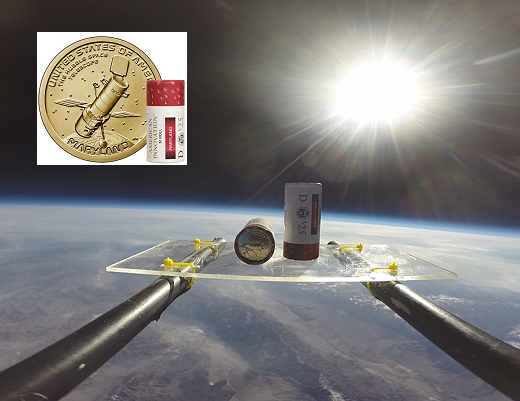
You can have a single coin for $20 or a whole roll for $150. The students are selling Hubble coins to support their cosmic ray ballooning program. Each order comes with a greeting card showing the coins in flight and telling the story of their flight to the stratosphere. Best of all, this is real money! You can actually spend it. All sales support hands-on STEM research.
Far Out Gifts: Earth to Sky Store
All sales support hands-on STEM education
Realtime Spaceweather Photo Gallery
Free: Spaceweather.com Newsletter