CRACKS IN EARTH'S MAGNETIC FIELD: Minor cracks are opening in Earth's magnetic field today, Feb. 16th. Solar wind pouring through the gaps is sparking auroras around the Arctic Circle--no geomagnetic storm required. The solar wind speed is currently trending upward, so more lights could be in the offing tonight.
A live aurora webcam just recorded these dancing ribbons over Sweden's Abisko National Park:
"It was a beautiful show," says Chad Blakley of Lights of Lapland. "We are now broadcasting live video from Abisko around the clock, 24/7, so you can always tune in and see what's happening inside the Arctic Circle."
Realtime Aurora Photo Gallery
Free: Spaceweather.com Newsletter
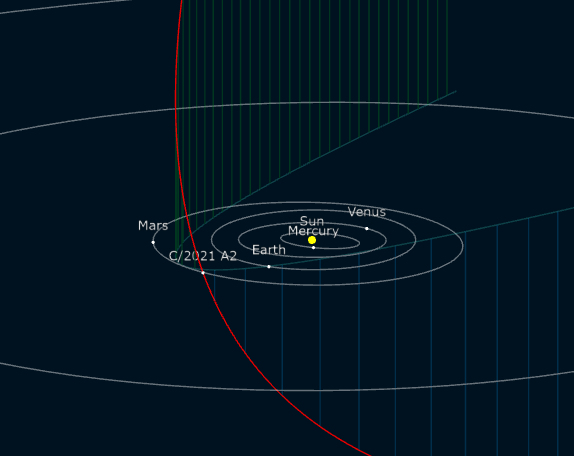
HYPERBOLIC COMET NEOWISE: Comet NEOWISE (C/2021 A2) is unusual. It is falling through the solar system--almost straight through--barely feeling the gravity of the sun. In fact, when it leaves, it probably won't be back. That's why this photo is technically a once-in-a-lifetime shot:
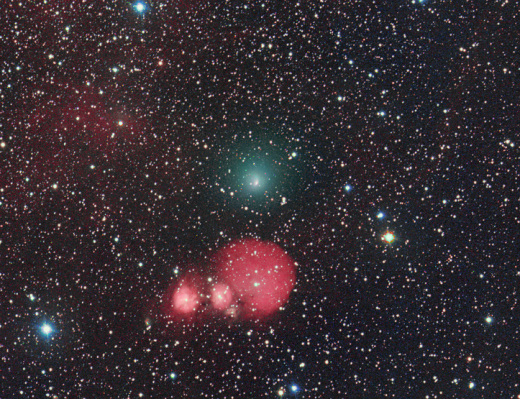
On Feb. 14th, Michael Jaeger of Weißenkirchen in der Wachau, Austria, photographed the 12th magnitude comet passing by IC 2162, a cluster of ionized hydrogen clouds in the constellation Orion. "What a photo-op," he says. "The comet's green color beautifully complemented the red glow of hydrogen in IC 2162."
Discovered in early January by NASA's Wide-field Infrared Survey Explorer spacecraft, Comet NEOWISE is splitting the gap between Earth and Mars. The distant comet has a hyperbolic orbit (e=1.0010460), which means it is not bound to the sun. It might have come from the Oort Cloud or even from interstellar space. No one knows.
Astrophotographers who wish to get their own once-in-a-lifetime shot can find the comet's coordinates here.
Realtime Spaceweather Photo Gallery
Free: Spaceweather.com Newsletter
THIS IS *REAL* MONEY FROM SPACE: The US Mint has just released a reverse-proof dollar coin honoring the Hubble Space Telescope. The students of Earth to Sky Calculus took it one step further, flying a whole roll of Hubble coins to the edge of space. Here they are floating 35.3 km (115,814 ft) above the Sierra Nevada mountains of central California:
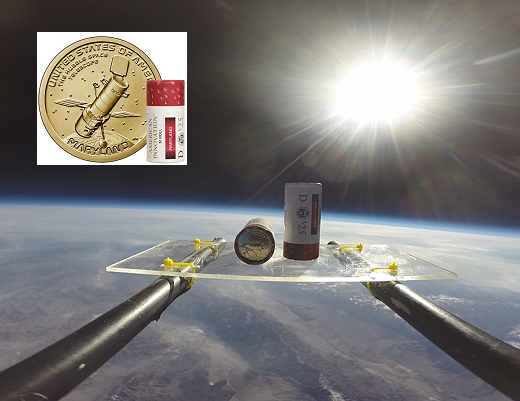
You can have a single coin for $20 or a whole roll for $150. The students are selling Hubble coins to support their cosmic ray ballooning program. Each order comes with a greeting card showing the coins in flight and telling the story of their flight to the stratosphere. Best of all, this is real money! You can actually spend it. All sales support hands-on STEM research.
Far Out Gifts: Earth to Sky Store
All sales support hands-on STEM education
Realtime Spaceweather Photo Gallery
Free: Spaceweather.com Newsletter