GEOMAGNETIC STORM WARNING: A solar wind stream is approaching Earth. It could cause a minor G1-class geomagnetic storm when it hits Earth' magnetic field on Feb. 21st. The gaseous material is flowing faster than 500 km/s from an equatorial hole in the sun's atmosphere. Aurora alerts: SMS Text.


A MYSTERY IN THE SKY: The ground was covered in snow; the trees clothed in frost. The air was filled with floating, swirling crystals of ice. That was the situation last week in Lake Geneva, Wisconsin, when dawn broke and a magnificent display of sun halos appeared in Wiwid Paramita's backyard:
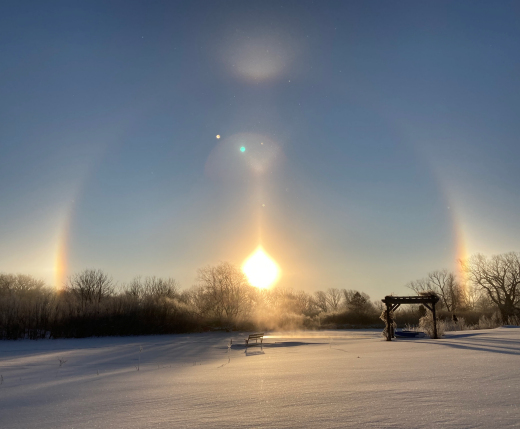
"I took this picture using my iPhone," says Paramita. "It was a cold and beautiful morning."
We've all seen luminous arcs, rings and 'dogs around the sun on cold days. They appear when sunlight shines through airborne ice crystals. This was no ordinary display, however. It contains a big mystery, right here.
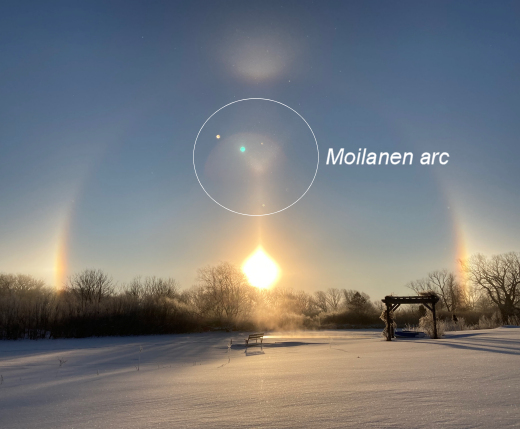
The "V" in the middle of the picture is a Moilanen arc, named after its discoverer, halo expert Jarmo Moilanen of Finland. No one can figure it out. Computer simulations show that it *might* be formed by ice crystals with faces sloping at an unusual angle of 34o. Experts in Finland have sampled ice crystals whenever they have seen the Moilanen arc, but so far they can find no traces of crystals with the required angles.
"How and what forms it is one of the halo world's biggest mysteries," says atmospheric optics expert Les Cowley.
Realtime Spaceweather Photo Gallery
Free: Spaceweather.com Newsletter
ASTEROID APOPHIS: You've probably heard of asteroid 99942 Apophis. For a while, astronomers thought it might hit Earth in April 2029. Instead, it's just going to dive through our planet's belt of geosynchronous satellites. Feel better? Last night in Market Harborough, UK, amateur astronomer Robert Forrest video-recorded the space rock gliding past HD 91803, an 8th magnitude star in the constellation Hydra:

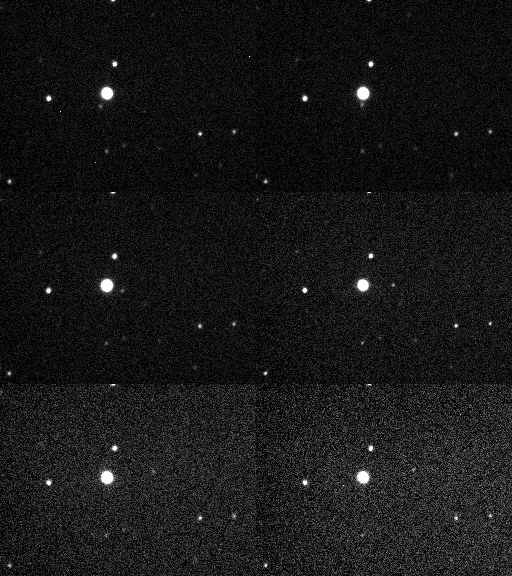
"For the next few weeks, Apophis is well-placed for observation and is brighter than it will be until its naked-eye close pass by Earth in April 2029," reports Forrest. "On Feb. 19th it was at 16th magnitude and 0.12 AU distant."
Apophis is currently making a "pre-flyby" of Earth, giving astronomers a chance to study it one last time before the big event in 2029. At closest approach on March 5, 2021, the 370-meter rock will be 0.11 AU away, about 40 times farther than the Moon. Telescopes and radars will observe the space rock as it passes, gathering data on its shape and composition to improve predictions of what might happen 8 years hence.
Realtime Spaceweather Photo Gallery
Free: Spaceweather.com Newsletter
THIS IS *REAL* MONEY FROM SPACE: The US Mint has just released a reverse-proof dollar coin honoring the Hubble Space Telescope. The students of Earth to Sky Calculus took it one step further, flying a whole roll of Hubble coins to the edge of space. Here they are floating 35.3 km (115,814 ft) above the Sierra Nevada mountains of central California:
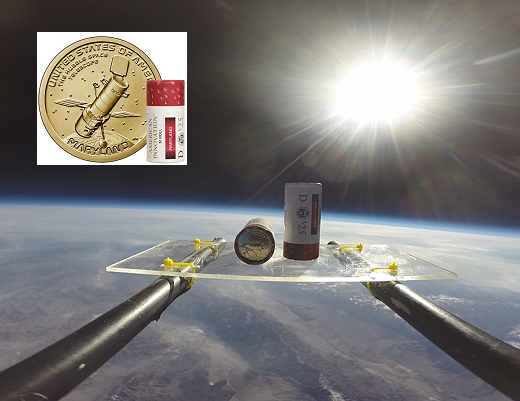
You can have one for $39.95. The students are selling Hubble coins to support their cosmic ray ballooning program. Each coin comes with a greeting card showing the money in flight and telling the story of its trip to the stratosphere. Best of all, this is real money! You can actually spend it. All sales support hands-on STEM research.
Far Out Gifts: Earth to Sky Store
All sales support hands-on STEM education
Realtime Aurora Photo Gallery
Free: Spaceweather.com Newsletter