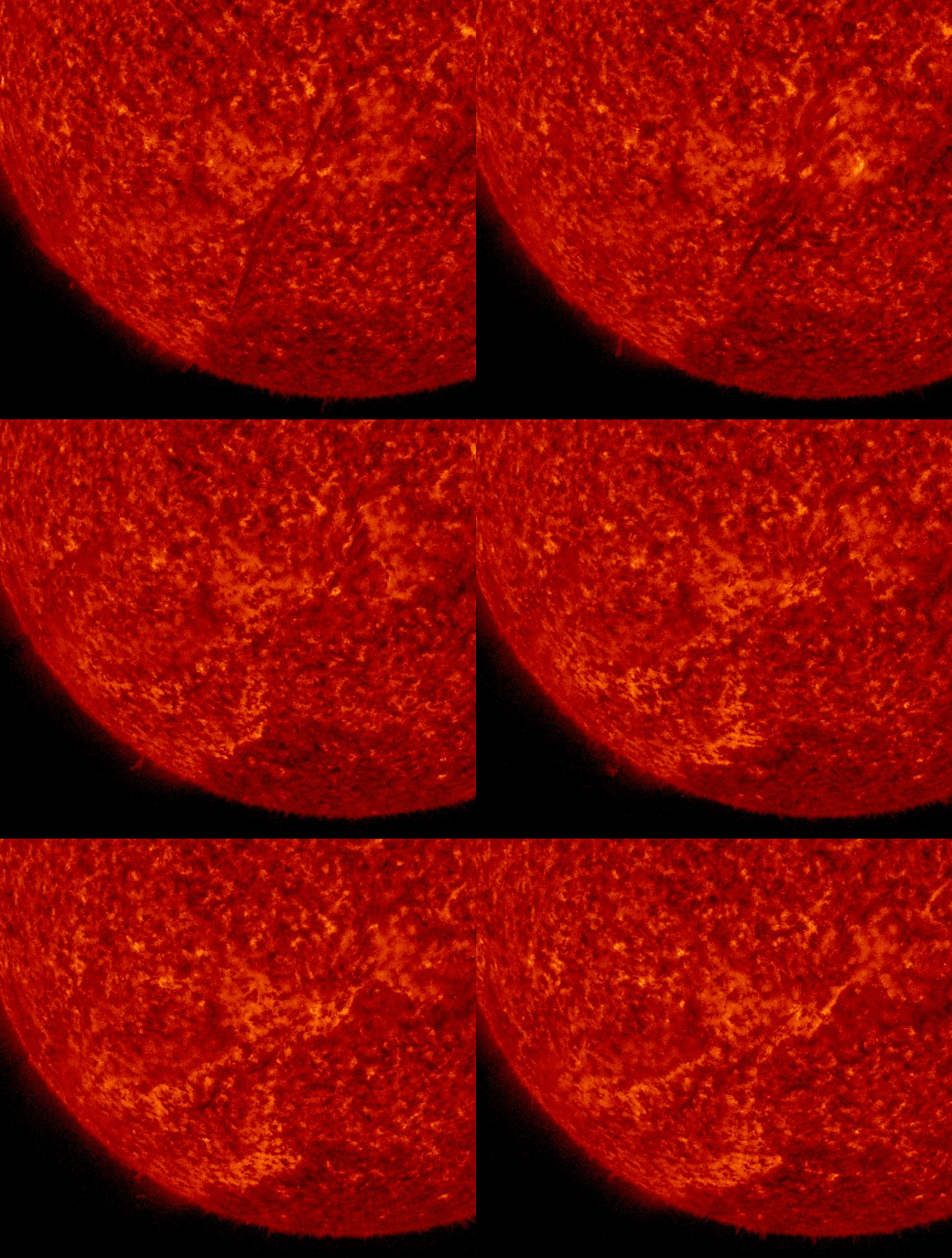
CHANCE OF STORMS TODAY: A coronal mass ejection (CME) might hit Earth's magnetic field today or tomorrow, Feb. 23-24. The storm cloud was hurled in our direction by a magnetic filament, which erupted three days ago in the sun's southern hemisphere. NOAA forecasters say the CME might cause a minor G1-class geomagnetic storm when it arrives. Aurora alerts: SMS Text.


AURORAS FROM THE WINDOW SEAT: Travel advisory: If you're flying at high-latitudes tonight, grab a window seat. You might see something like this:

Todd Salat took the picture last night during a red-eye flight from Seattle to Anchorage. "The auroras were tens of miles above the cruising altitude of our airplane, and hundreds of miles in the distance, but the elevated perspective coupled with the curve of the Earth made it feel like we could reach out and touch them straight out the window," says Salat.
"I snapped this picture with an iPhone 11 Pro," he adds. "Thank you night mode!"
Scenes like these could recur on the night of Feb. 23-24 if, as expected, a CME sideswipes Earth's magnetic field. Aurora alerts: SMS Text.
Realtime Aurora Photo Gallery
Free: Spaceweather.com Newsletter
ANVIL CRAWLERS OVER ZIMBABWE: Most lightning happens so fast, it's gone almost before you can see it. Anvil crawlers are different. The spider-like forms crawl across cloudtops slowly enough to be tracked by the human eye. Peter Lowenstein photographed this example last night in Mutare, Zimbabwe:

"This spectacular anvil crawler extended for several kilometers," says Lowenstein. "It bifurcated and appeared to head directly towards my camera! Fortunately it remained high and far away."
In an anvil crawler, electrical charges scramble through the uppermost layers (the anvil) of a thunderstorm. Moving jerkily and never touching the ground, this type of lightning can cover a very large distance with spectacular sky-filling discharges. Because anvil crawlers occur at very high altitudes, the thunder they produce is muted by distance; it sounds soft and rolling.
Realtime Spaceweather Photo Gallery
Free: Spaceweather.com Newsletter
THIS IS *REAL* MONEY FROM SPACE: The US Mint has just released a reverse-proof dollar coin honoring the Hubble Space Telescope. The students of Earth to Sky Calculus took it one step further, flying a whole roll of Hubble coins to the edge of space. Here they are floating 35.3 km (115,814 ft) above the Sierra Nevada mountains of central California:
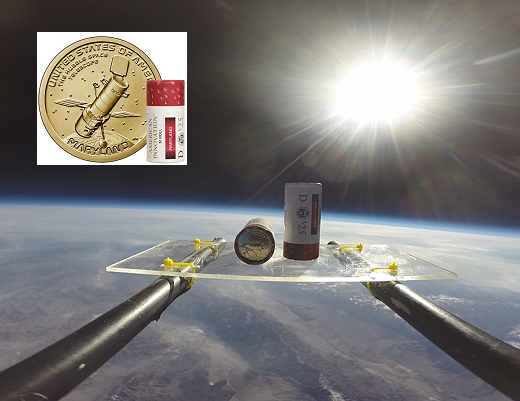
You can have one for $39.95. The students are selling Hubble coins to support their cosmic ray ballooning program. Each coin comes with a greeting card showing the money in flight and telling the story of its trip to the stratosphere. Best of all, this is real money! You can actually spend it. All sales support hands-on STEM research.
Far Out Gifts: Earth to Sky Store
All sales support hands-on STEM education
Realtime Spaceweather Photo Gallery
Free: Spaceweather.com Newsletter