WEAK IMPACT: As expected, a coronal mass ejection (CME) hit Earth's magnetic field during the early hours of Feb. 24th (~0430 UT). It was a weak impact. The CME was not heading directly for Earth, and it delivered only a glancing blow. Neither geomagnetic storms nor strong auroras were observed after the CME's arrival. Aurora alerts: SMS Text.

DYNAMIC SUNSPOT: Sunspot group AR2804 is putting on a show. This morning, the group developed a Moon-sized spot, which raced across almost 50,000 km of solar "terrain" in a matter of hours. NASA's Solar Dynamics Observatory recorded the action:
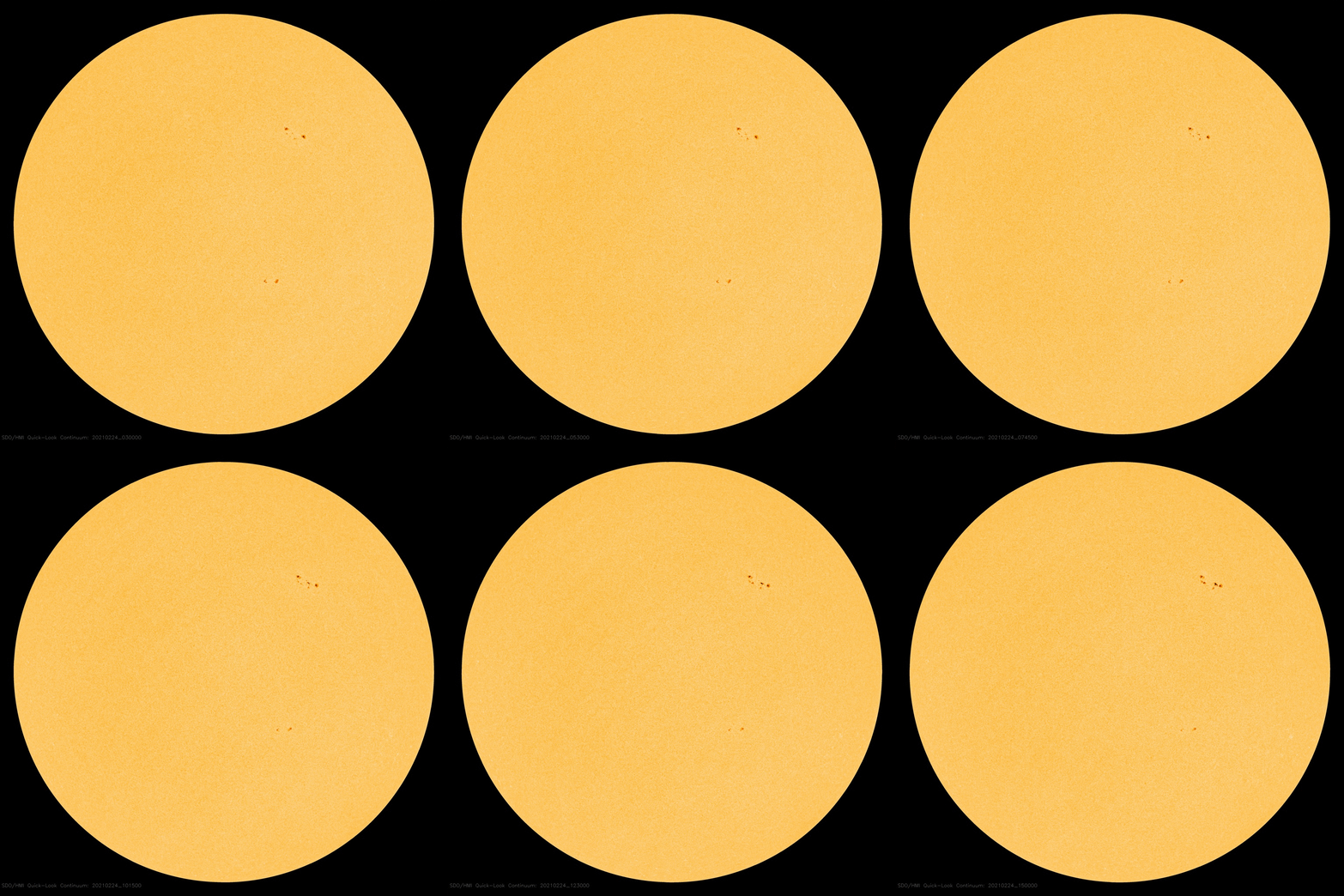
Sunspot dynamics like this are a sign of instability. The magnetic field of AR2804 is quickly rearranging itself, a tumult that could lead to criss-crosses and explosive reconnection. The sunspot is crackling with minor B-class solar flares; stronger eruptions might be in the offing. Instant solar flare alerts: SMS Text.
Realtime Spaceweather Photo Gallery
Free: Spaceweather.com Newsletter
DUSTY WITH A CHANCE OF 'MUD RAIN': Mud rain. Brown sunsets. No stars. This is what happens when Sahara dust fills the air. This week, a dense plume of dust from Africa is swirling through parts of Europe. "Greetings from the Sahara desert over Germany," says Heiko Ulbricht, who sends this picture of the dust-streaked sun from Lerchenberg hill, Saxony:
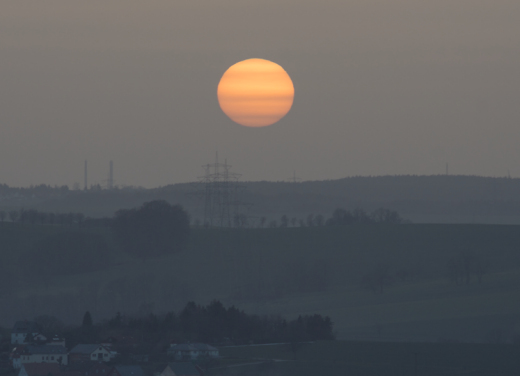
"At one point today the sun actually turned dull blue," says Ulbricht. Dust grains about 1 micron wide formed a giant airborne color-filter, altering the hue of the solar disk. After sunset, the Moon might have turned blue, too.
NASA's EPIC camera on the DSCOVR satellite photographed the plume approaching Europe on Feb. 18th. There was a chance of 'mud rain' in Spain as dust combined with a wet storm in the Iberian peninsula. Almost a week later the dust storm is in full force with more pictures arriving every day.
Realtime Spaceweather Photo Gallery
Free: Spaceweather.com Newsletter
THIS IS *REAL* MONEY FROM SPACE: The US Mint has just released a reverse-proof dollar coin honoring the Hubble Space Telescope. The students of Earth to Sky Calculus took it one step further, flying a whole roll of Hubble coins to the edge of space. Here they are floating 35.3 km (115,814 ft) above the Sierra Nevada mountains of central California:
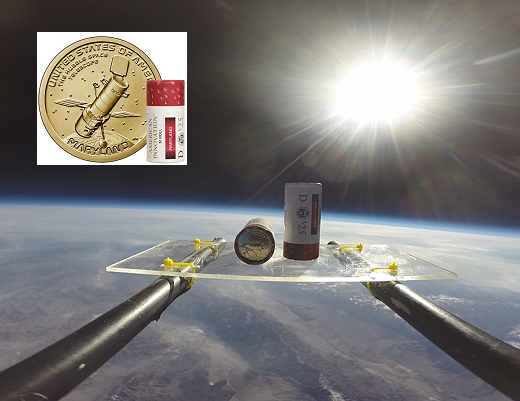
You can have one for $39.95. The students are selling Hubble coins to support their cosmic ray ballooning program. Each coin comes with a greeting card showing the money in flight and telling the story of its trip to the stratosphere. Best of all, this is real money! You can actually spend it. All sales support hands-on STEM research.
Far Out Gifts: Earth to Sky Store
All sales support hands-on STEM education
Realtime Aurora Photo Gallery
Free: Spaceweather.com Newsletter