GOOD NEWS FOR AURORA FANS: March is the most geomagnetically active month of the year, according to NASA. Why? It's the Russell-McPherron Effect. During weeks around equinoxes, the sun's magnetic field can link up with Earth's, creating a portal for energetic particles. Good news for aurora fans: March is less than 2 days away. Solar flare alerts: SMS Text.

PROMINENCE ALERT: If you have a solar telescope, point it at the edge of the sun. An enormous prominence is poised to erupt. Eduardo Schaberger Poupeau sends this picture from Rafaela, Santa Fe, Argentina:
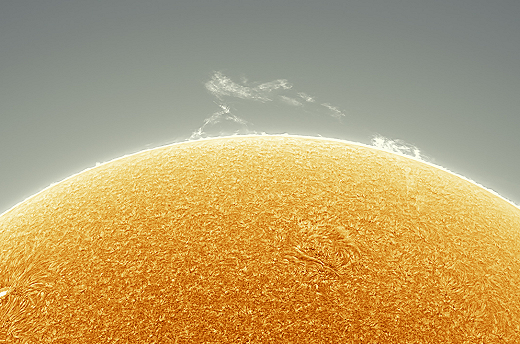
"This morning from my backyard, I photographed this huge but faint structure floating above the sun," says Poupeau. "This prominence is about 200,000 km long and rises about 80,000 km above the surface of the sun."
Prominences are filamentary clouds of hydrogen held aloft by solar magnetic fields. They are inherently unstable; indeed, this one has been shifting perilously for days. A photogenic eruption may be in the offing.
Realtime Spaceweather Photo Gallery
Free: Spaceweather.com Newsletter
MAGNETIC FROTH: Some sunspots are flare-y. Sunspot AR2804 is simply frothy. Apollo Lasky of Naperville, Illinois, photographed the growing active region on Feb 25th and this is what he saw:
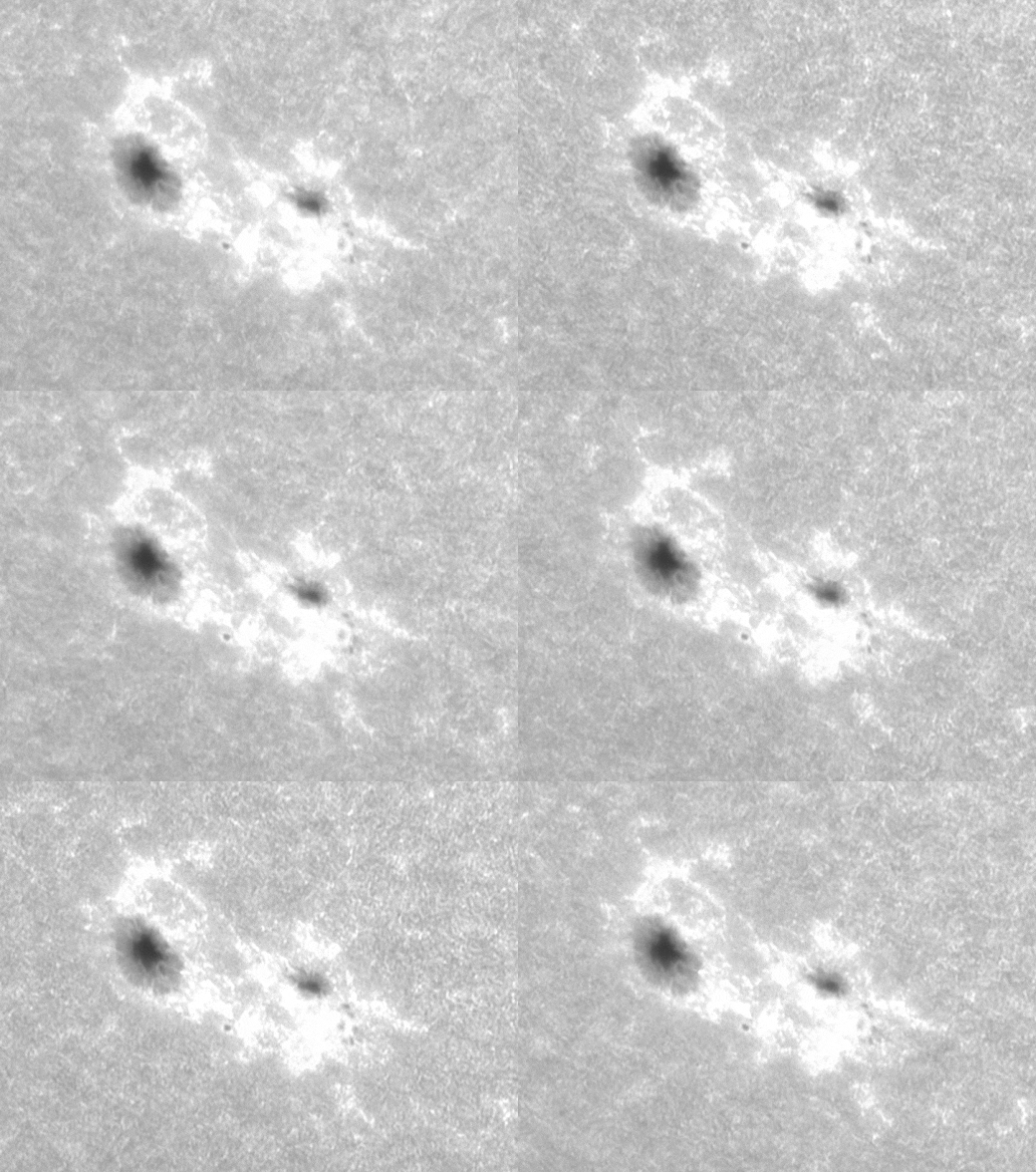
AR2804 is surrounded by a seething, white-hot foam of magnetized plasma. "Visually, it reminds me a little of an iceberg--really hot ice!" says Lasky.
To photograph the sunspot group, Lasky used a "Calcium K" (CaK) filter that passes light from singly-ionized calcium atoms in the sun's atmosphere. CaK filters are excellent detectors of froth--the bubbly, turbulent sea of magnetism that surrounds many large sunspot groups. AR2804 has not yet produced any strong flares, but it is very frothy indeed.
Realtime Spaceweather Photo Gallery
Free: Spaceweather.com Newsletter
THIS IS *REAL* MONEY FROM SPACE: The US Mint has just released a reverse-proof dollar coin honoring the Hubble Space Telescope. The students of Earth to Sky Calculus took it one step further, flying a whole roll of Hubble coins to the edge of space. Here they are floating 35.3 km (115,814 ft) above the Sierra Nevada mountains of central California:
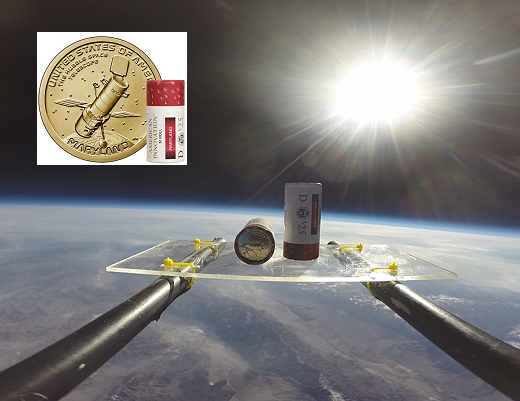
You can have one for $39.95. The students are selling Hubble coins to support their cosmic ray ballooning program. Each coin comes with a greeting card showing the money in flight and telling the story of its trip to the stratosphere. Best of all, this is real money! You can actually spend it. All sales support hands-on STEM research.
Far Out Gifts: Earth to Sky Store
All sales support hands-on STEM education
Realtime Aurora Photo Gallery
Free: Spaceweather.com Newsletter