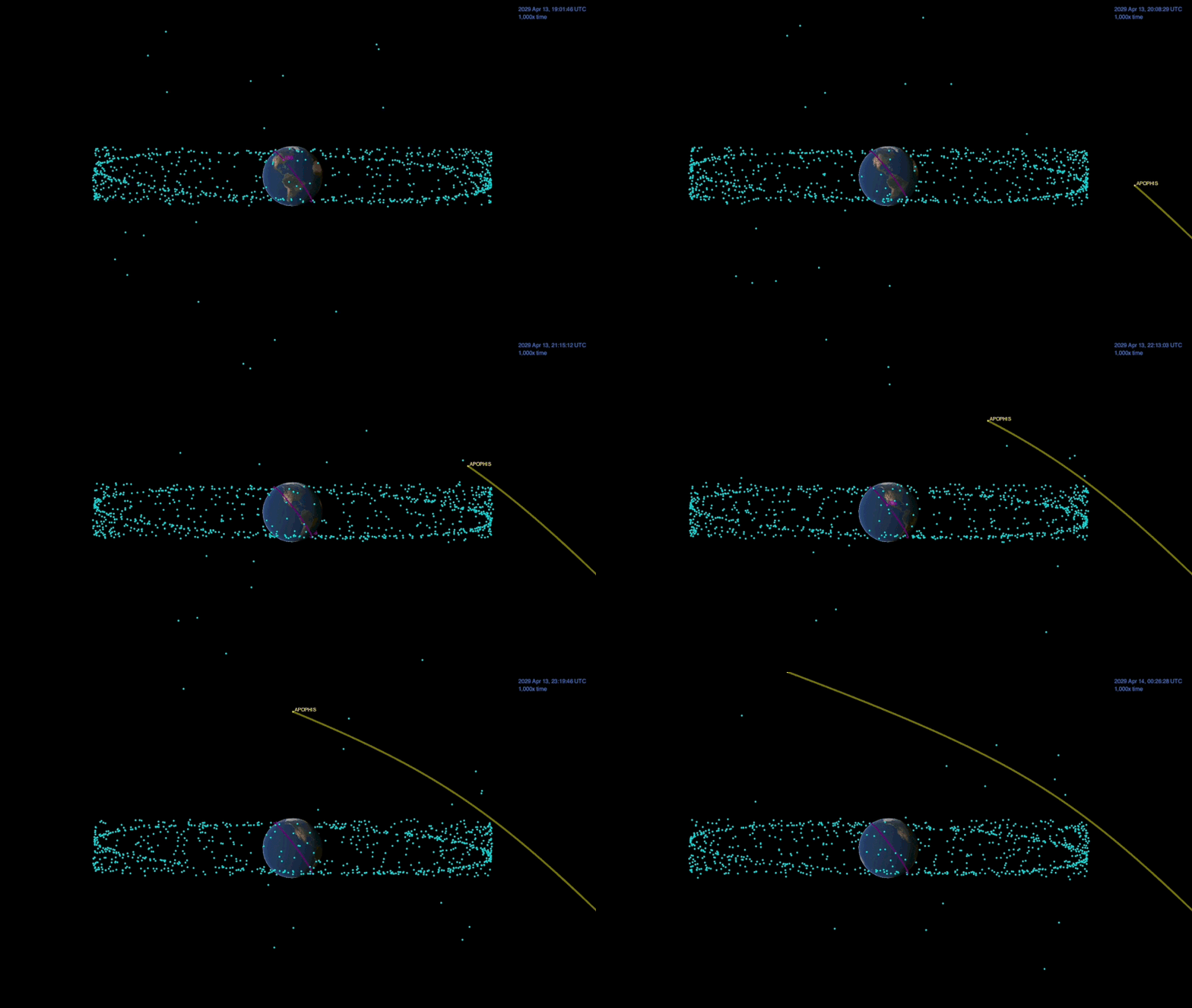
WANTED! IMAGES OF ASTEROID APOPHIS: Asteroid Apophis is flying past Earth this week at a safe distance of 0.11 AU (about 40 times farther than the Moon). This is our last chance to study the space rock before it returns for a sensational naked-eye plunge through the geosynchronous satellite belt in April 2029. Do you have recent images of Apophis? Please submit them here.
A SHADOWY WAVE IN THE SUN'S ATMOSPHERE (UPDATED): During the late hours of Feb. 27th, departing sunspot AR2804 produced a C2-class solar flare. NASA's Solar Dynamics Observatory (SDO) detected a shadowy wave rippling away from the blast site:

This kind of wave is usually a sure-fire sign of a coronal mass ejection (CME). Indeed, just after the flare, the Solar and Heliospheric Observatory (SOHO) detected a CME emerging from the sun's northwestern limb. Because the sunspot was not facing Earth, the CME will miss our planet.
Update: A few hours later, it happened again. Another C-flare, another shadowy wave, another miss.
Realtime Spaceweather Photo Gallery
Free: Spaceweather.com Newsletter
OMEGA SUNRISE: Last Sunday morning, the sun rose over Delaware Bay as usual. Except for one thing. Some of the sun dripped back into the water. Gary Brown photographed the phenomenon from Woodland Beach, Delaware:

"It was about 25 degrees out--really cold," says Brown.
And that explains what happened to the sun. The water in Delaware Bay was warmer than the air above it, creating a strong temperature gradient in the low atmosphere. This, in turn, dragged some of the solar disk back into the Bay--a mirage called "the omega sun."
Realtime Spaceweather Photo Gallery
Free: Spaceweather.com Newsletter
THIS IS *REAL* MONEY FROM SPACE: The US Mint has just released a reverse-proof dollar coin honoring the Hubble Space Telescope. The students of Earth to Sky Calculus took it one step further, flying a whole roll of Hubble coins to the edge of space. Here they are floating 35.3 km (115,814 ft) above the Sierra Nevada mountains of central California:
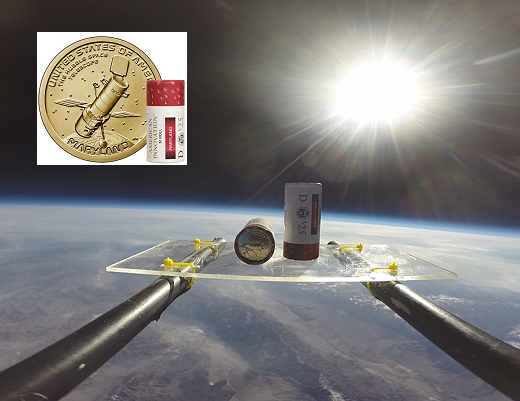
You can have one for $39.95. The students are selling Hubble coins to support their cosmic ray ballooning program. Each coin comes with a greeting card showing the money in flight and telling the story of its trip to the stratosphere. Best of all, this is real money! You can actually spend it. All sales support hands-on STEM research.
Far Out Gifts: Earth to Sky Store
All sales support hands-on STEM education
Realtime Aurora Photo Gallery
Free: Spaceweather.com Newsletter