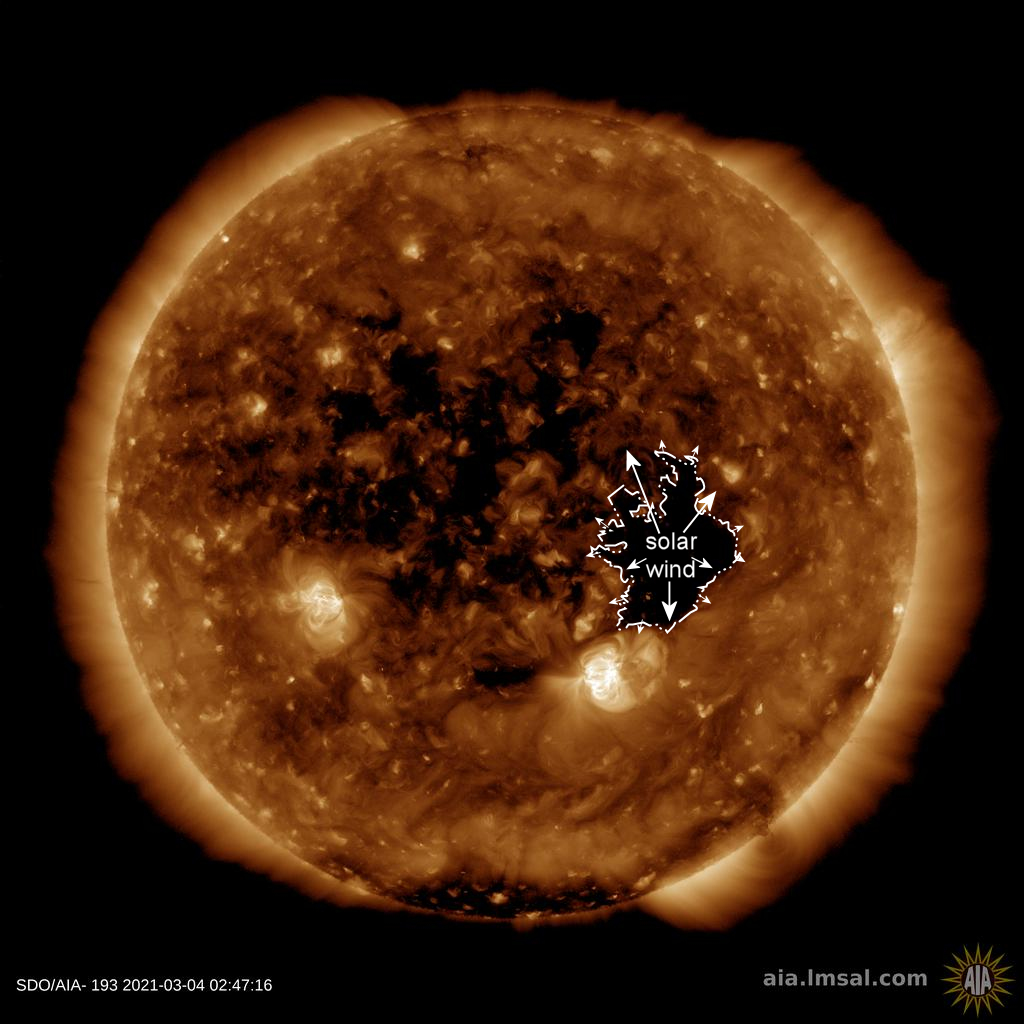
GEOMAGNETIC STORM WATCH: NOAA forecasters say that a minor G1-class geomagnetic storm is possible on March 6th when a high-speed stream of solar wind reaches Earth. The gaseous material is flowing from an equatorial hole in the sun's atmosphere. Aurora alerts: SMS Text.

SUNRISE PLANETS AND NOCTILUCENT CLOUDS: This morning in Huntsville, Alabama, Roy Spencer pointed his camera at the brightening pre-dawn sky. Watch Jupiter and Mercury leap up together into the twilight:
The two planets are in conjunction, less than a Moon-width apart. But that's not what really amazed the photographer. "I also caught some bright noctilucent clouds (NLCs)," says Spencer.
Natural NLCs, which form when wisps of water vapor crystalize around specks of meteor dust near the top of Earth's atmosphere, are almost never seen in Alabama. But these NLCs were not natural. "They came from Elon Musk's latest launch of 60 Starlink satellites on a Falcon-9 rocket," explains Spencer. The rocket's exhaust provided the water vapor necessary for NLCs.
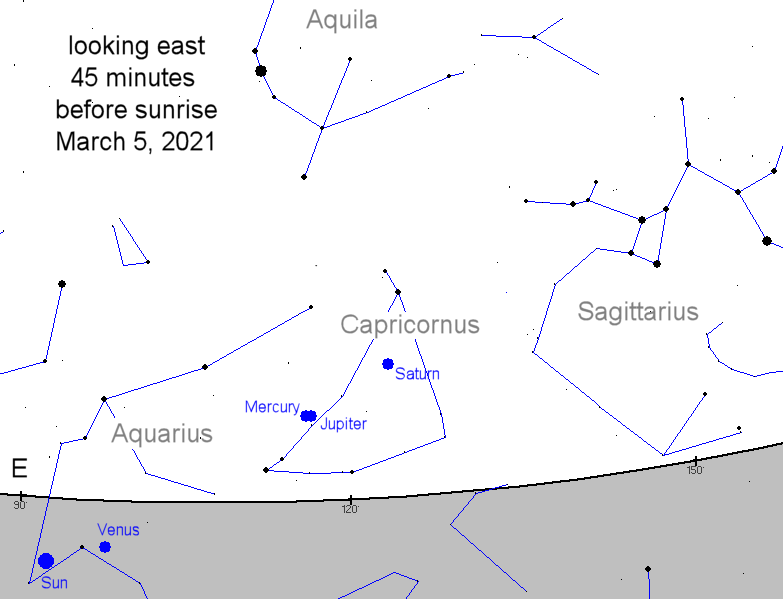
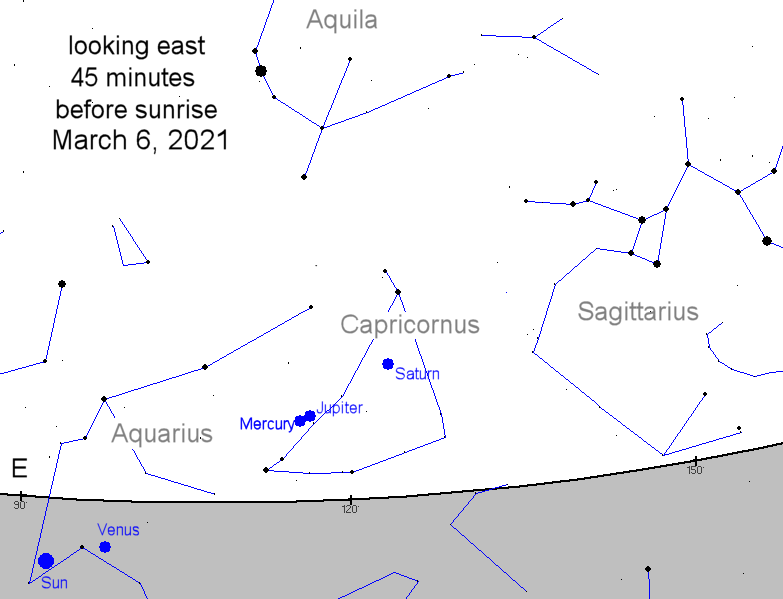
The clouds will be gone tomorrow, but the planets won't. Jupiter and Mercury are at their best on March 5th, so close together than you can see them both at once in binoculars. Set your alarm for 1 hour before sunrise. Sky maps: March 5, 6.
Realtime Space Weather Photo Gallery
Free: Spaceweather.com Newsletter
A CONJUNCTION AMONG THE STAR CLOUDS OF TAURUS: Is there any advantage to a lockdown? Maybe just one: Time to make really long exposures of the sky. Confined to his cabin in Ústupky, Czech Republic, Petr Horálek photographed the star clouds of Taurus during last night's conjunction of Mars and the Pleiades star cluster:

"For this image, I combined 63 one minute exposures--all taken from the balcony of my cabin during a very hard lockdown here," says Horálek. "Deep imaging revealed not only the conjunction (lower right), but also a complex network of surrounding molecular clouds."
Containing compounds such as carbon monoxide, water, methane and alcohol, the clouds are so dense, they appear inky black. Deep inside these dark structures, newborn stars are coalescing, and one day they will burst forth in clusters resembling the Pleiades.
This scene will repeat itself in about 17 years when Mars approaches the Pleiades for an even closer conjunction. Mark your calendar for Feb. 2038, and meanwhile enjoy this tableau.

Realtime Space Weather Photo Gallery
Free: Spaceweather.com Newsletter
THE STRATOSPHERE SUNFLOWER: This sunflower has touched space. The crystal blossom flew to the stratosphere on Feb. 22nd onboard an Earth to Sky Calculus cosmic ray balloon, floating 112,451 feet above the Sierra Nevada mountains of central California:
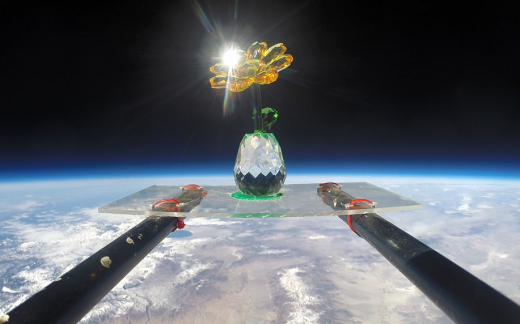
You can have it for $139.95. The students are selling Stratosphere Sunflowers to support their cosmic ray ballooning program. They make great Mother's Day, anniversary, and birthday gifts. Each one comes with a greeting card showing the flower in flight and telling the story of its journey to the edge of space.
Far Out Gifts: Earth to Sky Store
All sales support hands-on STEM education
Realtime Aurora Photo Gallery
Free: Spaceweather.com Newsletter