CO-ROTATING INTERACTION REGION: A co-rotating interaction region (CIR) could hit Earth's magnetic field on March 18th. CIRs are transition zones between slow- and fast-moving streams of solar wind. They contain density gradients and enhanced magnetic fields that often do a good job sparking high-latitude auroras. Aurora alerts: SMS Text
BE ALERT FOR STEVE: Northern spring is less than a week away. That means hot ribbons of plasma are starting to flow in Earth's magnetosphere. Mark Duffy just saw one of them over Moose Jaw, Saskatchewan:
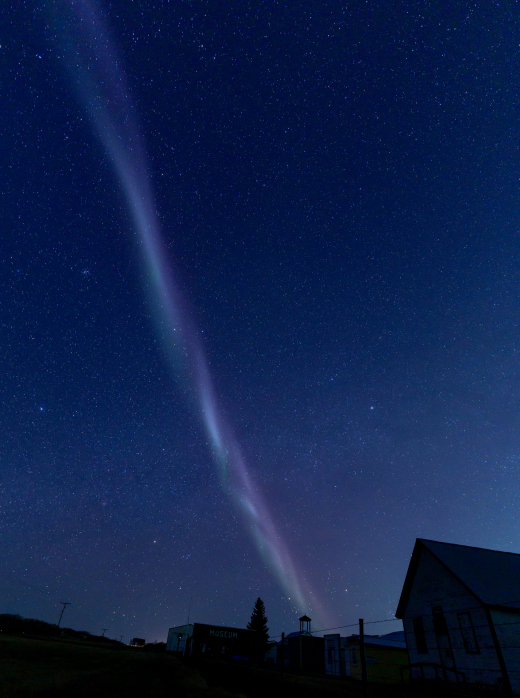
"This was the most dynamic apparition of STEVE I've ever seen," says Duffy, who took the picture on March 13th.
STEVE--short for "Strong Thermal Emission Velocity Enhancement"--was long thought to be a type of aurora borealis. But it's not. Auroras appear when particles rain down from space. STEVE, on the other hand, does not require "rain." Instead, satellite measurements show that it is a ribbon of hot (3000°C) gas speeding through the upper reaches of Earth's magnetic field faster than 10,000 mph. The ribbon's purple hue is still a mystery; some research suggests the color comes from heated nitrogen, but the jury's still out.
Studies show that, while STEVE may be seen at any time of year, he appears most often in weeks around equinoxes--that is, now. If you live at high latitudes, be alert for purple ribbons in the sky.
Realtime STEVE Photo Gallery
Free: Spaceweather.com Newsletter
ALSO... STEVE'S SIDEKICK: Although STEVE is not an aurora, he has an aurora side-kick: the "picket fence." Evenly-spaced blobs of green light often appear alongside or underneath STEVE during geomagnetic storms. Alan Dyer photographed these specimens on March 13th:

"STEVE put on a great show, appearing first as the characteristic purple arc then developing green picket fence fingers rippling from east to west," says Dyer.
What are these green pickets? A team of researchers led by Toshi Nishimura of Boston University may have found the answer. Using data from NASA's THEMIS spacecraft, they pinpointed STEVE's power source. More than 22,000 km above Earth's surface, magnetic explosions called "substorms" hurl streams of hot plasma toward Earth. When the streams reach an altitude ~250 km above Earth's surface, they begin to emit a soft-purple light. This is STEVE.
The same explosions spray energetic electrons toward Earth. The electrons move even deeper into the atmosphere, all the way down to 100 km, where they ignite fingers of green auroras. This is the picket fence.
So when you see STEVE, look for his sidekick as well. Sometimes the picket fence appears first, so one can herald the other. Either way, it's a beautiful show.
Realtime Space Weather Photo Gallery
Free: Spaceweather.com Newsletter
STERLING SILVER HUMMINGBIRD PENDANT: This hummingbird has touched space. The sterling silver pendant hitched a ride to the stratosphere on Jan. 15, 2021, when the students of Earth to Sky Calculus launched a cosmic ray balloon. Here it is, floating 111,202 feet above the snow-capped Sierra Nevada of central California:
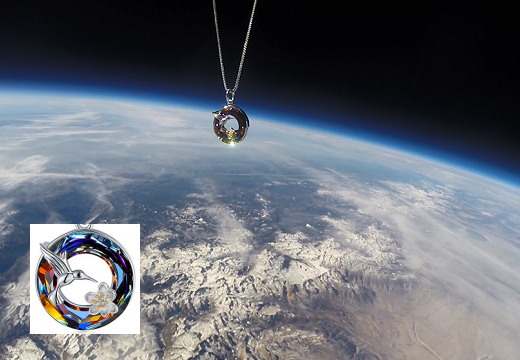
You can have it for $133.95. The students are selling hummingbird pendants to support their cosmic ray ballooning program. Each one comes with a greeting card showing the hummingbird in flight and telling the story of its journey to the edge of space. It makes an out-of-this-world birthday, anniversary, or Mother's Day gift!
Far Out Gifts: Earth to Sky Store
All sales support hands-on STEM education
Realtime Aurora Photo Gallery
Free: Spaceweather.com Newsletter