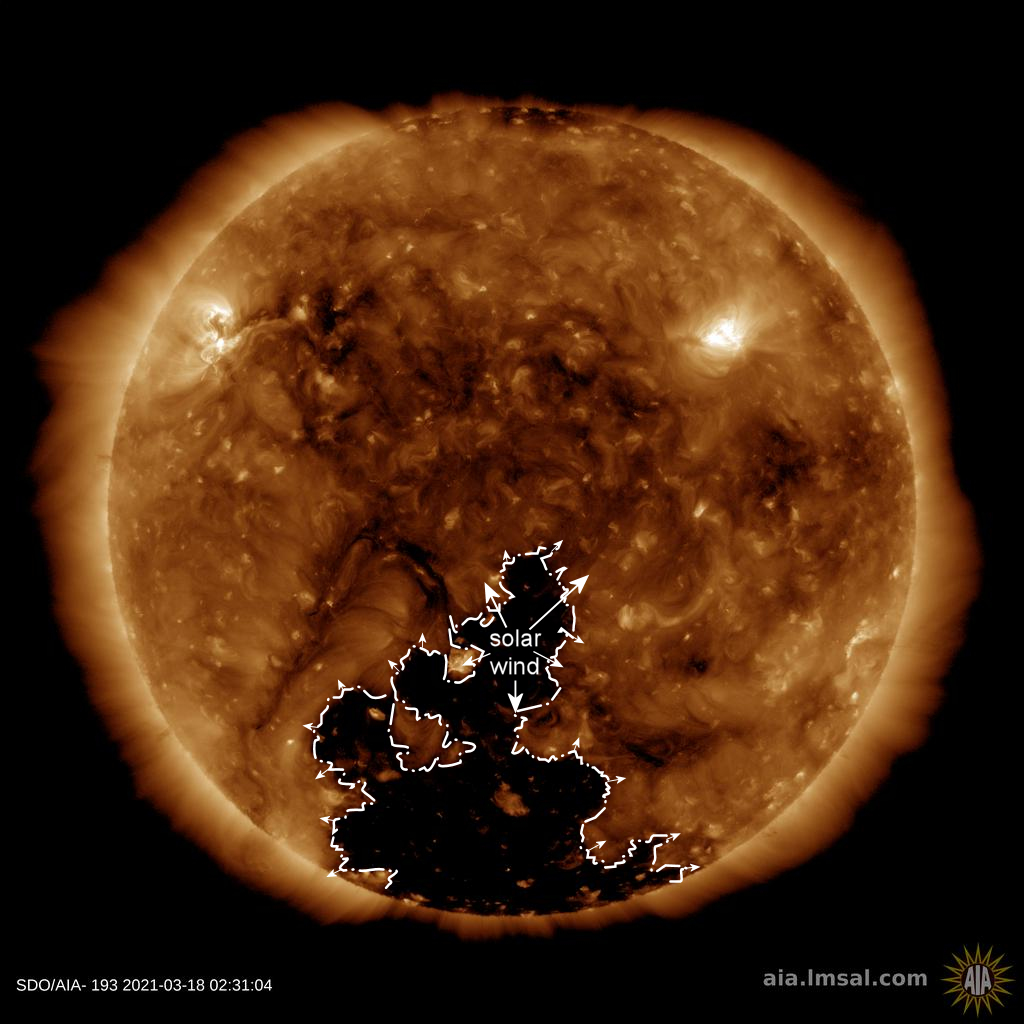
GEOMAGNETIC STORM WATCH: NOAA forecasters say that a minor G1-class geeomagnetic storm is likely on March 21st when a stream of high-speed solar wind hits Earth's magnetic field. The gaseous material is flowing faster than 600 km/s from a southern hole in the sun's atmosphere. Aurora alerts: SMS Text

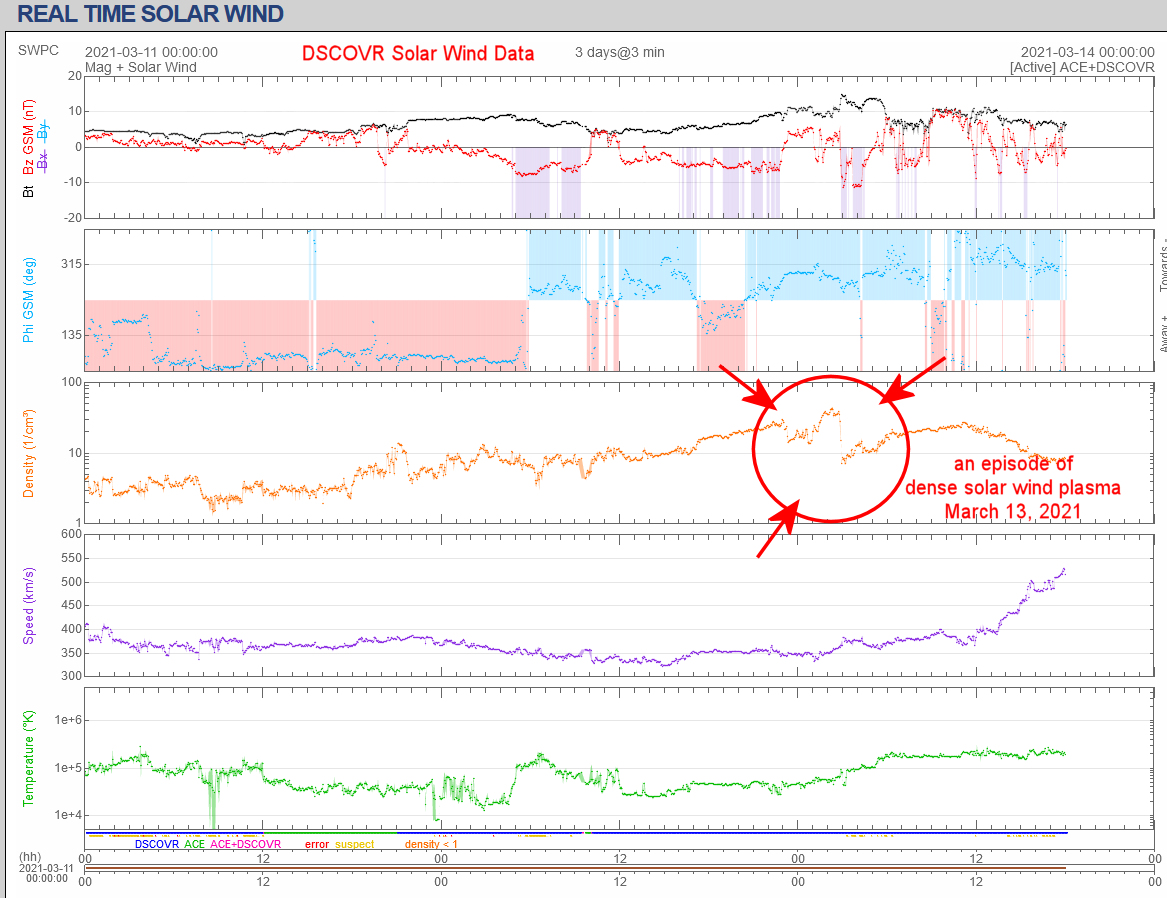
THE COLORS OF ARCTIC OXYGEN: A slow-moving but dense cloud of solar wind plasma hit Earth's magnetic field on March 13th, sparking auroras around both poles. "During the most intense activity, I noticed a bright pillar behind a cloud, and zoomed in on the structure," says Geir T. Birkeland Øye of Ørsta, Norway. "It is an example of the beautiful palette that Northern Lights can present."
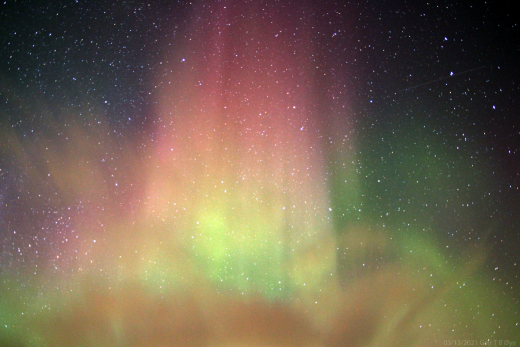
Almost every color in this palette is linked to some form of oxygen. The green band in the middle comes from oxygen atoms floating 100 to 150 km above Earth's surface. At that altitude, the temperature and density of air is just right for the production of green photons by oxygen when it is peppered by energetic particles from space. The red band on top also comes from oxygen atoms, but higher, between 150 km and 250 km. The lower density of air up there favors red photons.
The range mass at the bottom? Those are clouds reflecting the lights of Ørsta. Composition: H2O.
Realtime Aurora Photo Gallery
Free: Spaceweather.com Newsletter
UNTIL WE MEET AGAIN, APOPHIS: If the words "Asteroid Apophis" give you a frisson of dread, good news: The dangerous space rock is receding from Earth. Austrian astronomer Michael Jaeger photographed it leaving the area on March 12th:
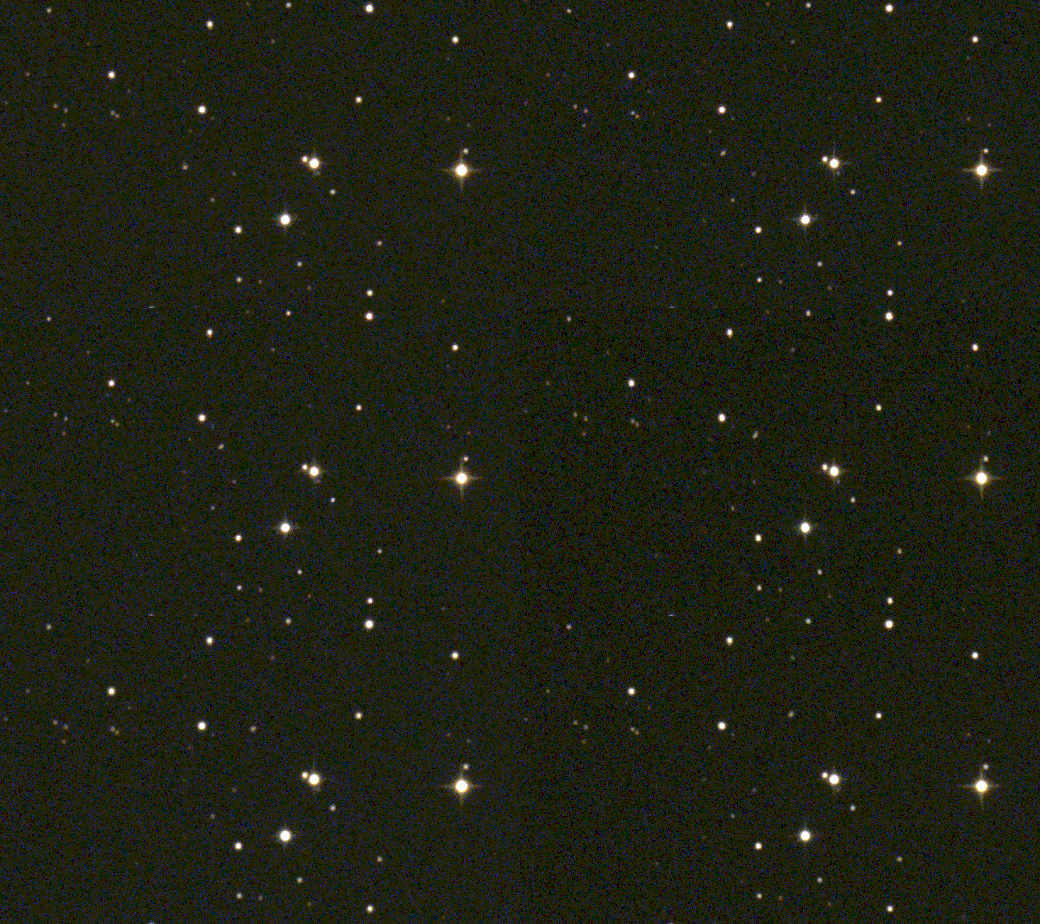
The 370-meter wide asteroid completed a distant flyby of Earth in early March, about 0.11 AU (16 million km) away. At closest approach it shone like a 16th magnitude star--that is, extremely faint. Only experienced astrophotographers like Jaeger had any hope of seeing it.
Next time will be different. When Apophis returns on April 13, 2029, it will come so close to Earth that you can see it with your naked eye (3rd magnitude). The asteroid will not hit us, but it will come as close as many communications satellites. Apophis might actually be stretched by Earth's gravity, triggering avalanches on its surface. That's close. Until we meet again, Apophis....
Realtime Space Weather Photo Gallery
Free: Spaceweather.com Newsletter
RARE PINK "AURORA PEARL": Inspired by the color of rare pink auroras, Spaceweather.com and the students of Earth to Sky Calculus launched a pink pearl to the stratosphere. It hitched a ride onboard the students' cosmic ray balloon, and reached an altitude 112,205 feet above the Sierra Nevada mountains of central California:
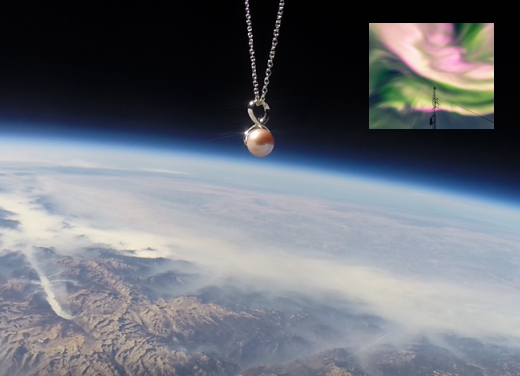
You can have it for $249.95. The students are selling space pearls to support their cosmic ray monitoring program. Measuring 9 mm in diameter, the Aurora Pearl is mounted on a 925 sterling silver infinity twist and suspended on a matching 17-inch long sterling silver chain. Each pearl comes with a greeting card showing the pendant in flight and telling the story of its journey to the edge of space.
Far Out Gifts: Earth to Sky Store
All sales support hands-on STEM education
Realtime Aurora Photo Gallery
Free: Spaceweather.com Newsletter