ALL QUIET ON THE SUN: According to NOAA, Solar Minimum occurred more than a year ago. You wouldn't know it by looking at the sun. The solar disk is completely blank (no sunspots) and solar activity is very low. Solar Minimum conditions are still in effect--right now. This doesn't mean NOAA is wrong. It's just a sign that young Solar Cycle 25 is struggling to lift the sun out of a very deep minimum. If previous cycles are any guide, sustained activity will return before 2021 is finished. Stay tuned! Solar flare alerts: SMS Text.
SAHARA DUST IN EUROPE: A new plume of Sahara dust just swept across Europe. "Bringing to eastern England the warmest March day for half a century (24C), southerly winds carried dust north from Africa, coating our cars with a dusty film and making the sunset remarkably orange," reports Ian Carstairs of Harleston UK. He took this picture at the end of the day on March 31st:
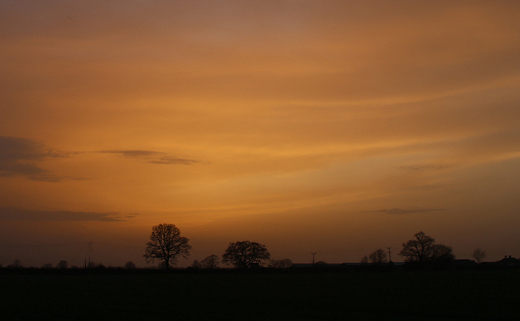
A similar plume of dust made headlines in February. Effects include spectacular sunsets, grit on cars, and a weather phenomenon called "mud rain," which occurs when dust combines with wet storm fronts. A more subtle phenomenon is the Bishop's Ring--a pale brown halo around the sun caused by the scattering action of micron-sized sand. Peter Paul Hattinga Verschure just saw one in The Netherlands.
Each year more than 180 million tons of dust blow out from North Africa--and the Spring season is just getting started. European sky watchers, submit your photos here.
Realtime Space Weather Photo Gallery
Free: Spaceweather.com Newsletter
SPACE STATION TRANSITS A 'MINERAL MOON': On March 26th in the Republic of Moldova (between Romania and Ukraine), astrophotographer Alexandru Barbovschi filmed a split-second transit of the ISS across the Moon. "I didn't expect it to be sooooo awesome," says Barbovschi. But it was:
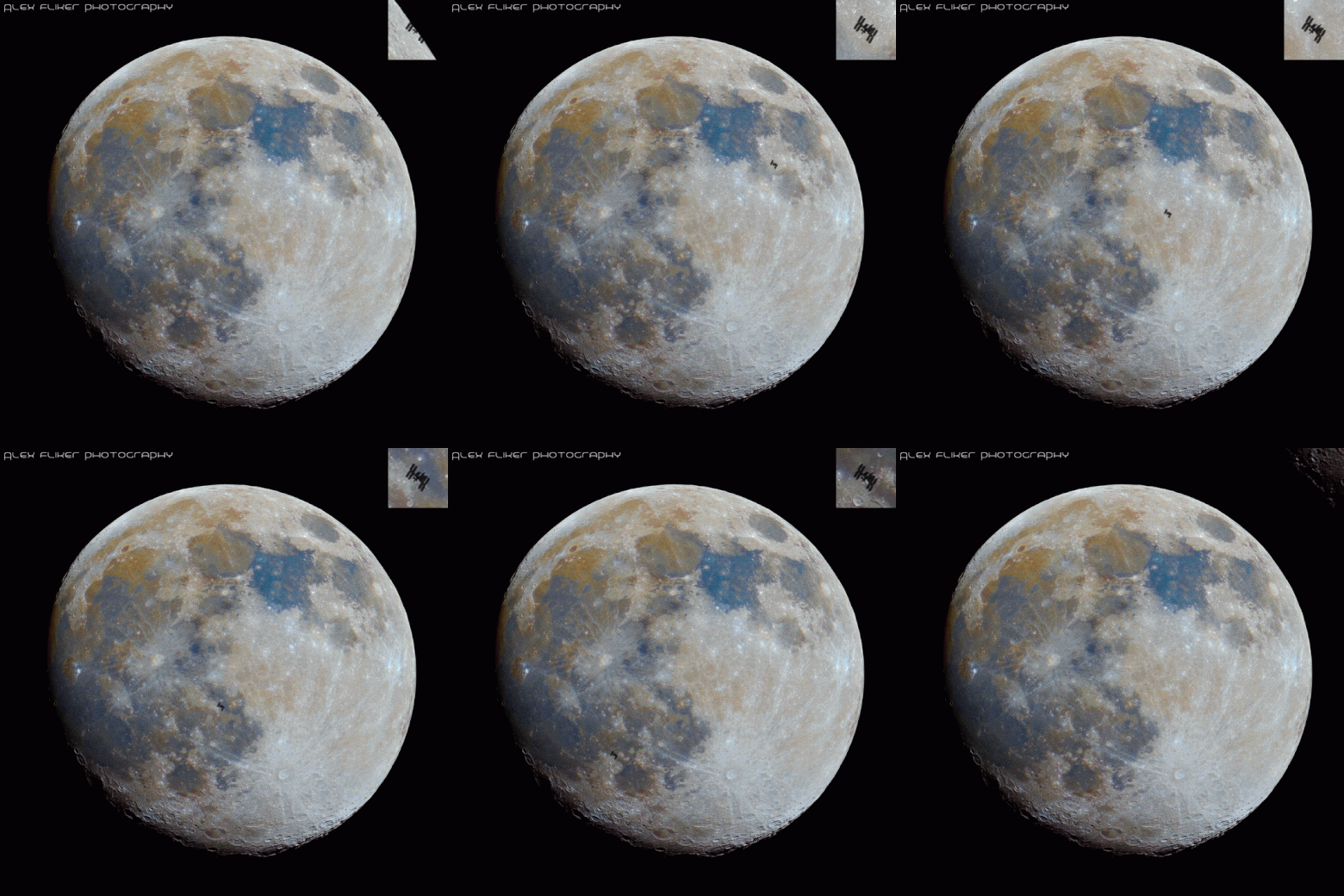
"After the transit we took additional photos of the Moon through Baader LRGB filters," he says. "This allowed us to enhance the natural colors of lunar terrain, creating a 'Mineral Moon' behind the ISS."
Each color on the lunar disk represents a class of minerals. For instance, blue areas are rich in titanium, while orange areas are titanium poor. Titanium-rich zones are interesting because lunar titanium is bound to oxygen. A common lunar mineral, ilmenite, is rich in titanium oxides. This oxygen may be easily extracted, providing future astronauts a source of air to breath and oxidizer for rocket engines.
Barbovschi's beautiful presentation captures the present state of space exploration and the resources for its future. Additional shots may be found here.
Realtime Aurora Photo Gallery
Free: Spaceweather.com Newsletter
STERLING SILVER HUMMINGBIRD PENDANT: This hummingbird has touched space. The sterling silver pendant hitched a ride to the stratosphere on Jan. 15, 2021, when the students of Earth to Sky Calculus launched a cosmic ray balloon. Here it is, floating 111,202 feet above the snow-capped Sierra Nevada of central California:
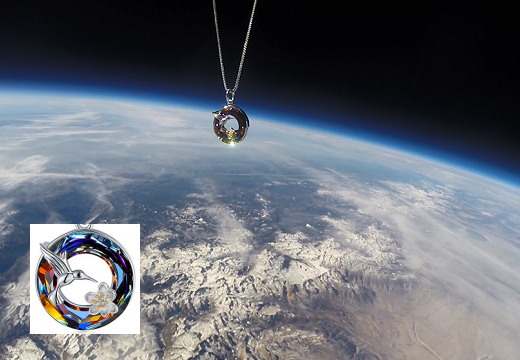
You can have it for $142.95. The students are selling hummingbird pendants to support their cosmic ray ballooning program. Each one comes with a greeting card showing the hummingbird in flight and telling the story of its journey to the edge of space. It makes an out-of-this-world birthday, anniversary, or Mother's Day gift!
Far Out Gifts: Earth to Sky Store
All sales support hands-on STEM education
Realtime Space Weather Photo Gallery
Free: Spaceweather.com Newsletter