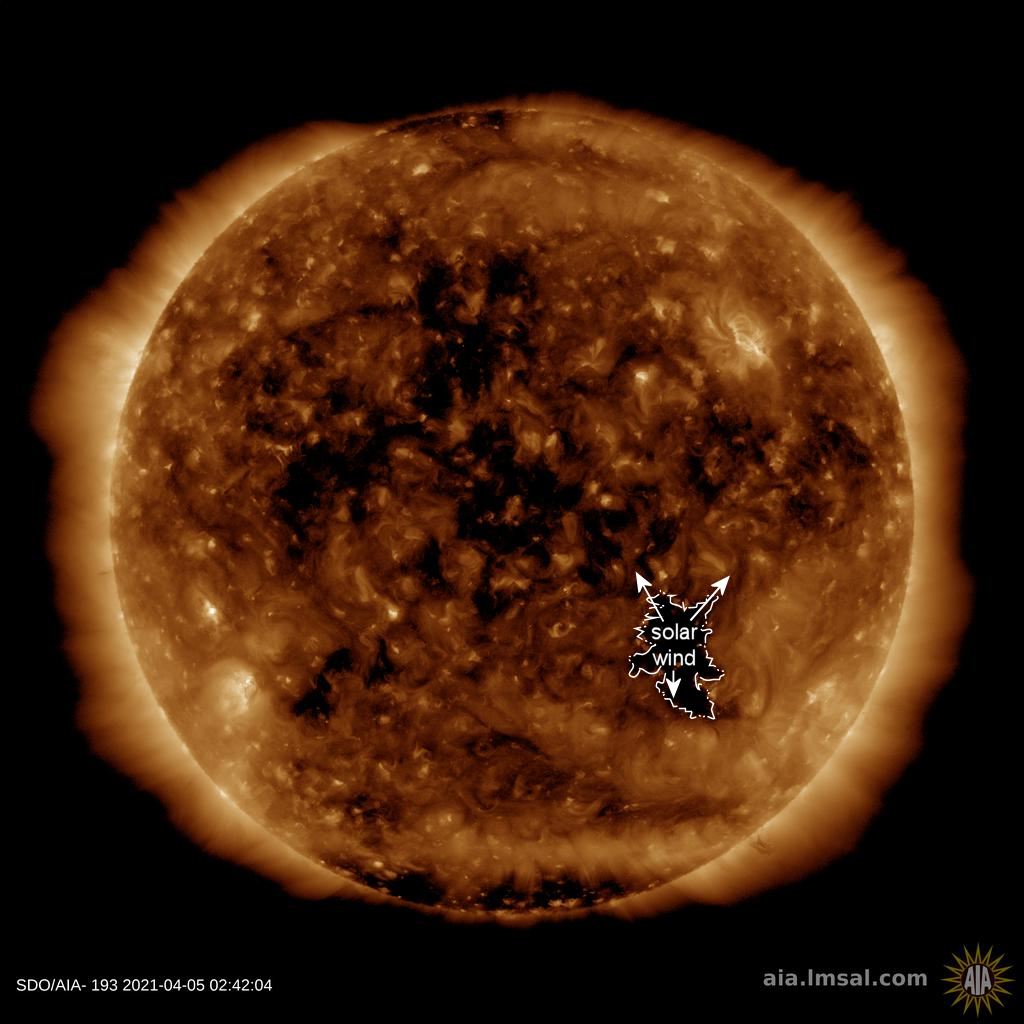
GEOMAGNETIC FORECAST: This week, Earth's polar magnetic field could be disturbed by the arrival of a minor solar wind stream. ETA: April 6th or 7th. The gaseous material is flowing from a southern hole in the sun's atmosphere. Sky watchers around the Arctic Circle should be alert for auroras mixed with waxing Spring twilight. Aurora alerts: SMS Text.
SOLAR PROMINENCE: Today the sun is quiet -- except for one location near the sun's southwestern limb. There, a beautiful prominence is rising into space. Luigi Morrone photographed it this morning from the Amalfitan Coast in Italy:

"This is a very nice solar prominence," says Morrone. "I photographed it using a refracting telescope and a Daystar H-alpha filter."
Prominences are clouds of plasma held up by solar magnetic fields. The magnetic infrastructure of this one is unstable. Other amateur images submitted today show it twisting sharply at the base; it might soon twist off completely. Got a solar telescope? Monitoring is encouraged.
Realtime Space Weather Photo Gallery
Free: Spaceweather.com Newsletter
ZODIACAL LIGHT: Last night, nature photographer James W. Young was photographing the skeleton of Peter Iredale, a famous shipwreck in Oregon, when he also saw the backbone of the Solar System. It's the pale triangle of light cutting diagonally across the sky:
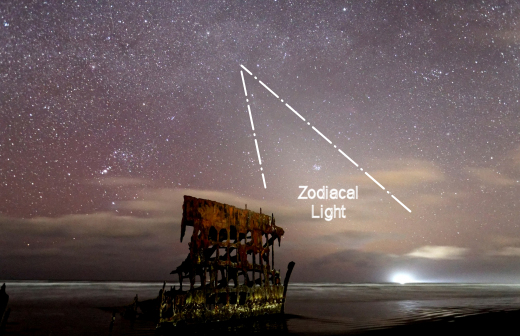
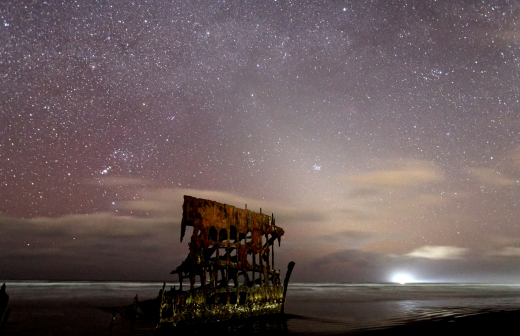
This is the Zodiacal Light. "It was very faint, but showed up nicely in this 30 second exposure," says Young.
When you see Zodiacal Light, you've seen the backbone of our solar system. Zodiacal Light is sunlight reflected from interplanetary dust. The pale glow traces the dusty plane through which all planets orbit, known to astronomers as the ecliptic plane. February, March and April are the best months to see evening Zodiacal Light because the ecliptic plane juts over the horizon almost vertically.
Because Zodiacal Light is faint, moonlight easily overwhelms it. Evenings just before and around the New Moon, therefore, favor visibility. The next new Moon: April 11th. Photographers, you know what to do.
Realtime Zodiacal Light Photo Gallery
Free: Spaceweather.com Newsletter
STERLING SILVER SUNFLOWER PENDANT: Looking for a far out gift? Consider the blue sunflower. On April 1, 2021, the students of Earth to Sky Calculus launched a cosmic ray research balloon to the stratosphere. This unique pendant went along for the ride:
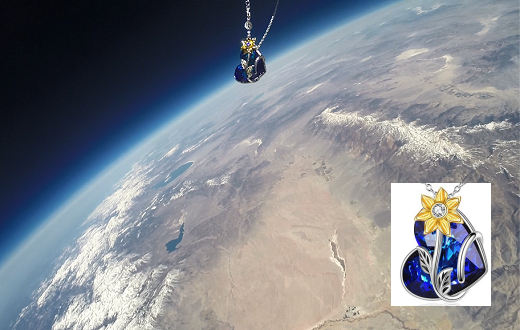
You can have it for $138.95. The students are selling space pendants to fund their cosmic ray ballooning program. The stem of this hypoallergenic sterling silver sunflower wraps around a blue heart-shaped Swarovski crystal--all suspended from a matching 18-inch chain. Each pendant comes with a greeting card showing the item in flight and telling the story of its journey to the edge of space and back again.
Far Out Gifts: Earth to Sky Store
All sales support hands-on STEM education
Realtime Aurora Photo Gallery
Free: Spaceweather.com Newsletter