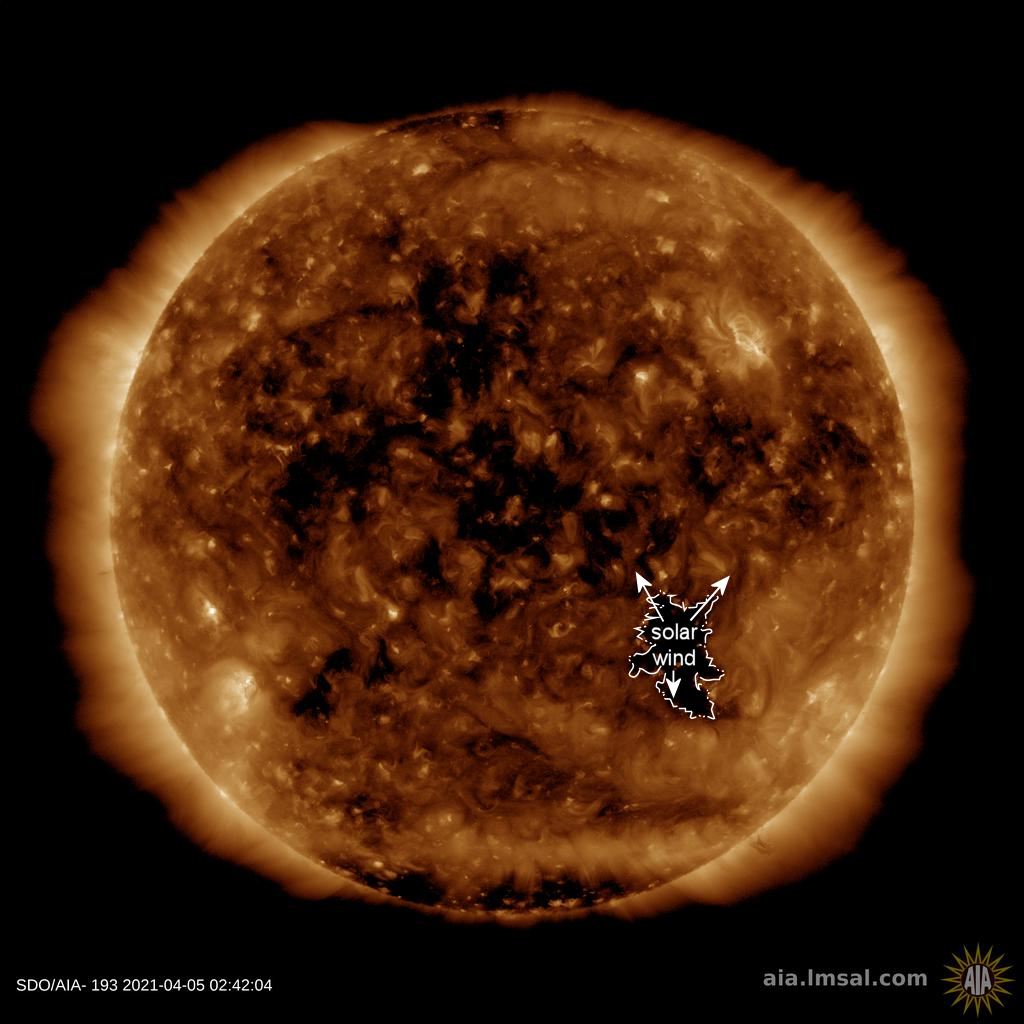
GEOMAGNETIC FORECAST: Today Earth's polar magnetic field could be disturbed by the arrival of a minor solar wind stream. ETA: April 6th or 7th. The gaseous material is flowing from a southern hole in the sun's atmosphere. Sky watchers around the Arctic Circle should be alert for auroras mixed with waxing Spring twilight. Aurora alerts: SMS Text.
100 DAYS OF SUNSPOTS: Are you dissatisfied by the sunspot number? Soumyadeep Mukherjeee of Kolkata, India, has found an optimistic way to look at young Solar Cycle 25. Add together a hundred days of sunspot activity:
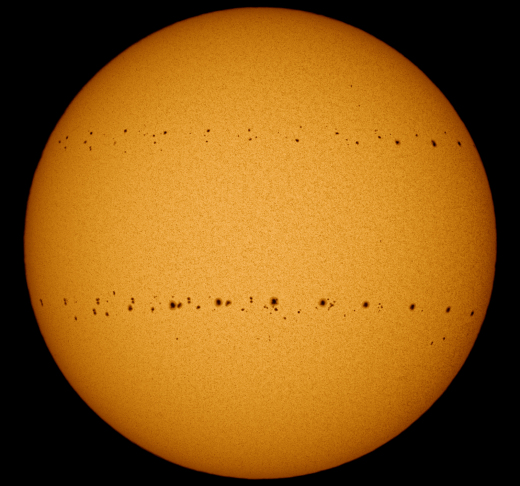
"I imaged the sun for 100 days in a row, from 25th December 2020 to 3rd April 2021," says Mukherjeee. "This image is a blend showing every sunspot that has appeared on the solar disk over these 100 days. There were a total of 19 active regions."
His composite shows that sunspot activity is clustered in two narrow bands approximately 25 degrees north and south of the sun's equator, respectively. This is typical of young solar cycles. As Solar Cycle 25 matures, the bands will converge toward the equator, and become more densely populated. By the time Solar Maximum arrives in 2025 (that's the official NOAA prediction), 100-day composites should be very congested, indeed.
Realtime Space Weather Photo Gallery
Free: Spaceweather.com Newsletter
FLYING TO THE VOLCANO: Iceland's Geldingadalur volcano has turned into an popular tourist attraction---especially since auroras were sighted above the glowing lava. Early this morning, Tuesday, April 6th, Brian Emfinger saw auroras before he even reached the Reykjanes peninsula:
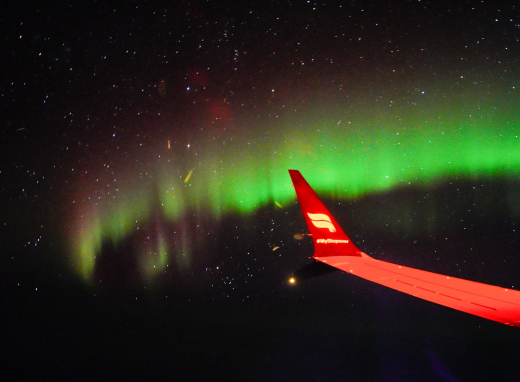
"I was flying high above Greenland en route to the volcano when auroras appeared outside the window," says Emfinger. "I could see them with my unaided eye, and the camera picked them up easily."
There was no special reason for the display. Geomagnetic indices were low and the solar wind was blowing slowly when Emfinger looked out the window. Sometimes auroras just happen around the Arctic Circle. Let's hope they happen again when he reaches Geldingadalur.
Realtime Aurora Photo Gallery
Free: Spaceweather.com Newsletter
STERLING SILVER SUNFLOWER PENDANT: Looking for a far out gift? Consider the blue sunflower. On April 1, 2021, the students of Earth to Sky Calculus launched a cosmic ray research balloon to the stratosphere. This unique pendant went along for the ride:
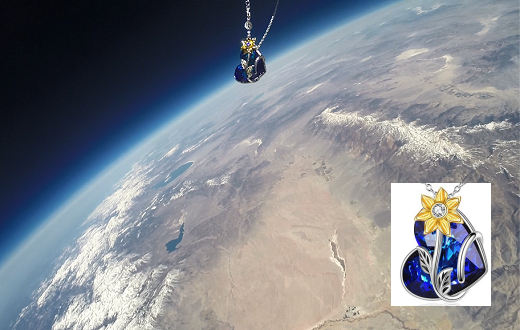
You can have it for $138.95. The students are selling space pendants to fund their cosmic ray ballooning program. The stem of this hypoallergenic sterling silver sunflower wraps around a blue heart-shaped Swarovski crystal--all suspended from a matching 18-inch chain. Each pendant comes with a greeting card showing the item in flight and telling the story of its journey to the edge of space and back again.
Far Out Gifts: Earth to Sky Store
All sales support hands-on STEM education
Realtime Space Weather Photo Gallery
Free: Spaceweather.com Newsletter