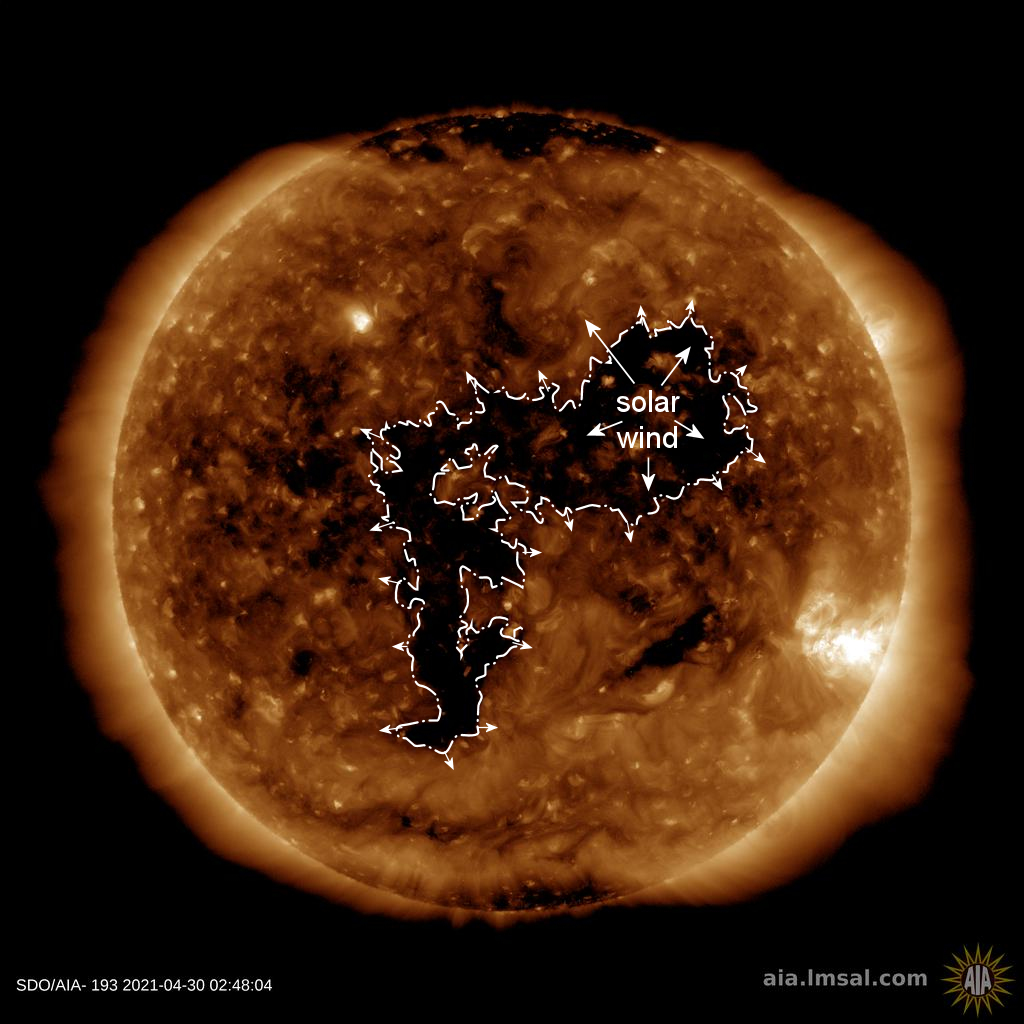
SOLAR WIND, INCOMING: Minor G1-class geomagnetic storms are possible on May 2nd when a stream of solar wind is expected to hit Earth's magnetic field. The gaseous material is flowing faster than 500 km/s from an equatorial hole in the sun's atmosphere. Aurora alerts: SMS Text.

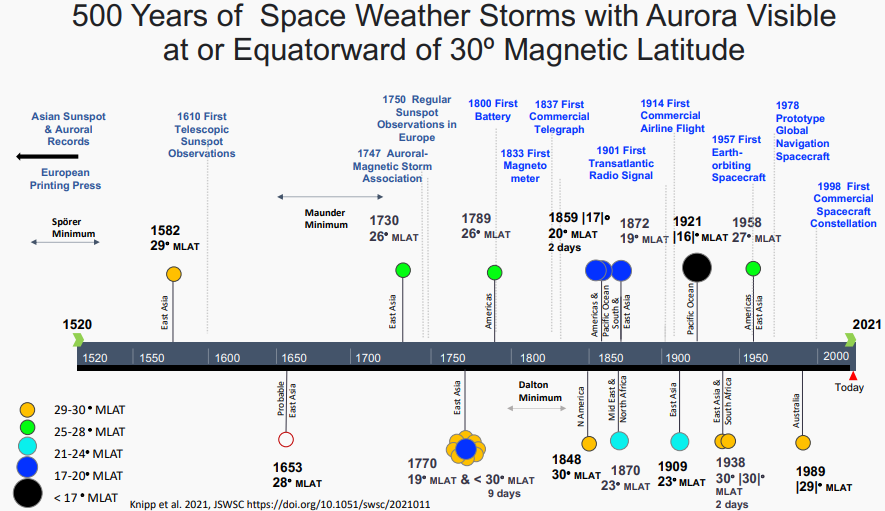
A TIMELINE OF GREAT AURORA STORMS: Imagine living in Florida. You'll never see the Northern Lights ... right? Actually, the odds may be better than you think. A new historical study just published in the Journal of Space Weather and Space Climate shows that great aurora storms occur every 40 to 60 years.
"They're happening more often than we thought," says Delores Knipp of the University of Colorado, the paper's lead author. "Surveying the past 500 years, we found many extreme storms producing auroras in places like Florida, Cuba and Samoa."
This kind of historical research is not easy. Hundreds of years ago, most people had never even heard of the aurora borealis. When the lights appeared, they were described as "fog," "vapors", "spirits"--almost anything other than "auroras." Making a timeline 500 years long requires digging through unconventional records such as personal diaries, ship's logs, local weather reports--often in languages that are foreign to the researchers.
"We defined a 'Great Storm' simply as one in which auroras were visible to the unaided eye at or below 30 degrees magnetic latitude," says Knipp.
Visual sightings were key. The human eye is a sensor we've had in common with observers since the beginning of recorded history. Pre-modern scientists didn't have satellites or magnetometers to measure solar storms, but they could look up at the night sky. In all, Knipp's team tallied 14 examples of storms where many people saw auroras within 30 degrees of the equator.
"There may be more," she notes. "For example, I am aware of a low latitude event that occurred between February and April 1648. It's not on the timeline, though, because we haven't yet been able to pin down the date."
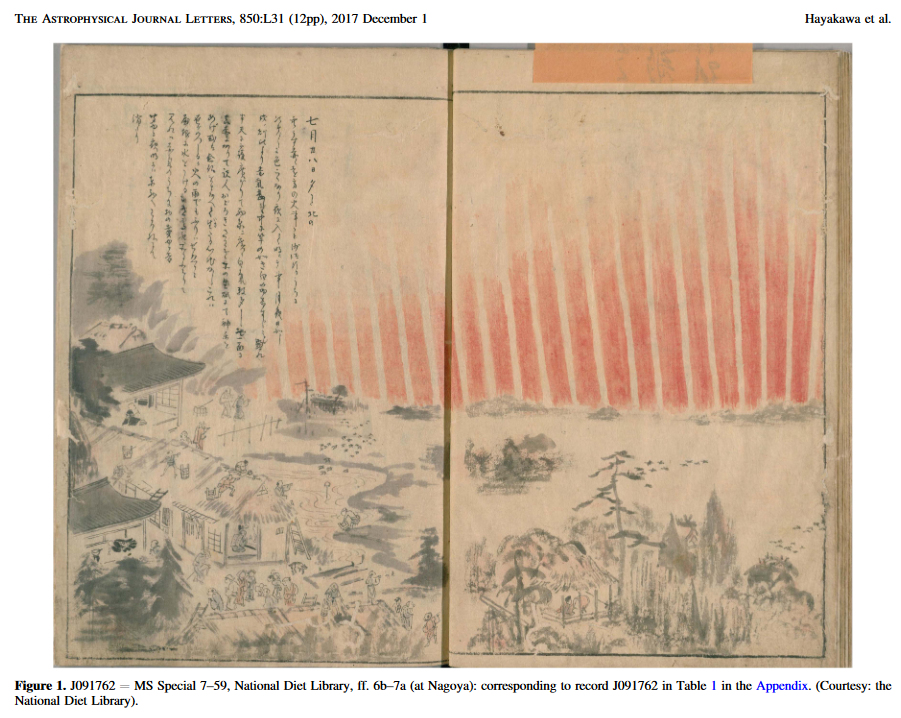
Above: An eyewitness sketch of red auroras over Japan in mid-September 1770. [ref]
Look at the timeline again; there's a whole cluster of sightings in Sept. 1770. "The Great Storm of 1770 appears to be a 500-year event," says Knipp. "There were low-latitude auroras for 9 nights in a row."
During the 1770 storm, extremely bright red auroras blanketed Japan and parts of China. Captain James Cook himself saw the display from the HMS Endeavour near Timor Island, south of Indonesia. Knipp's colleague Hisashi Hayakawa (Nagoya University) has found drawings of the instigating sunspot; it is twice the size of the sunspot that caused the infamous Carrington Event of 1859. Knipp's timeline suggests that this was not "just another Great Storm"; something exceptional happened in 1770 that researchers still don't fully understand.
Today's senior space weather researchers were taught in school that Great Storms are rare. The Carrington Event was long thought to be a singular event, alone in the historical record. Recent studies are finding otherwise. Just last month Jeffrey Love of the US Geological Survey published a paper in Space Weather showing that extreme geomagnetic storms recur every ~45 years or so--a result in accord with Knipp's. He used completely different techniques (extreme value statistics and magnetometer records) to reach a similar conclusion.
The last Great Storm in the timeline occurred 32 years ago. Soon, it will be time for another. Stay tuned.
A sharable version of this story is available here.
Realtime Space Weather Photo Gallery
Free: Spaceweather.com Newsletter
MOTHER'S DAY IS MAY 9TH: Are you looking for an out-of-this world Mother's Day gift? Consider this: Every time the students of Earth to Sky Calculus launch a cosmic ray balloon, they include something extra in the payload--something Mom will love:
Every item in the Earth to Sky Store has flown to the edge of space and comes with a greeting card showing the item in flight. The interior of the card tells the story of the gift's journey from launch to landing. Mom-satisfaction guaranteed!
Mother's Day Special: Use coupon code "SPACEMOM" at checkout for a 10% discount. Offer valid from now until Mother's Day (May 9, 2021) .
Far Out Gifts: Earth to Sky Store
All sales support hands-on STEM education
Realtime Aurora Photo Gallery
Free: Spaceweather.com Newsletter