A CME IS APPROACHING EARTH: A coronal mass ejection (CME) is expected to hit Earth on May 12th or 13th, according to NOAA forecasters. It was hurled toward us yesterday by an erupting filament of magnetism on the sun. This is not an especially fast or powerful CME, but it could spark G1-class geomagnetic storms when it arrives later this week. Aurora alerts: SMS Text.

THE SODIUM TAIL OF MERCURY: The biggest comet in the Solar System is actually a planet. It's Mercury. Researchers have known for years that Mercury has an enormous tail. Last week, Andrea Alessandrini photographed it from the balcony of his house in Veroli, Italy:
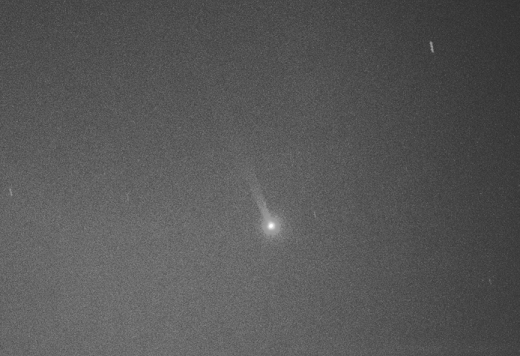
"I took the picture on May 5th using a 66 mm (2.5 inch) refracting telescope and a Pentax K3-II camera," says Alessandrini, an amateur astronomer who works by day as an aerospace engineer. "This is a 7 minute exposure @ ISO 1000."
First predicted in the 1980s, Mercury's tail was discovered in 2001. Its source is Mercury's super-thin atmosphere. Mercury is so close to the sun, pressure from sunlight itself can push atoms out of the atmosphere and into space. The escaping gas forms a tail more than 24 million km long.
The key to detecting Mercury's tail is sodium. There are many elements in Mercury's tail; sodium is only one. But because sodium is so good at scattering yellow light, it is the best element for tracing the long plume of gas. "I use a special 589 nm filter tuned to the yellow glow of sodium," says Alessandrini. "Without that filter, Mercury's tail would be invisible."
NASA's MESSENGER spacecraft spent years observing Mercury's tail often from close range. This movie shows how the brightness of the tail varies as Mercury orbits the sun:
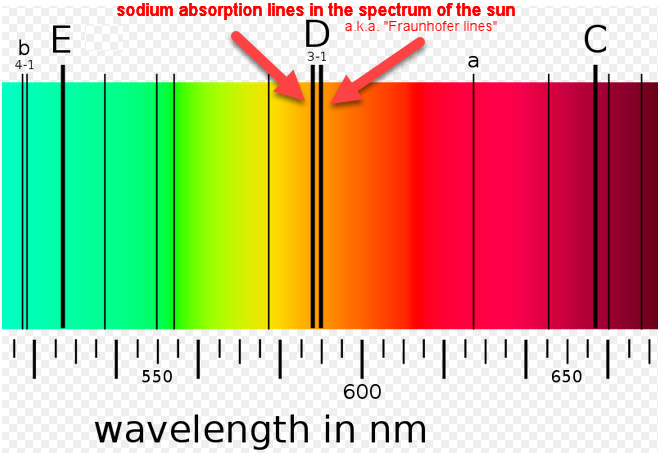
For reasons having to do with the Doppler shift of sodium absorption lines in the solar spectrum, Mercury's tail is brightest when the planet is ±16 days from perihelion (closest approach to the sun). Read the research here.
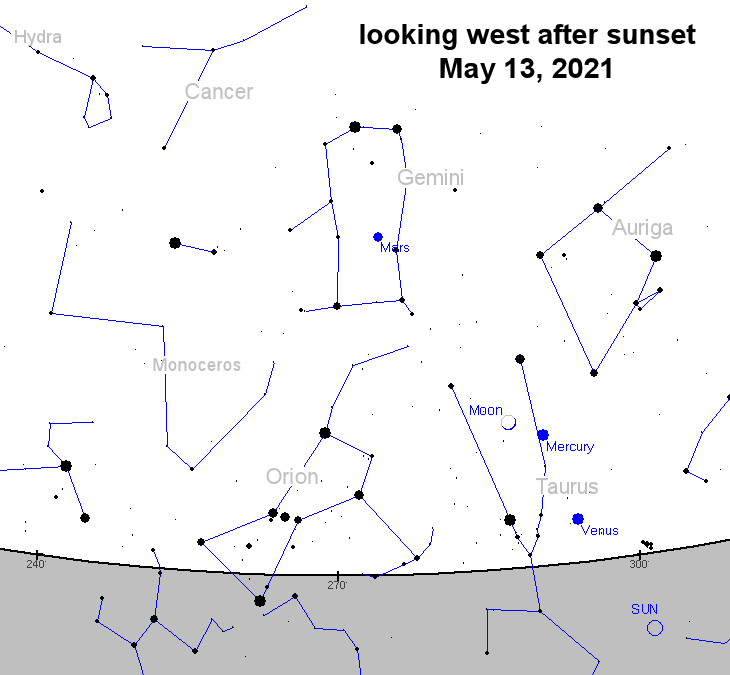
That special date is this week: On May 13th, Mercury will be 16 days past perihelion and the tail could be as much as 10 times brighter than Alessandrini saw last week. Coincidentally, on that same day the crescent Moon will pass by Mercury in the evening sky. Can you say "photo-op"? Just don't forget your sodium filter.... [sky map]
Realtime Space Weather Photo Gallery
Free: Spaceweather.com Newsletter
WHISKEY STONES FROM SPACE: It's the gift for the person who has everything: Whisky Stones from Space. These granite cubes have experienced the cold of the stratosphere, more than 50 degrees below zero! Put them in your cup for an truly out of this world drink:
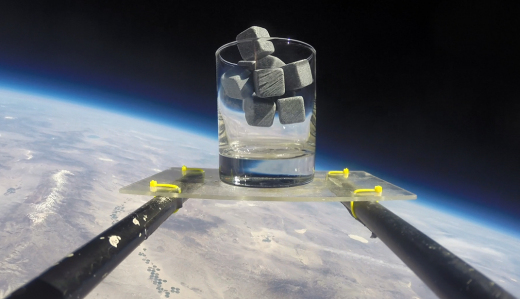
You can have a set of 9 cubes for $99.95 (glass not included). The students of Earth to Sky Calculus are selling whiskey stones to support their cosmic ray monitoring program. The ones picture above flew to the stratosphere onboard a cosmic ray research balloon on April 23, 2021, reaching an altitude of 97,543 feet.
Refrigerated whiskey stones cool a drink without diluting it, solving the problem of ordinary melting ice cubes. They make great Father's Day and birthday gifts. All stones come with a greeting card showing the cubes in flight.
Far Out Gifts: Earth to Sky Store
All sales support hands-on STEM education
Realtime Aurora Photo Gallery
Free: Spaceweather.com Newslette