ANOTHER CME IS COMING: A minor CME billowed away from sunspot AR2822 on May 13th (around 1600 UT). NOAA computer models suggest that it might deliver a glancing blow to Earth's magnetic field on May 18th. This will not be a big event, but it could spark high latitude auroras. Aurora alerts: SMS Text.
THE CRESCENT MOON AND MERCURY'S SODIUM TAIL: Earlier this week, we predicted that Mercury's sodium tail would reach maximum brightness on May 13th--perfectly timed for Mercury's close encounter with the crescent Moon. "You were right!" reports amateur astronomer Andrea Alessandrini of Veroli, Italy, who photographed Mercury's tail (inset) during the conjunction:
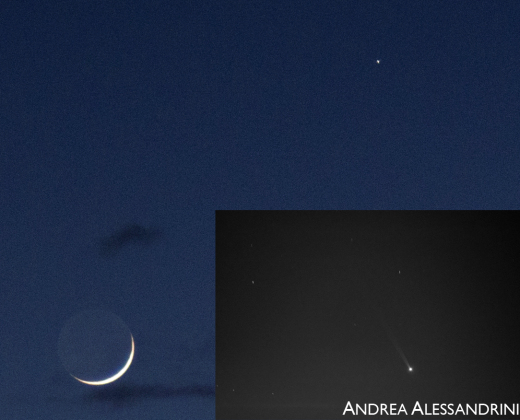
Alessandrini has been monitoring Mercury's tail since 2020. "This is the first time that I have seen it so bright," he says. "It was detectable even with the Moon nearby. In the composite, the Moon and Mercury are at the same scale; the tail was wider than the Moon itself!"
Mercury's tail is a comet-like streamer of gas blown away from the planet's thin atmosphere by the pressure of sunlight. Sodium atoms in the tail do a great job scattering yellow sunlight at wavelengths near 589 nm. As a result, if you're an astronomer and you have a 589 nm sodium filter, you can see Mercury's tail. That's how Alessandrini did it. The inset image was taken through a sodium filter; the surrounding photo is unfiltered white light.
Why was Mercury's tail extra-bright around May 13th? It's complicated. To understand, take a look at the spectrum of sunlight hitting Mercury:
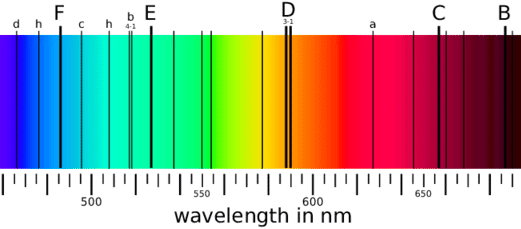
The vertical dark lines are Fraunhofer lines. They are colors absorbed by different elements in the sun's atmosphere. Sodium atoms are responsible for the D lines at 589 nm. Ironically, sunlight is missing the precise wavelengths needed to "light up" Mercury's sodium tail. Fortunately for observers, those dark lines Doppler shift as Mercury races around its elliptical orbit; on May 13th the D lines Doppler shifted so much that Mercury's tail was bathed in 589 nm yellow light, allowing it to be seen with unusual brightness.
Realtime Space Weather Photo Gallery
Free: Spaceweather.com Newsletter
WHISKEY STONES FROM SPACE: It's the gift for the person who has everything: Whisky Stones from Space. These granite cubes have experienced the cold of the stratosphere, more than 50 degrees below zero! Put them in your cup for an truly out of this world drink:
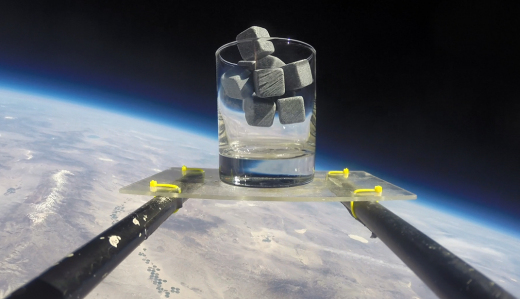
You can have a set of 9 cubes for $99.95 (glass not included). The students of Earth to Sky Calculus are selling whiskey stones to support their cosmic ray monitoring program. The ones picture above flew to the stratosphere onboard a cosmic ray research balloon on April 23, 2021, reaching an altitude of 97,543 feet.
Refrigerated whiskey stones cool a drink without diluting it, solving the problem of ordinary melting ice cubes. They make great Father's Day and birthday gifts. All stones come with a greeting card showing the cubes in flight.
Far Out Gifts: Earth to Sky Store
All sales support hands-on STEM education
Realtime Aurora Photo Gallery
Free: Spaceweather.com Newsletter