GEOMAGNETIC STORM WATCH: Minor G1-class geomagnetic storms are possible on May 18-19 when a pair of coronal mass ejections (CMEs) is expected to hit Earth's magnetic field. The two CMEs left the sun on consecutive days: One from sunspot AR2822 on May 13th, the next from sunspot AR2823 on May 14th. Individually, the CMEs appear to be weak and insubstantial; however, they could add up to a geomagnetic storm when they arrive in quick succession this Tuesday. Aurora alerts: SMS Text.
A GREEN BLOB OVER RHODE ISLAND: It looks like an aurora, but it's not. Last night in Rhode Island, a green blob appeared just above the treeline of North Kingstown:
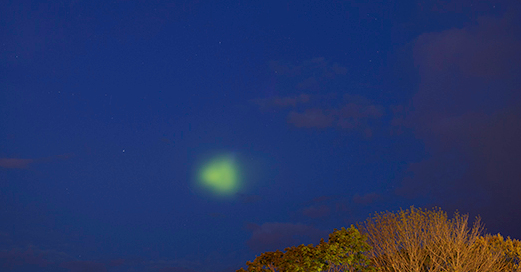
"It only lasted a few seconds," says photographer Ronald Zincone, "but it was very bright green."
This is a cloud of barium vapors released by a Black Brant sounding rocket, launched at 8:44 pm EDT on May 16th from Wallops Island, Virginia. Researchers from the University of Alaska are doing an experiment called KiNET-X. Its purpose is to solve a longstanding mystery about auroras. Electrons in the solar wind are low energy; yet electrons that make auroras have high energy. How are they energized?
Barium vapors may help answer that question. High altitude sunlight rapidly ionizes the barium, which releases electrons into the upper atmosphere. Instruments on the sounding rocket watch what happens, and may learn how the electrons are energized.
Update: Here is a sequence of images showing how the blob evolved. Note the faint violet streamer rising out of the fading green gas:

The streamer is a sign that the barium is being ionized, changing form from green (neutral) to violet (ionized). Ions and electrons in the newly ionized cloud begin to migrate along Earth's magnetic field lines, forming an elongated structure parallel to the local magnetic field.
Realtime Space Weather Photo Gallery
Free: Spaceweather.com Newsletter
MERCURY'S TAIL, UNFILTERED: Mercury's comet-like tail is full of sodium, an element which glows yellow (589 nm) when it is hit by sunlight. So, you'll need a sodium filter to see it, right? Maybe not. "On three recent nights I took photos of Mercury's tail with NO filter at all," reports Paul Robinson on vacation in Flagstaff, Arizona.
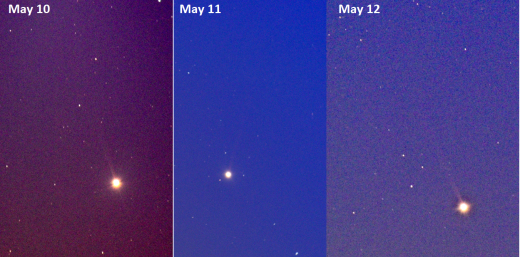
"In each case I stacked several 30 second exposures @ ISO 3200," he says. "To be sure I was really seeing Mercury's tail, I tried different camera orientations. All showed the tail aligned with the sun."
How is this possible? Right now, Mercury is passing through a part of its orbit where the tail is especially bright. This may allow it to be photographed in ordinary white light--no special filters required. Look for Mercury in the evening sunset sky; the planet reaches its maximum elongation from the sun on May 17th.
Realtime Mercury Photo Gallery
Free: Spaceweather.com Newsletter
WHISKEY STONES FROM SPACE: It's the gift for the person who has everything: Whisky Stones from Space. These granite cubes have experienced the cold of the stratosphere, more than 50 degrees below zero! Put them in your cup for an truly out of this world drink:
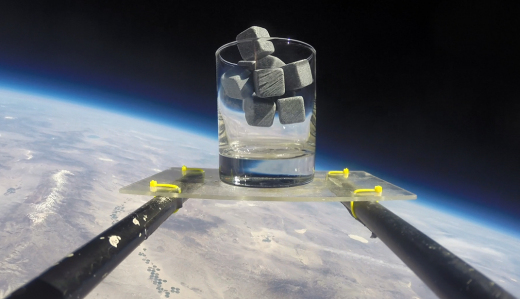
You can have a set of 9 cubes for $99.95 (glass not included). The students of Earth to Sky Calculus are selling whiskey stones to support their cosmic ray monitoring program. The ones picture above flew to the stratosphere onboard a cosmic ray research balloon on April 23, 2021, reaching an altitude of 97,543 feet.
Refrigerated whiskey stones cool a drink without diluting it, solving the problem of ordinary melting ice cubes. They make great Father's Day and birthday gifts. All stones come with a greeting card showing the cubes in flight.
Far Out Gifts: Earth to Sky Store
All sales support hands-on STEM education
Realtime Aurora Photo Gallery
Free: Spaceweather.com Newsletter