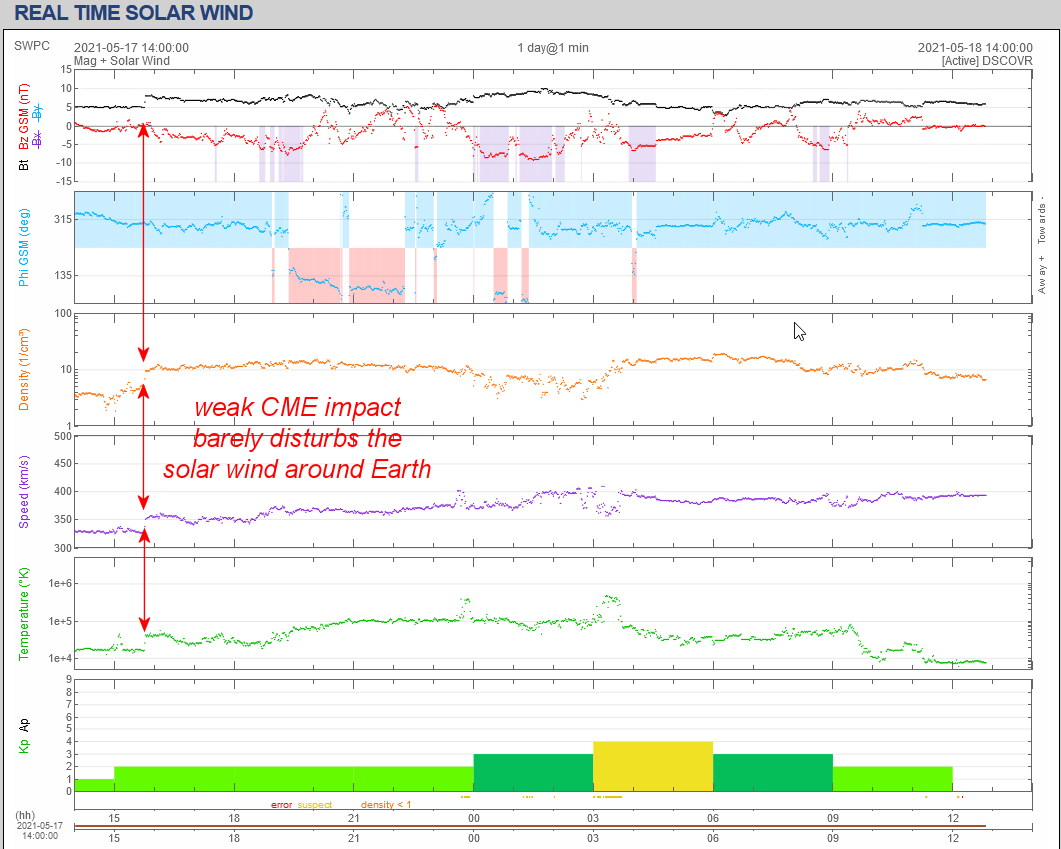
MINOR GEOMAGNETIC STORM WATCH: A CME hit Earth's magnetic field during the late hours of May 17th (~1600 UT). Its impact was weak, lifting the solar wind speed by a measly 25 km/s. A second, more effective CME might arrive later today, according to NOAA. Minor G1-class geomagnetic storms are therefore still possible on May 18-19. Aurora alerts: SMS Text.

FAILURE TO LAUNCH: A new sunspot (AR2824) is emerging over the sun's northeastern limb, and it is crackling with C-class solar flares. NASA's Solar Dynamics Observatory recorded this one, a C1.1 flare, at 0209 UT on May 18th:
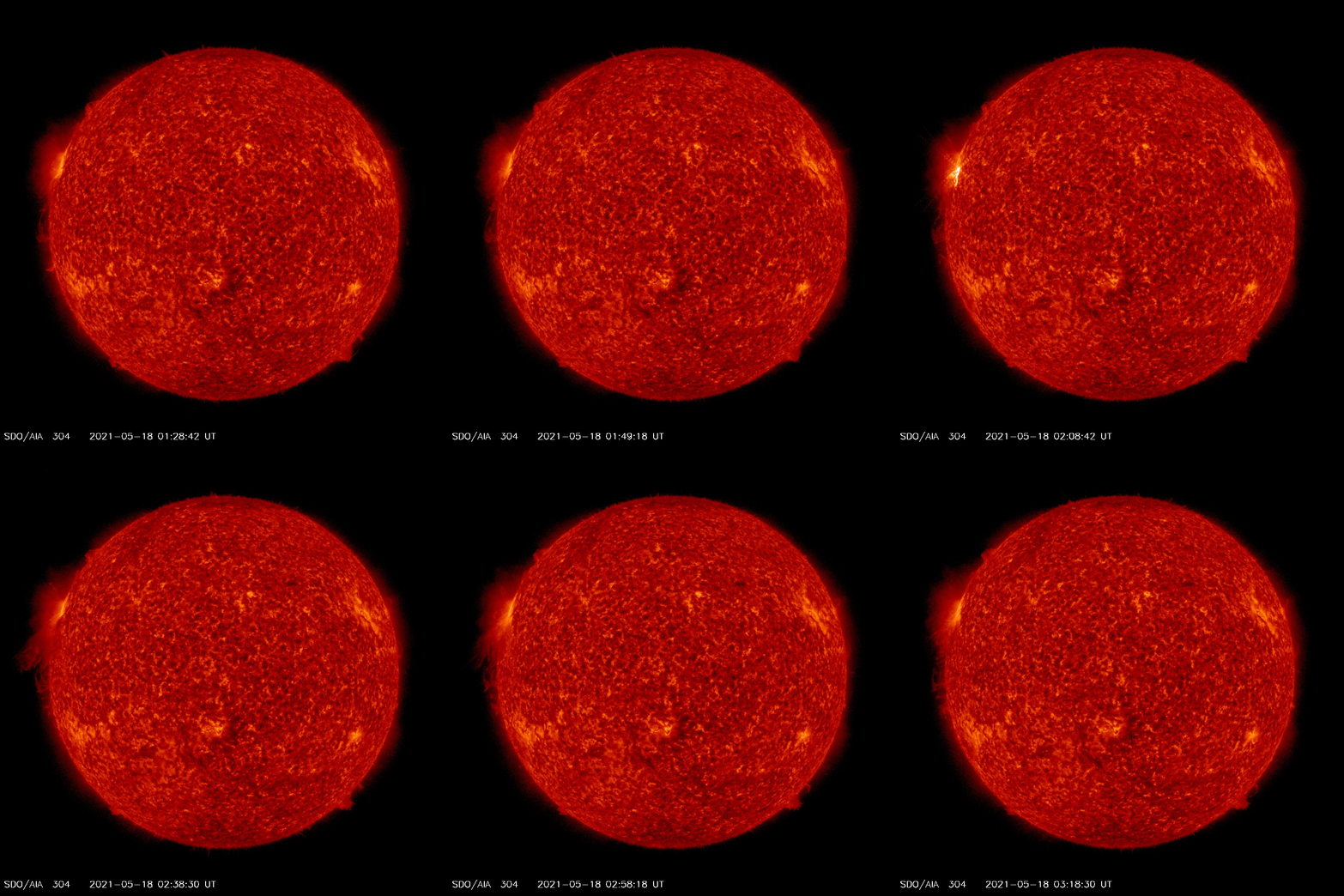
The explosion hurled a plume of plasma off the surface of the sun, but not all the way into space. Most of the material fell back to the sun's surface. Low level C-flares are simply not that powerful.
Stronger flares might be in the offing. This is a relatively large sunspot with the potential for explosive magnetic mixing around its Neptune-sized dark core. Stay tuned for updates as AR2824 turns toward Earth.
Realtime Space Weather Photo Gallery
Free: Spaceweather.com Newsletter
EARTH'S RING CURRENT, GLOWING RED: Last week on May 12th, a CME struck Earth's magnetic field, sparking the strongest geomagnetic storm of young Solar Cycle 25. During the G3-class storm, photographers in Canada noticed something odd. An arc of red glowing light cut through the Milky Way. "It was an SAR," reports Alan Dyer, who photographed it near Gleichen, Alberta:

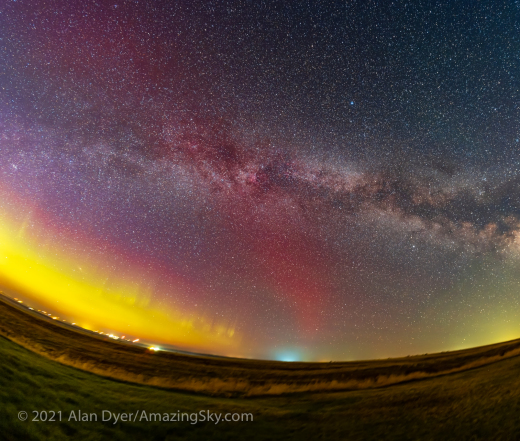
Stable Auroral Red arcs (SARs) were discovered in 1956 at the beginning of the Space Age and have been recorded by cameras on satellites hundreds of times since. Most aurora watchers have never seen one, though, because they are almost always invisible to the human eye.
Indeed, "I myself could not see it, but my camera, a red-sensitive Canon EOS Ra, picked it up in 30-second and 2-minute exposures," says Dyer. Jay Anderson of Kaleida, Manitoba, photographed it, too.
SARs are related to auroras, but they are not the same. Regular auroras appear when high-energy particles rain down along polar magnetic field lines, hitting the atmosphere (100-200 km high) and causing it to glow like the picture tube of an old color TV. SARs form differently. They are a sign of heat energy leaking into the upper atmosphere (~400 km high) from Earth's ring current system. This kind of leakage occurs most often during strong geomagnetic storms.
Realtime Aurora Photo Gallery
Free: Spaceweather.com Newsletter
WHISKEY STONES FROM SPACE: It's the gift for the person who has everything: Whisky Stones from Space. These granite cubes have experienced the cold of the stratosphere, more than 50 degrees below zero! Put them in your cup for an truly out of this world drink:
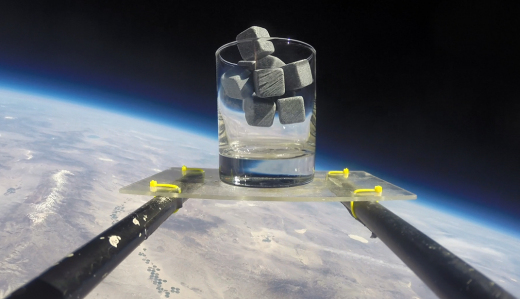
You can have a set of 9 cubes for $99.95 (glass not included). The students of Earth to Sky Calculus are selling whiskey stones to support their cosmic ray monitoring program. The ones picture above flew to the stratosphere onboard a cosmic ray research balloon on April 23, 2021, reaching an altitude of 97,543 feet.
Refrigerated whiskey stones cool a drink without diluting it, solving the problem of ordinary melting ice cubes. They make great Father's Day and birthday gifts. All stones come with a greeting card showing the cubes in flight.
Far Out Gifts: Earth to Sky Store
All sales support hands-on STEM education
Realtime Aurora Photo Gallery
Free: Spaceweather.com Newsletter