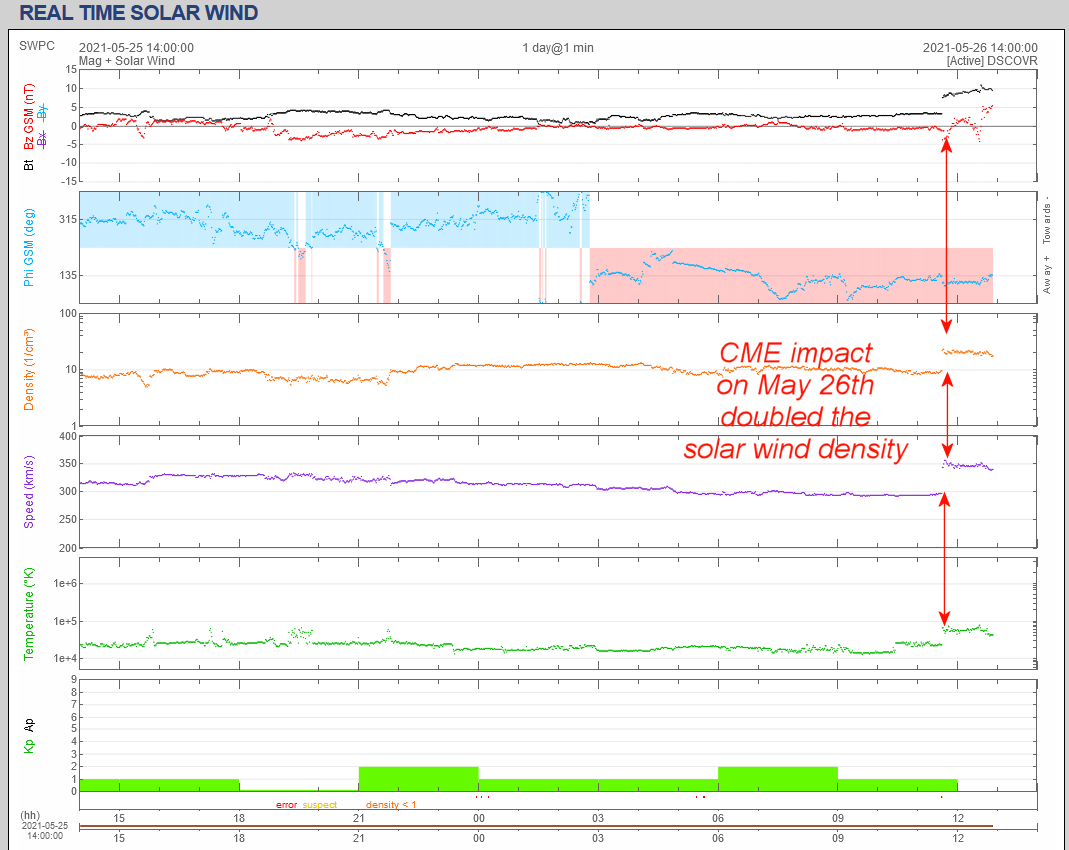
CME SPARKS MINOR GEOMAGNETIC STORM: A coronal mass ejection (CME) struck Earth's magnetic field yesterday, May 26th (1250 UT). The CME was not fast, but it was dense, doubling the density of solar wind in its wake and sparking a minor G1-class geomagnetic storm. The storm's green afterglow was seen over Canada during the early hours of May 27th. Aurora alerts: SMS Text.

NOCTILUCENT CLOUD ALERT: Something unusual is happening at the top of Earth's atmosphere. Noctilucent clouds (NLCs) are forming, and people are seeing them from the ground even though it is only May. Andy Stables sends this photo from the Isle of Skye, Scotland, taken May 26th:
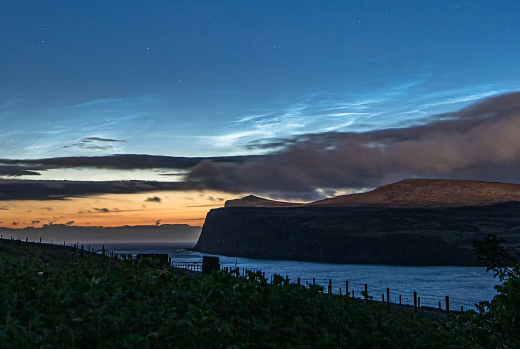
The electric-blue ripples "were clearly visible to the unaided eye," says Stables. "This is the earliest I have ever seen them here in Scotland."
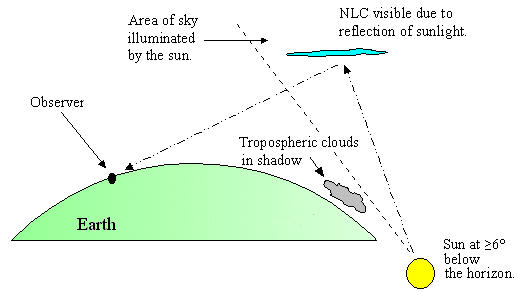
NLCs are Earth’s highest clouds. Seeded by meteoroids, they float at the edge of space about 83 km above the ground. The clouds form when summertime wisps of water vapor rise up to the mesosphere, allowing water to crystallize around specks of meteor smoke. The season for bright naked-eye NLCs typically stretches from June through August.
This year NLCs are getting an early start. We've already received multiple reports of sightings in Europe from latitudes as low as 50 degrees, and according to NASA's AIM spacecraft the clouds are rapidly intensifying. In only 4 days since the clouds were first spotted, their coverage of the Arctic has multiplied 10-fold:
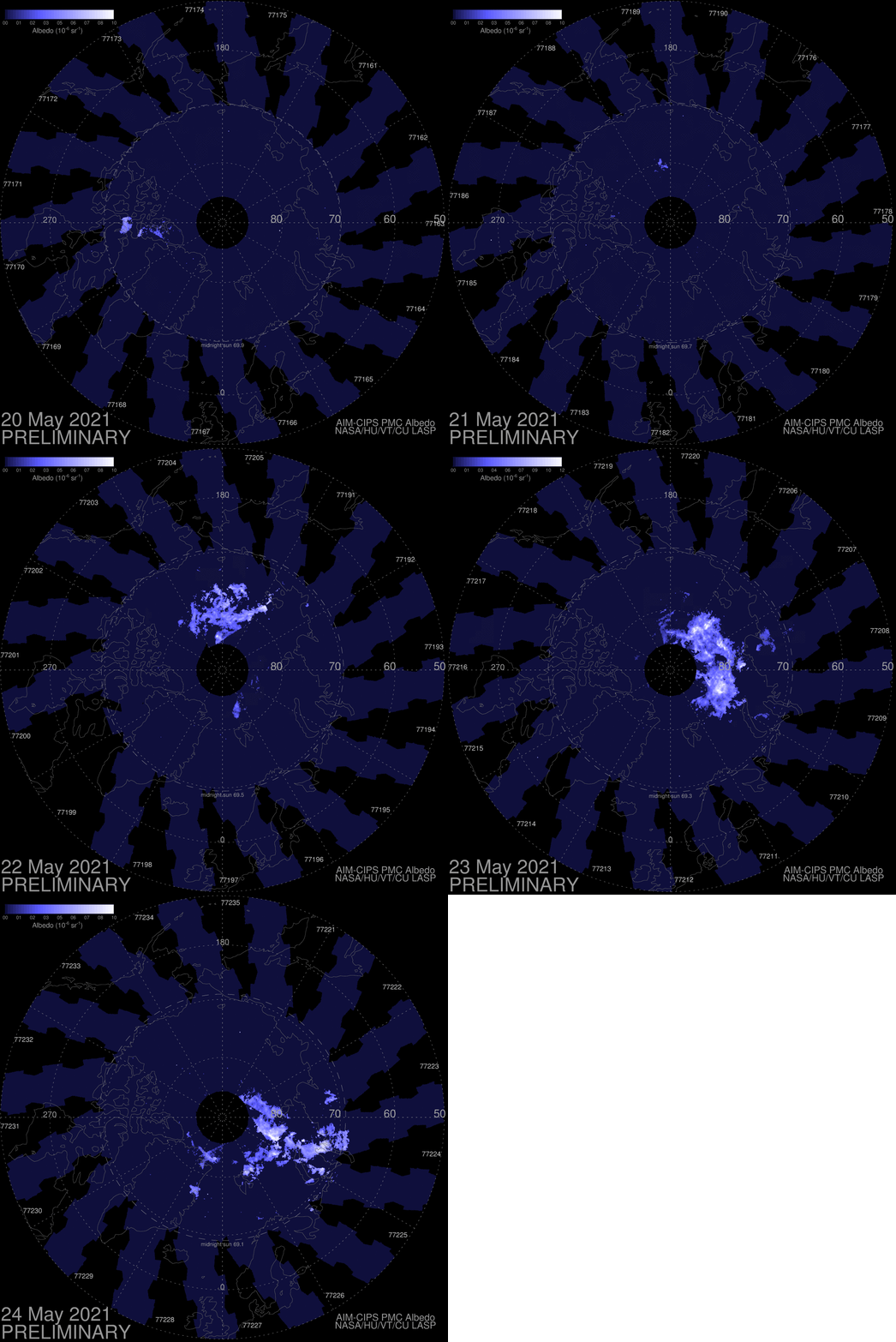
Daily images of Earth's north pole from NASA's AIM spacecraft: May 20-24, 2021.
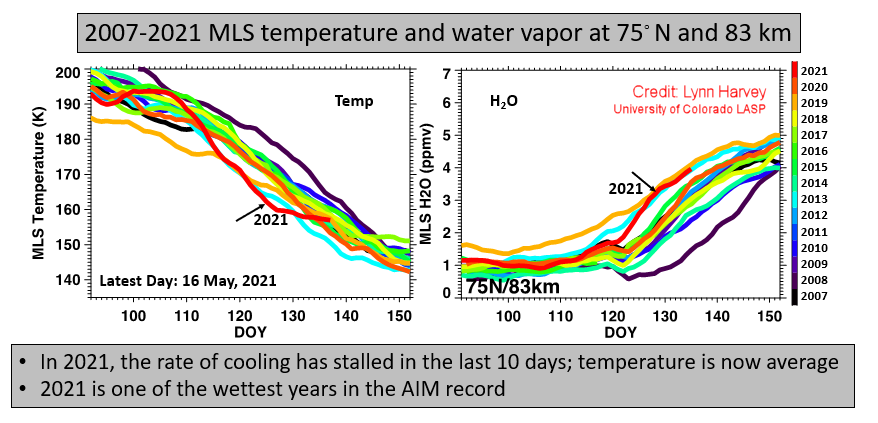
The reason may be extra water in the mesosphere: NASA satellite data show that 2021 is one of the wettest years since 2007. NLCs have more H2O to work with--hence the early start and rapid growth.
In recent years, summertime noctilucent clouds have spilled as far south as Los Angeles and Las Vegas, setting records for low-latitude sightings. 2021 is shaping up to be such a year. Pro tip for northern sky watchers: Look west 30+ minutes after sunset. If you see luminous blue-white tendrils spreading across the sky, you may have spotted a noctilucent cloud
Realtime Noctilucent Cloud Photo Gallery
Free: Spaceweather.com Newsletter
DUELING SPACE STATIONS: There's a new space station in Earth orbit: Tianhe-1, launched by China on April 29th. How does it compare to the International Space Station (ISS)? Philip Smith of Manorville, New York, decided to find out. The longtime photographer of Earth-orbiting spacecraft trained his 14-inch telescope on both, then placed the images side-by-side:
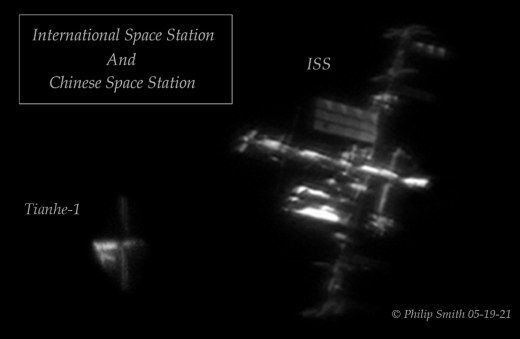
"This is how it would look if the two space stations were flying in tandem," says Smith. "I photographed the ISS on May 6th and Tianhe-1 on May 19th, both with the same setup. They were at approximately the same height, so this is a true comparison." (Bonus: Smith's video of Tianhe-1 is a must-see.)
The ISS dwarfs Tianhe-1, but the new space station will soon begin to catch up. Tianhe-1 is only the first of three modules that will eventually join to create the greater Chinese Space Station (CSS). When the CSS is finished, it will be about as big as Russia’s old Mir space station.Three astronauts will live onboard.
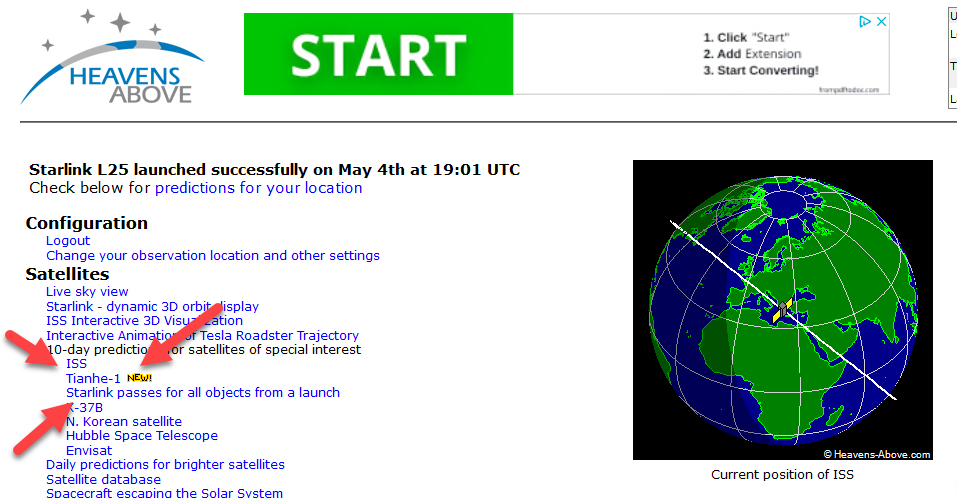
You can see Tianhe-1 with your unaided eye. It is typically as bright as a 1st magnitude star, and sometimes much brighter. Visit Heavens-Above.com and select flyby predictions for Tianhe-1.
Realtime Space Weather Photo Gallery
Free: Spaceweather.com Newsletter
STERLING SILVER HUMMINGBIRD: This hummingbird has touched space. The sterling silver pendant hitched a ride to the stratosphere on Jan. 15, 2021, when the students of Earth to Sky Calculus launched a cosmic ray balloon. Here it is, floating 111,202 feet above the snow-capped Sierra Nevada of central California:
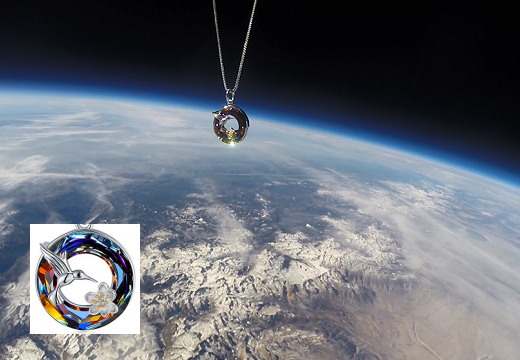
You can have it for $142.95. The students are selling hummingbird pendants to support their cosmic ray ballooning program. Each one comes with a greeting card showing the hummingbird in flight and telling the story of its journey to the edge of space. It makes an out-of-this-world birthday, anniversary, or Christmas gift!
Far Out Gifts: Earth to Sky Store
All sales support hands-on STEM education
Realtime Aurora Photo Gallery
Free: Spaceweather.com Newsletter