SOLAR SECTOR BOUNDARY CROSSING: Earth's magnetic field is quieting as effects from the May 26th CME impact subside. The calm should continue until May 30th when our planet is expected to cross through a fold in the heliospheric current sheet.The crossing, called a "solar sector boundary crossing," could trigger minor geomagnetic activity. Aurora alerts: SMS Text.
A 'LIGHTNING BOLT' ON THE SUN: Yesterday, during the late hours of May 27th, the magnetic canopy of sunspot AR2824 became unstable and erupted. The blast expelled a mass of hot plasma that zig-zagged across the surface of the sun like an oversized lightning bolt:
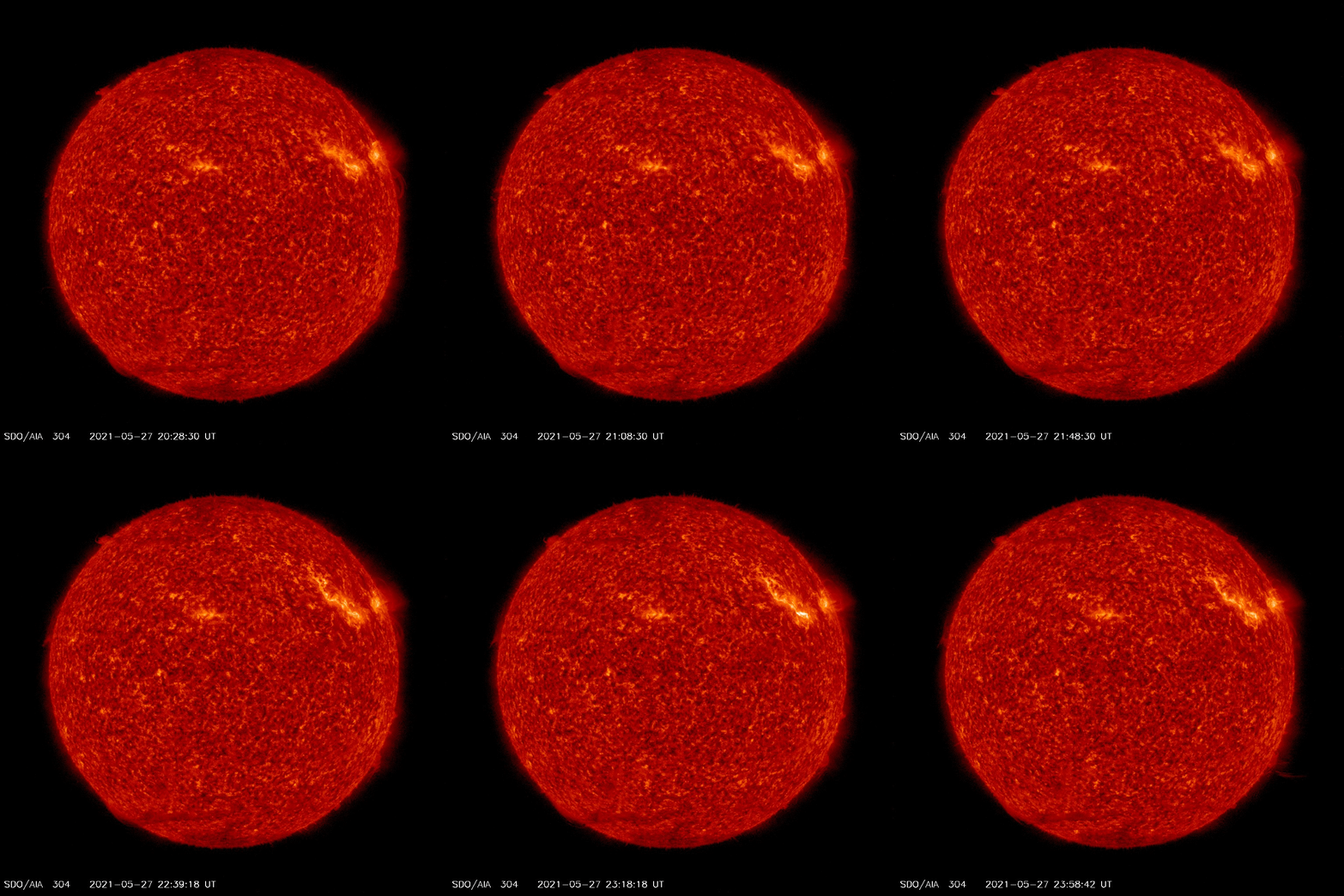
"Oversized" in this case means ~500,000 km long. The blast channel stretched almost one and a half times the distance from Earth to the Moon!
Because the debris was confined to the sun's surface, possibly guided and held down by a naturally-occuring tunnel of magnetic arches, there was no significant coronal mass ejection (CME). This was an explosion that failed to launch.
Realtime Space Weather Photo Gallery
Free: Spaceweather.com Newsletter
LUNAR POLLEN CORONA: This week in Poland, photographer Marek Nikodem went out after dark to search for noctilucent clouds. He couldn't find any. "Instead," says Nikodem, "I noticed a pollen corona around the Moon." Here is what it looked like:
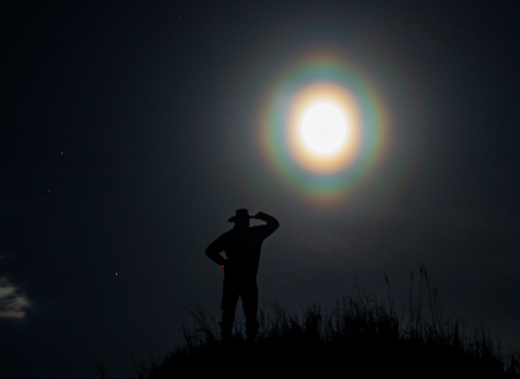
"Pine is strongly flowering now in Poland," explains Nikodem. "Strong evening winds picked up tiny pollen grains and carried them in front of the Moon."
Most readers have seen coronas around the sun and Moon before. They are usually caused by water droplets in clouds, which scatter light into ring-shaped forms. Pollen grains are even better at this than water droplets. The coronas they create are compact and intensely colorful.
Pollens are non-spherical--and this adds to their magic. Many pollens have air sacs to help carry them in the wind. These align the grains so that their coronas are elliptical, an effect which is seen in Nikodem's photo.
Spring is the season for pollen coronas, and they are often sighted in between sneezes. "While people suffering from hay fever are having a bad time, some sky watchers like me are actually enjoying themselves," says Nikodem.
Realtime Noctilucent Cloud Photo Gallery
Free: Spaceweather.com Newsletter
STERLING SILVER HUMMINGBIRD: This hummingbird has touched space. The sterling silver pendant hitched a ride to the stratosphere on Jan. 15, 2021, when the students of Earth to Sky Calculus launched a cosmic ray balloon. Here it is, floating 111,202 feet above the snow-capped Sierra Nevada of central California:
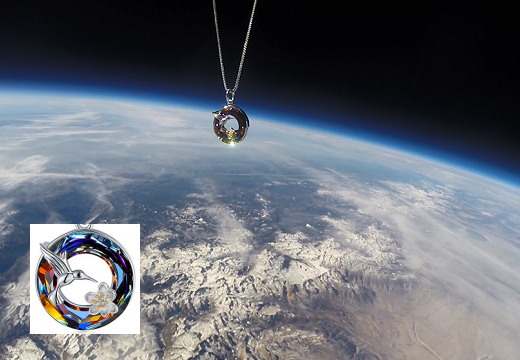
You can have it for $142.95. The students are selling hummingbird pendants to support their cosmic ray ballooning program. Each one comes with a greeting card showing the hummingbird in flight and telling the story of its journey to the edge of space. It makes an out-of-this-world birthday, anniversary, or Christmas gift!
Far Out Gifts: Earth to Sky Store
All sales support hands-on STEM education
Realtime Aurora Photo Gallery
Free: Spaceweather.com Newsletter