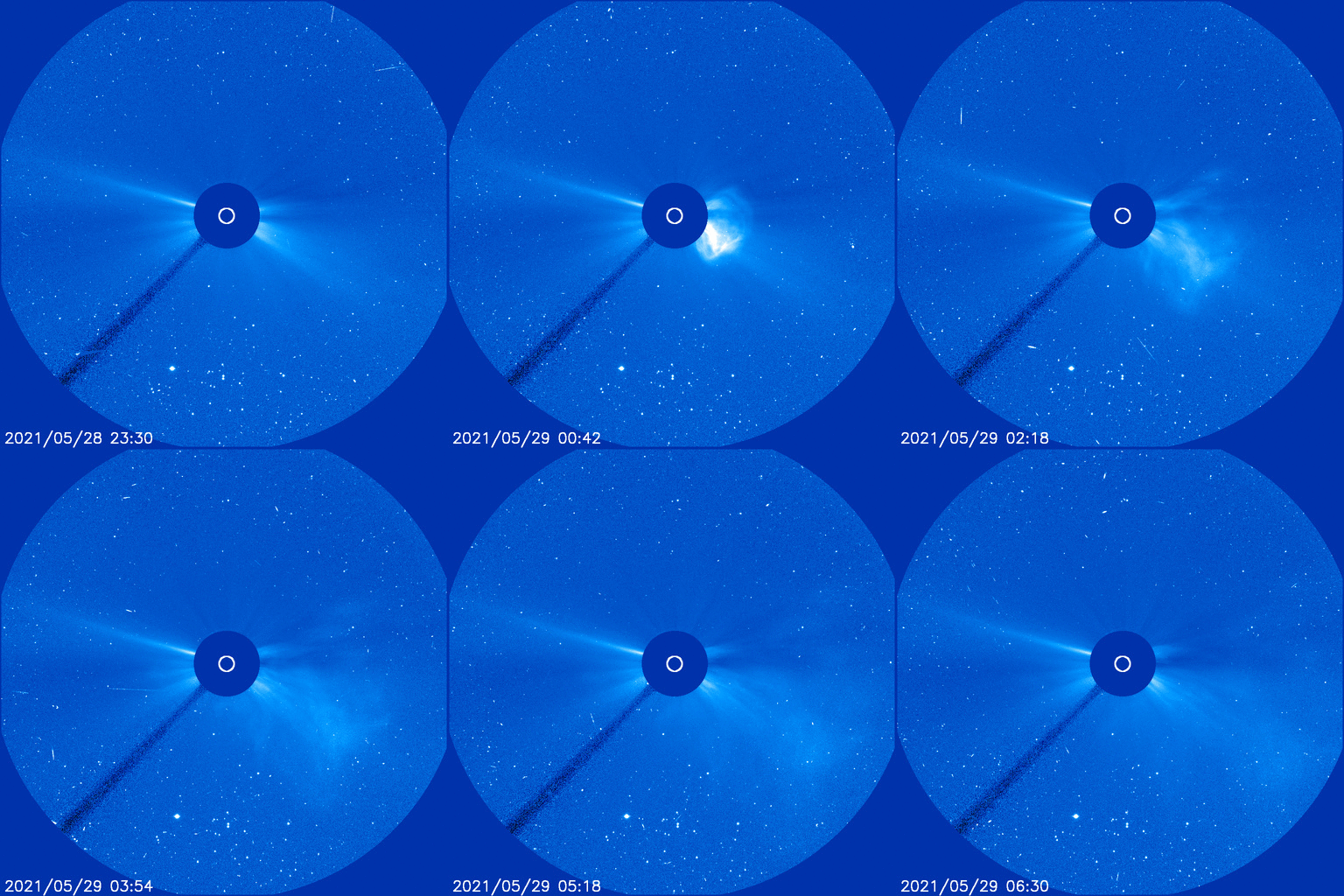
AN OFF-TARGET CME MIGHT SIDESWIPE EARTH TODAY: Minor G1-class geomagnetic storms are possible on June 1st when a CME is expected to sideswipe Earth's magnetic field. The storm cloud was hurled into space on May 28th by departing sunspot AR2824. High-latitude sky watchers should be alert for auroras, especially in the southern hemisphere where autumn darkness favors visibility. Aurora alerts: SMS Text.

'UFO' PHOTOBOMBS THE SUN: Last week, Philip Smith of Manorville, New York, was video-recording the sun when a spherical silhouette flitted between sunspots AR2824 and AR2826. "UFOs have been in the news a lot lately," says Smith. "Here's one in front of the sun!"
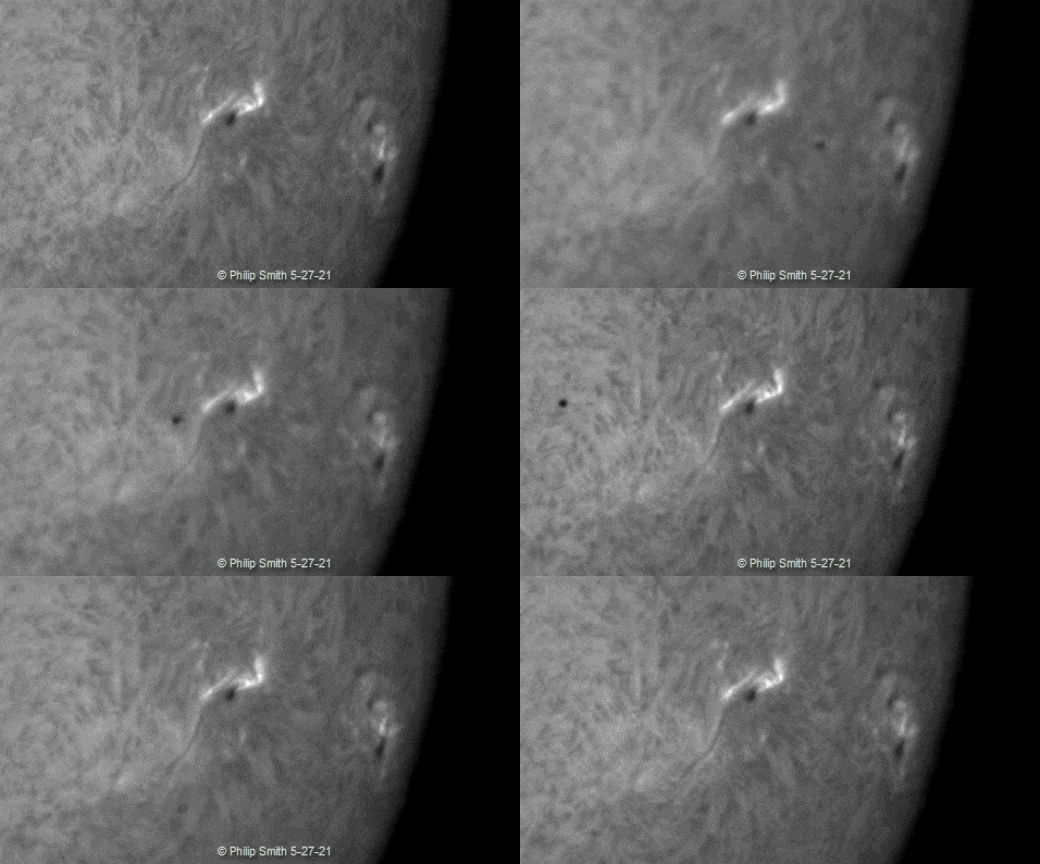
Note: This 128 fps video is slowed down 4x to improve visibility.
What was it? We asked expert satellite tracker Marco Langbroek of the Netherlands to check for possible satellite transits. "I was not able to find a matching satellite," says Langbroek. "Instead, I think this is very likely a balloon; 99.9% of all satellites would be smaller, about 1 pixel or less on this scale, and very few satellites are globular."
We agree with Langbroek. It's a weather balloon. Spaceweather.com launches 3 to 4 balloons a month to monitor cosmic rays in the stratosphere, so we have some experience in this area. Running the numbers, we find that the silhouette can be explained by a 10ft diameter balloon 15 miles from his telescope blowing ~200 mph--all within the realm of "normal."
"This isn't the first time I've seen balloons through my telescope," says Smith. "I had fun catching this one."
Realtime Space Weather Photo Gallery
Free: Spaceweather.com Newsletter
SOLAR POLLEN CORONA: Something in the air is making German sunsets look unusual. "It's pollen," says Heiko Ulbricht, who photographed the phenomenon May 30th from Landberg hill in Saxony:
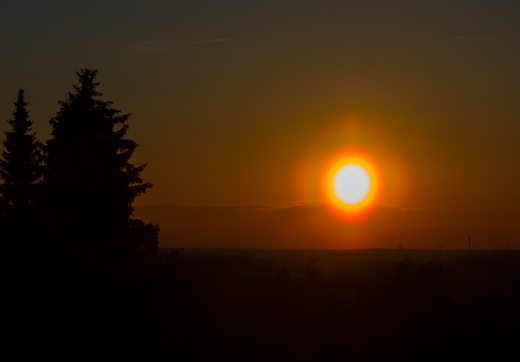
The elliptical rings around the sun are a pollen corona. Most readers have seen coronas around the sun before. They are usually caused by water droplets in clouds, which scatter light into ring-shaped forms. Pollens do this even better than water. The coronas they create are compact and intensely colorful.
"The pollen is coming from pine trees in the area," says Ulbricht. Springtime cones are opening, spreading pollen grains so that pines can reproduce. "There was a layer of pollen hanging in the still air when I took this picture," he explains.
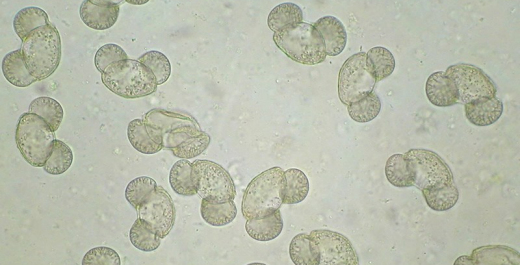
Above: pine pollens seen through a microscope [more]
Viewed through a microscope, pine pollens look like Mickey Mouse ears. The ears and cap are air sacs which help carry them in the wind. Air movement aligns these assymetrical scatterers so that the resulting corona is elliptical with bright patches.
Got pines? Your next sunset may be a little unusual. Submit your photos here.
Realtime Space Weather Photo Gallery
Free: Spaceweather.com Newsletter
"I LOVE YOU MORE" MOONSTONE PENDANT: Nothing says "I love you" like a moonstone from space. On May 26, 2021, this sterling silver infinity-wrapped moonstone pendant hitched a ride on an Earth to Sky Calculus cosmic ray research balloon. At the apex of the flight it floated 112,201 feet above the Sierra Nevada mountains of central California:
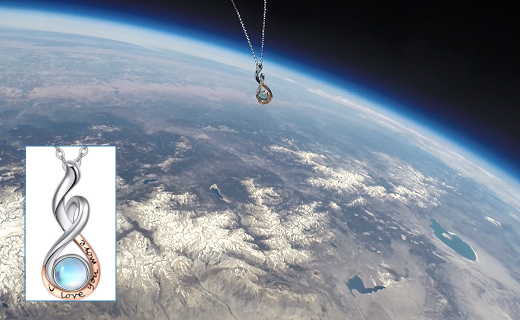
You can have it for $142.95. The students are selling these pendants to support their cosmic ray ballooning program. Engraved with "I Love You More," it makes a great anniversary, birthday or (never too early!) Christmas gift. Each pendant comes with a greeting card showing the moonstone in flight and telling the story of its trip to the stratosphere and back again.
Far Out Gifts: Earth to Sky Store
All sales support hands-on STEM education
Realtime Aurora Photo Gallery
Free: Spaceweather.com Newsletter