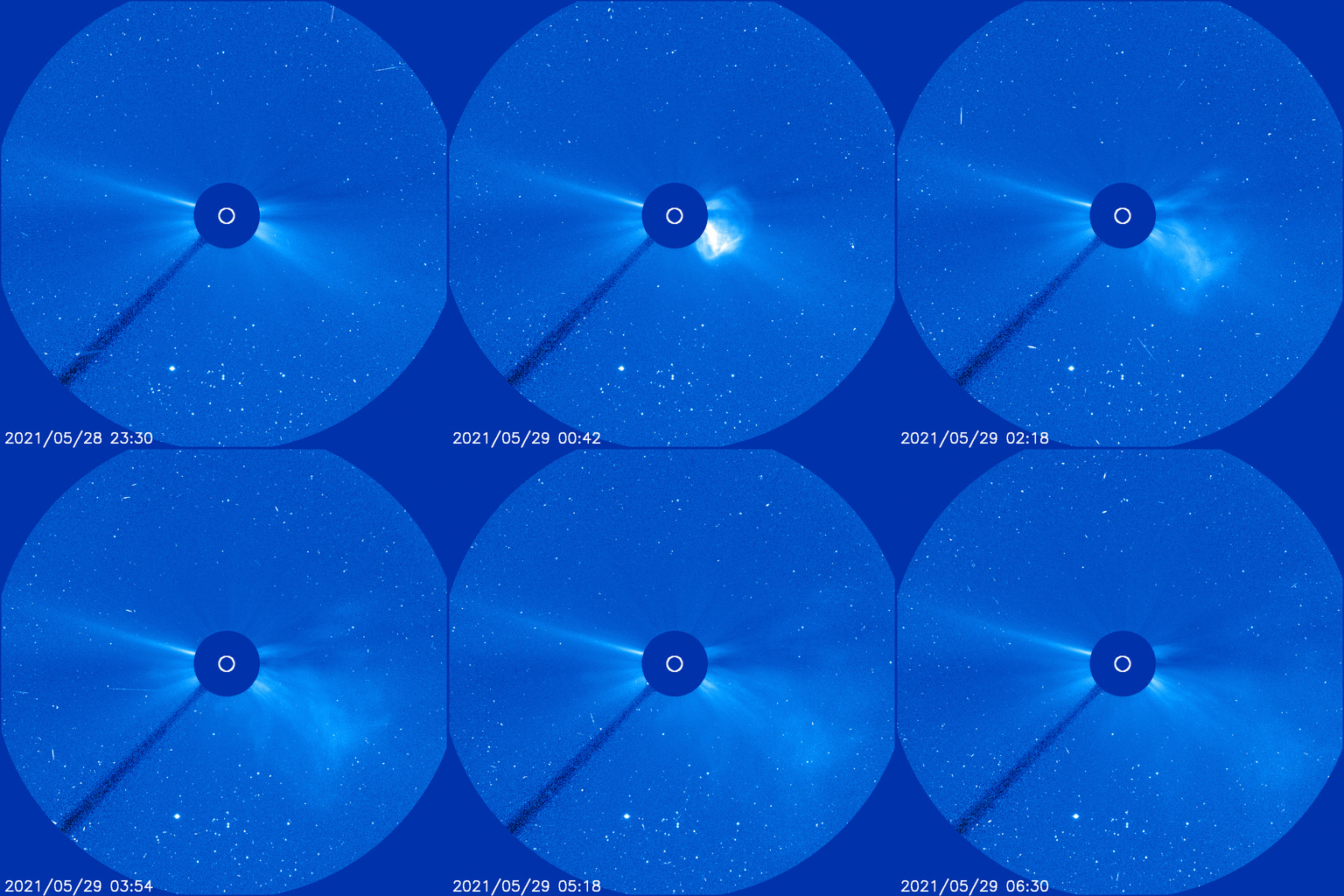
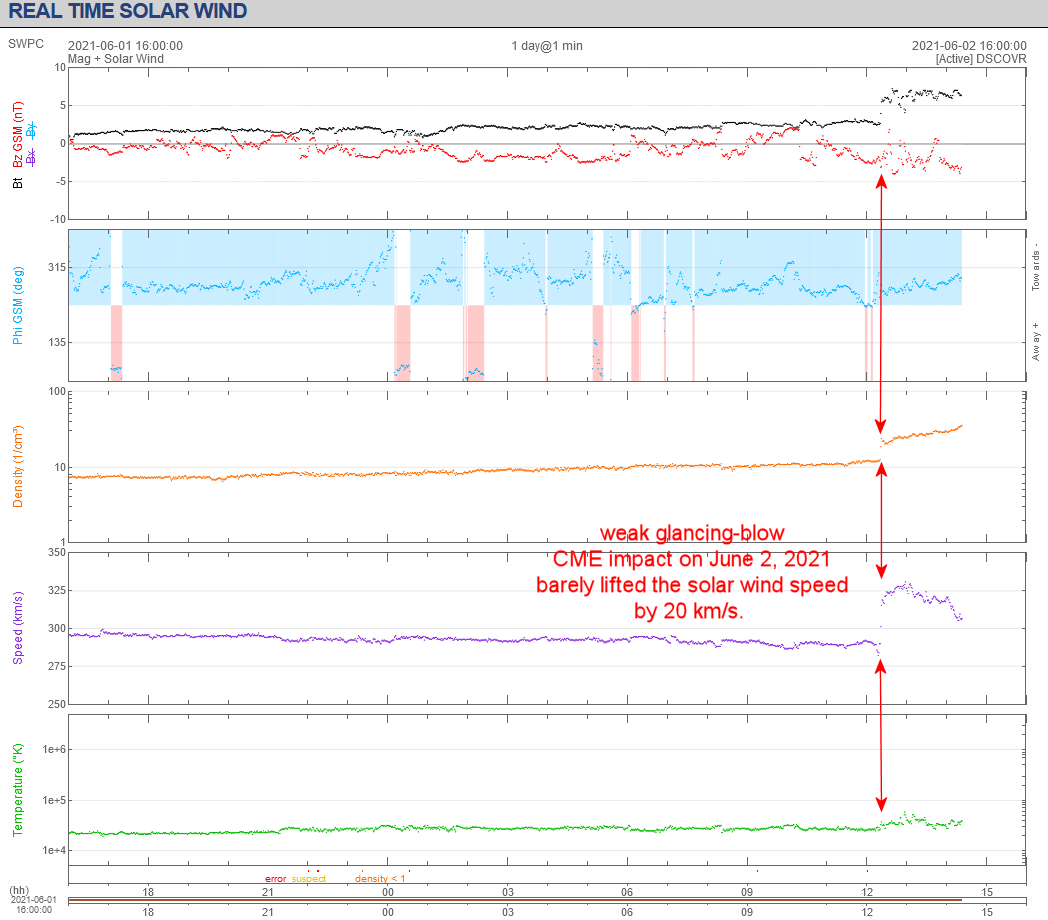
WEAK IMPACT: A CME hit Earth's magnetic field today, June 2nd, at approximately 1300 UT. It was a glancing blow, delivered by a storm cloud that left the sun on May 28th. The weak impact barely altered the solar wind speed around Earth (data) and has not sparked a geomagnetic storm. Aurora alerts: SMS Text.
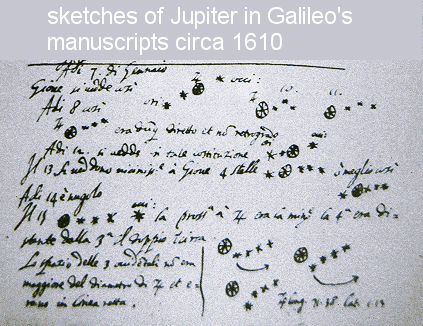
WHAT WOULD GALILEO SAY? Before you read any further, click here. That's what Galileo saw in 1610 when he turned his primitive telescope toward Jupiter: A fuzzy disk surrounded by four point-like moons. How times have changed. Fast foreward 411 years and this is what astronomers are seeing:
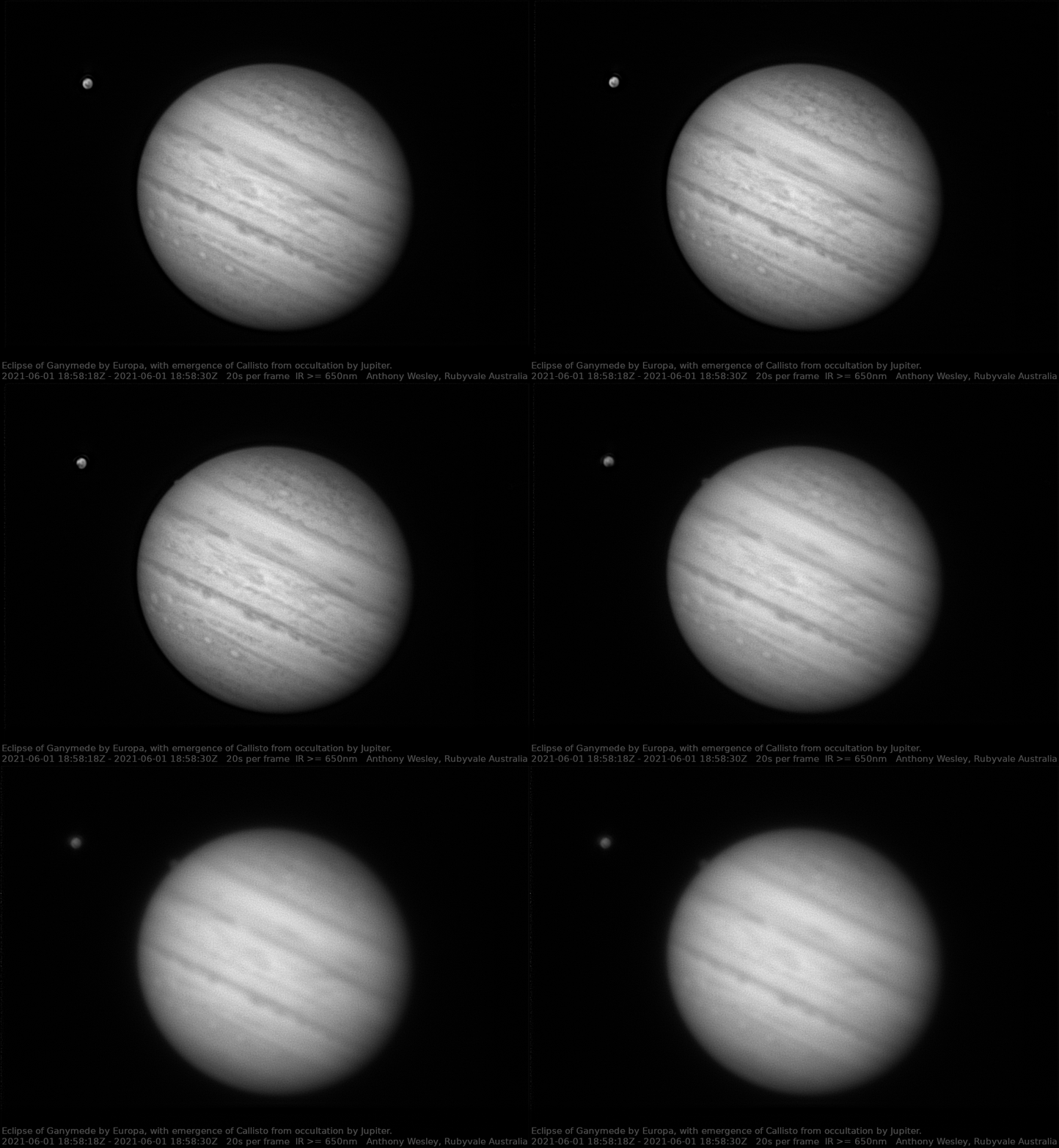
Anthony Wesley of Rubyvale, Australia, recorded this extraordinary video on June 1st using a 16-inch telescope. In it we see Jupiter's giant moon Ganymede, a fully-realized world with dark markings on its cratered disk, experiencing a total eclipse of the sun. The dark circular shadow moving across Ganymede's southern face belongs to the icy moon Europa, blocking the sun off screen.
Galileo himself never saw anything like this. Jupiter is currently edge-on to the sun (Jupiter's equinox), which causes the moons of Jupiter to cast their shadows one upon another. During such an eclipse, Galileo might have noticed one of the moons winking out -- but in the time it would take him to step away from the telescope, shake his head, and look again, the pinprick of light would re-appear. What would the great astronomer say? "I've got to stop staring at sunspots."
Realtime Space Weather Photo Gallery
Free: Spaceweather.com Newsletter
NOCTILUCENT CLOUDS OVERHEAD ... WAY OVERHEAD: No matter how high you fly in an airplane, you still can't fly above a noctilucent cloud (NLC). Anson Mount sends this report from 45,000 ft: "We were approaching the North Atlantic over the Labrador province of Canada when the NLCs appeared," he says. Their electric-blue tendrils were visible from the window seat:
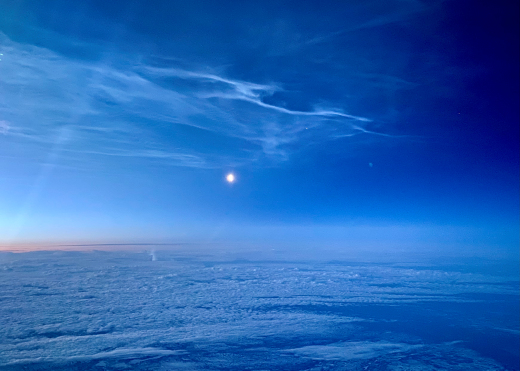
NLCs are Earth’s highest clouds. Seeded by meteoroids, they float at the edge of space about 83 km above the ground--in other words, 70 km above Mount's airplane. They weren't even close.
Usually, NLCs form in early summer when wisps of water vapor rise up to the mesosphere, allowing water to crystallize around specks of meteor smoke. This year, NLC season is off to an early start. Although summer hasn't started, people have already seen them in Canada, Scotland and several countries in Europe.
Realtime Noctilucent Cloud Photo Gallery
Free: Spaceweather.com Newsletter
WHISKEY STONES FROM SPACE: It's the gift for the person who has everything: Whisky Stones from Space. These granite cubes have experienced the cold of the stratosphere, more than 50 degrees below zero! Put them in your cup for an truly out of this world drink:
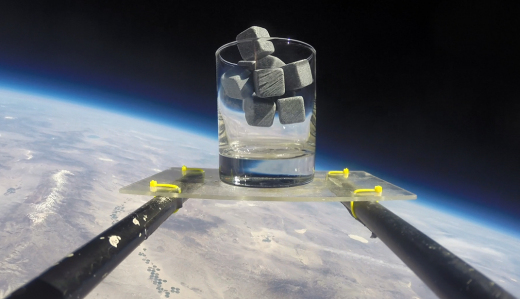
You can have a set of 9 cubes for $99.95 (glass not included). The students of Earth to Sky Calculus are selling whiskey stones to support their cosmic ray monitoring program. The ones picture above flew to the stratosphere onboard a cosmic ray research balloon on April 23, 2021, reaching an altitude of 97,543 feet.
Refrigerated whiskey stones cool a drink without diluting it, solving the problem of ordinary melting ice cubes. They make great Father's Day and birthday gifts. All stones come with a greeting card showing the cubes in flight.
Far Out Gifts: Earth to Sky Store
All sales support hands-on STEM education
Realtime Aurora Photo Gallery
Free: Spaceweather.com Newsletter