ARIETID METEOR SHOWER: Earth is entering a stream of debris from asteroid Icarus, source of the annual Arietid meteor shower. At its peak on June 7-8, as many as 60 Arietids per hour will streak across the sky. You probably won't see any, though. This meteor shower peaks in broad daylight.
CHINESE SPACE STATION TRANSITS THE SUN: Yesterday, telescopes all over Beijing, China, turned as one to face the sky. Their target: the sun. For a split second, China's new space station transited overhead, adding its silhouette to the solar disk:
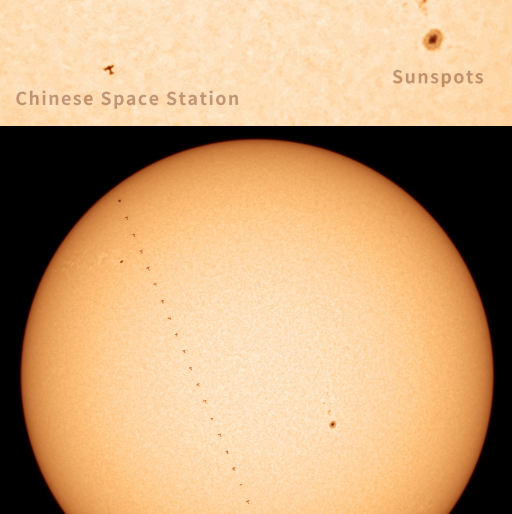
"It took 0.4 seconds for the dark shadow to pass over the sun, a blink of an eye that no one would normally notice," says photographer Steed Yu. "However, this time, all kinds of telescopes and telephoto lenses were lined up in Beijing, aiming at the sun and waiting. The shape of the silhouette is like an old-fashioned aircraft, but it is not an airplane, it is the Tiangong Space Station of China."
China launched the station's core module, Tianhe-1, on April 29th. Soon, two more modules will be launched to join it, approximately tripling the size of the orbiting outpost. When it is completed, the Tiangong Space Station will be about the same size as the old Soviet Mir, with room enough for three astronauts to live.
Caution: Do not look at the sun through unfiltered optics. Steed Yu and other photographers of the transit used safe solar filters to prevent eye damage.
Realtime Space Weather Photo Gallery
Free: Spaceweather.com Newsletter
iPHONE NOCTILUCENT CLOUDS: What kind of camera equipment do you need to photograph meteoritic clouds at the edge of space? "Tonight, I used my iPhone," says Shaun Greenwell, who sends this picture from Ponteland, Northumberland, UK:
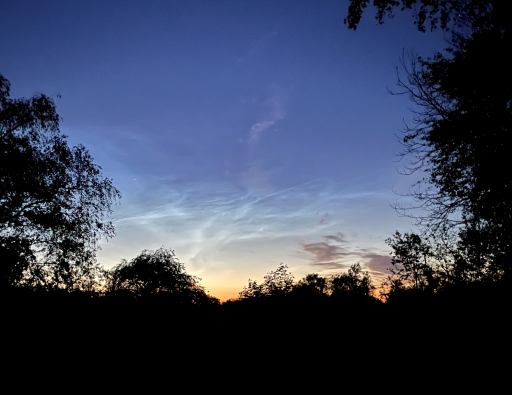
These are noctilucent clouds (NLCs). Seeded by meteoroids, NLCs float at the edge of space about 83 km above the ground. The clouds usually form in early summer when wisps of water vapor rise up to the mesosphere, allowing water to crystallize around specks of meteor smoke. Often, they're bright enough to photograph using no more than a cell phone.
"Every year they seem to be a few days earlier," says Greenwell. (He's right.) "NLCs are always always a welcome sight on an early summers night."
Realtime Noctilucent Cloud Photo Gallery
Free: Spaceweather.com Newsletter
WHISKEY STONES FROM SPACE: It's the gift for the person who has everything: Whisky Stones from Space. These granite cubes have experienced the cold of the stratosphere, more than 50 degrees below zero! Put them in your cup for an truly out of this world drink:
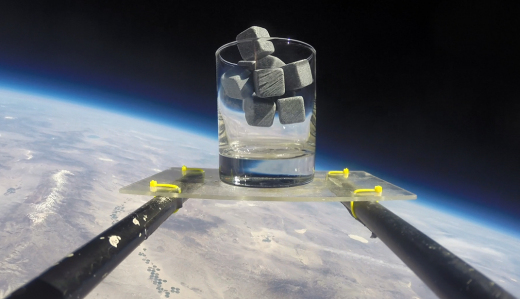
You can have a set of 9 cubes for $99.95 (glass not included). The students of Earth to Sky Calculus are selling whiskey stones to support their cosmic ray monitoring program. The ones picture above flew to the stratosphere onboard a cosmic ray research balloon on April 23, 2021, reaching an altitude of 97,543 feet.
Refrigerated whiskey stones cool a drink without diluting it, solving the problem of ordinary melting ice cubes. They make great Father's Day and birthday gifts. All stones come with a greeting card showing the cubes in flight.
Far Out Gifts: Earth to Sky Store
All sales support hands-on STEM education
Realtime Aurora Photo Gallery
Free: Spaceweather.com Newsletter