LOW LATITUDE NOCTILUCENT CLOUDS: On June 20th, noctilucent clouds broke free of the Arctic Circle and swept across Europe, reaching latitudes as low as +37.5N. That almost matches the all-time record for low latitude sightings. Noctilucent clouds could soon be coming to a sunset sky near you. More: full story, photo gallery.
A SUNSPOT GEYSER: Sunspot AR2833 has gone nearly two weeks without producing a significant flare. Don't call it 'boring' though. "This sunspot has a furious geyser," says Apollo Lasky who photographed the plasma fountain from his backyard observatory in Naperville, Illinois:
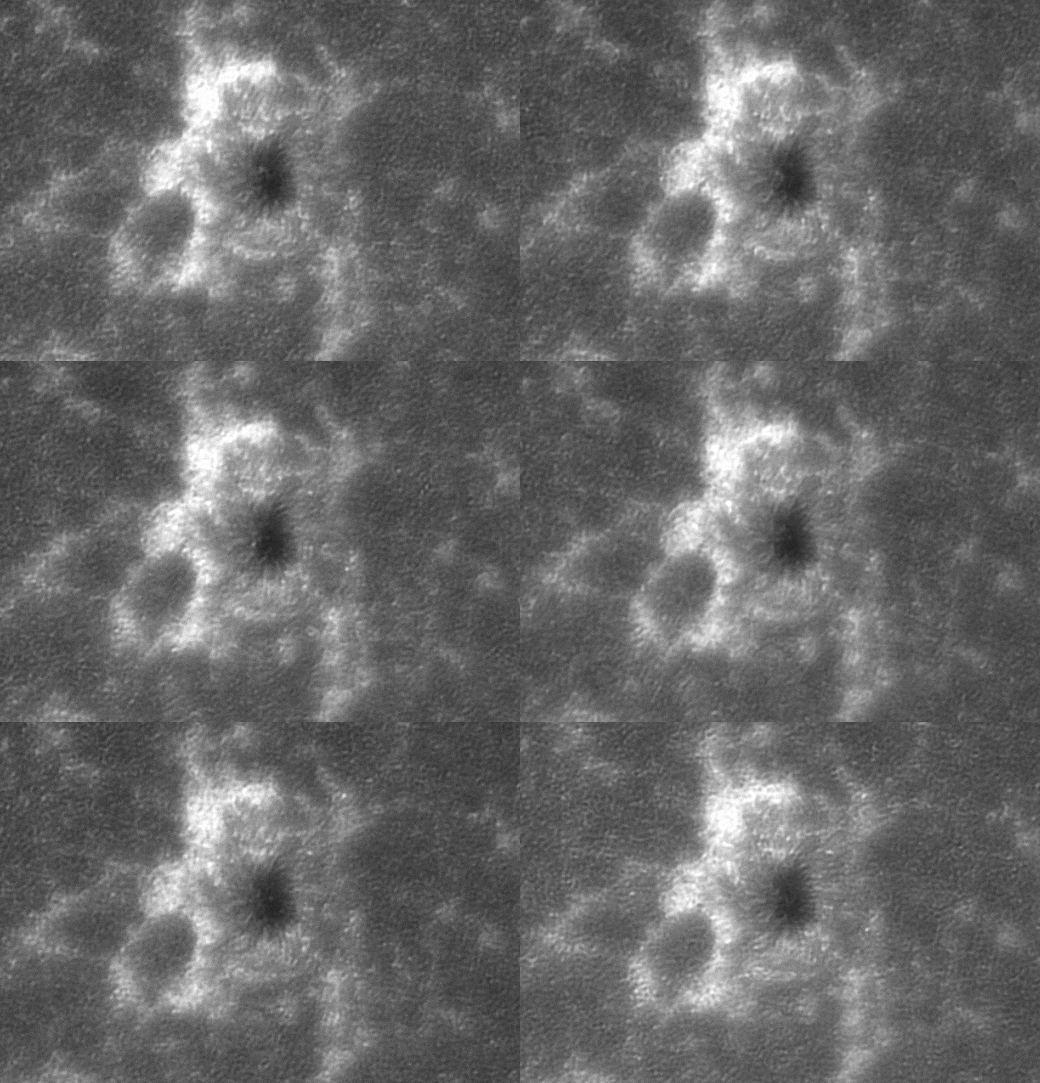
The geyser (if that's what it really is) dwarfs any geyser on Earth. It is more than a million times the size of Old Faithful in Yellowstone National Park, and could swallow most US states.
This could be an unusual type of "Moving Magnetic Feature" (MMF). MMFs are plasma flows around sunspots that carry away magnetic flux, causing sunspots to wither and decay. AR2833, however, has been remarkably stable (we didn't say 'boring'), barely changing as it glides quietly across the face of the sun. If the geyser is an MMF, it is not having the usual effect.
Realtime Space Weather Photo Gallery
Free: Spaceweather.com Newsletter
ASPERATUS CLOUDS: A new type of cloud appeared over Canada last week. "It was really weird and ominous looking," says Lauri Kangas, who sends this picture from Fort Frances, Ontario:
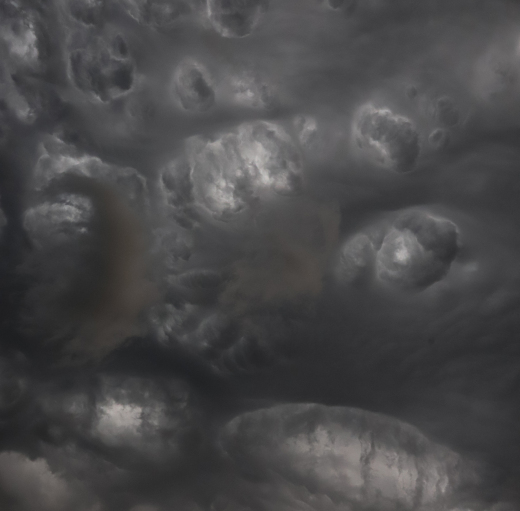
"On June 16th we had severe thunderstorm warnings, and we could see the storm approaching from the west," says Kangas. "The sky became dramatic and amazing. I believe these to be Asperatus Clouds."
He's right. This is a splendid example of "undulatus asperatus"--asperatus for short. The World Meteorological Organization added them to the International Cloud Atlas in 2017, the first new addition to the Atlas in over half a century.
Asperatus clouds are closely related to mammatus clouds, which form on the leading and trailing edges of thunderstorms. Wind shears at cloud level distort the pendulous forms of mammatus into strange and forboding asperatus.
Realtime Space Weather Photo Gallery
Free: Spaceweather.com Newsletter
THIS IS *REAL* MONEY FROM SPACE: Earlier this year, the US Mint released a reverse-proof dollar coin honoring the Hubble Space Telescope. You can no longer buy these coins from the Mint, but you can get some from Earth to Sky Calculus. The students launched the coins to the stratosphere onboard a cosmic ray research balloon:
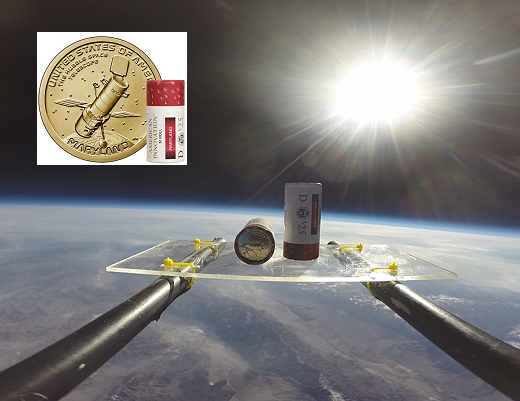
You can buy one coin for $39.95 or an unbroken roll of 25 for $299.95. Each coin comes with a greeting card showing the money in flight and telling the story of its trip to the stratosphere. Best of all, this is real money! You can actually spend it. All sales support hands-on STEM research.
Far Out Gifts: Earth to Sky Store
All sales support hands-on STEM education
Realtime Aurora Photo Gallery
Free: Spaceweather.com Newsletter
Realtime Noctilucent Cloud Photo Gallery
Free: Spaceweather.com Newsletter